
Unbiased headlines. Facts, not spin.
Unbiased Headlines is an independently owned news organization. We bring you the facts, not opinions, written fresh from 110+ named sources. Sources linked so you can verify it yourself.
 economy
Major Story (7/10)
Canada Substantially Concludes ASEAN Trade Talks and Finishes Philippines Deal While Saying a U.S. Deal Is 'Not Yet There'
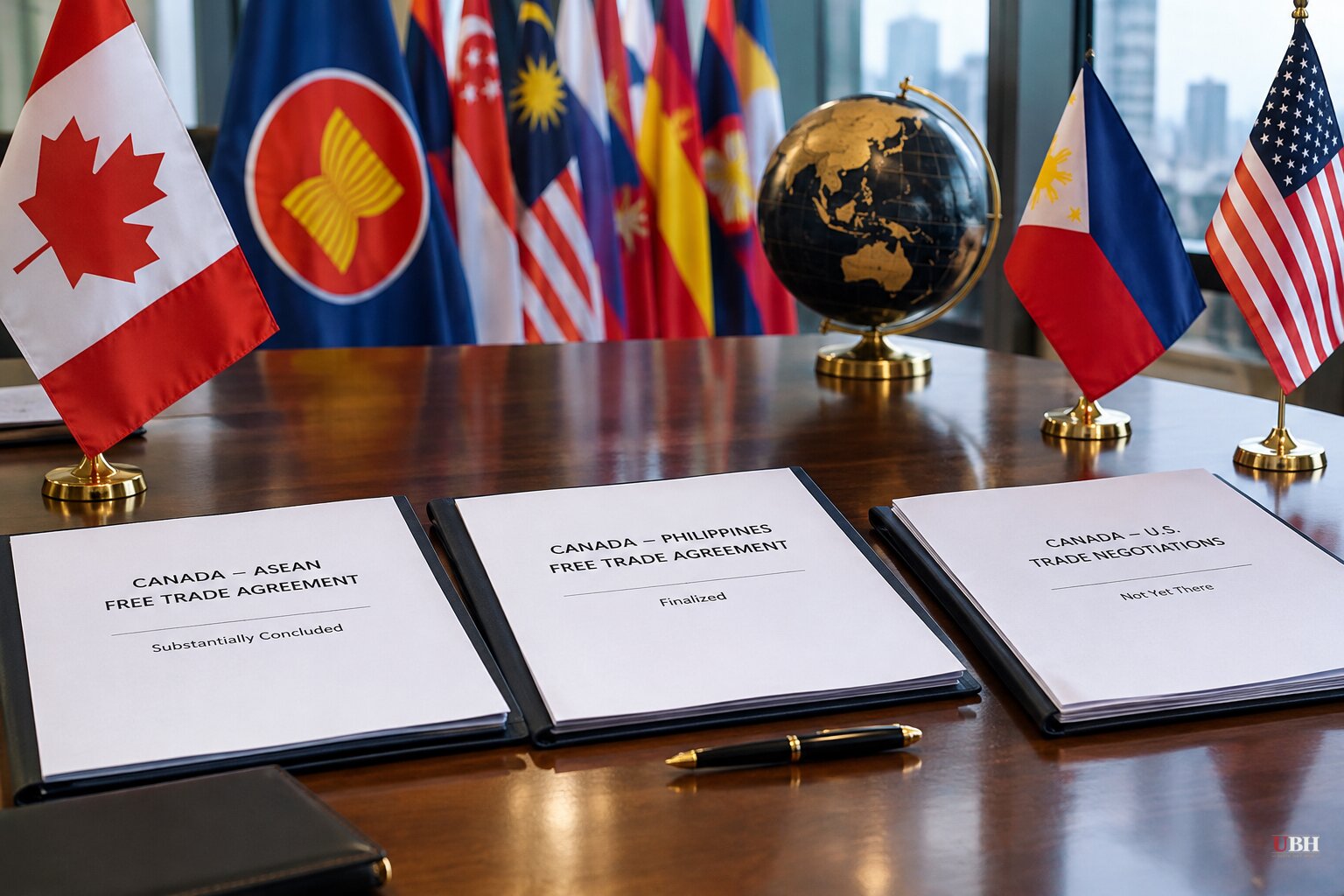
Since Canada suspended trade negotiations with Washington in August and Trump imposed 50% tariffs on about $20 billion in Canadian goods, Ottawa has been looking for other customers. On Saturday, Nov. 14, Prime Minister Mark Carney said that effort produced two results in Manila.
Canada has substantially concluded free-trade negotiations with the Association of Southeast Asian Nations, a bloc of nearly 700 million people. It has also completed separate negotiations with the Philippines.
Neither deal is signed. Officials hope to sign the ASEAN agreement next year, and the Philippines agreement is also expected to be signed in 2027.
What Canada says it gets
The Canadian government estimates the ASEAN agreement could add nearly C$2 billion (US$1.4 billion) to the economy and create almost 14,000 jobs, particularly in agriculture and manufacturing.
The Philippines deal covers more than 90% of tariff lines, Carney said. Ottawa says it could help triple Canadian exports to the Philippines by 2035.
These are government projections, not results. Carney is in the Philippine capital for a three-day summit of ASEAN and its Asian and Western counterparts that is scheduled to begin today, Nov. 15.
Finance Minister François-Philippe Champagne has framed the strategy as a broader shift. Of Canada's C$142.1 billion budget, titled "Masters of our Destiny," he said: "At its core, our plan is about changing Canada's growth model." The budget funds critical minerals, energy, housing and direct support for auto and steel workers hit by U.S. tariffs.
The U.S. track
Carney said he had "quite a long, substantive conversation" with President Trump just before leaving for the trip. U.S. Trade Representative Jamieson Greer and White House Chief of Staff Stephen Miller were also on the call.
"We are making progress," Carney told reporters. "There is the possibility of a deal, a bilateral deal. But we're not yet there."
He drew one firm line. "This government will not settle for a deal with the United States that is not consistent with a viable Canadian auto sector," Carney said. He called autos "one of the fundamental issues" and "one of the most challenging issues" in the talks.
Carney also said that some people think Canada should "just go and take whatever deal." He rejected that.
Washington's stated priorities point the other way. Greer said in an Aug. 26 interview with CBC that heavy trucks would be excluded from tariff relief, because the U.S. goal is to bring factories back to the United States. "We are focused on doing what's good for America and accommodating Canada to the extent we can," he said.
Trump said on Nov. 1 that the U.S. has been "losing money for many years with Canada, 70, 75 years," and that the two countries were "very close" to a deal.
Midterms add a second variable
Tariffs on Canadian goods became a midterm issue. Democrats blamed them for higher prices and pledged to challenge them. Sen. Ron Wyden has made repealing the Canada tariffs a priority, though Trump could veto any such bill.
That leaves Canada with a choice. It can accept a deal that cuts some tariffs but leaves others in place, or it can hold out for free trade while Congress moves against the tariffs.
Carney said in Montreal days after the vote that the decision-makers on trade over the next two or three years are "the President, the executive and Americans, not necessarily legislators." He was responding to Quebec's plan to contact U.S. governors and senators. "In a negotiation, it's always a good idea to have one negotiator," he said.
He has not said whether the election changed Canada's negotiating strategy. He did say that disputes over French-language protections and Canadian cultural programming, which helped derail the August talks, have been overcome. "There are still some tough issues to resolve with the Americans," he added.
The countries have resumed discussions since the collapse. A deal could reduce some tariffs on key sectors, including steel and aluminum.
What to watch
The Asian agreements have no signing dates beyond "next year." The U.S. deal has no announced date at all.
Whether Washington will move on autos is the key unknown. The White House has not publicly changed its position on heavy trucks since Greer's August statement, and Carney says Canada will not sign without a viable auto sector.
Sources used for this briefing
6 links from 6 independent newsrooms (syndicated copies of the same report count once)
These are the sources it draws on, linked so you can verify.


