
Unbiased headlines. Facts, not spin.
Every story is an unbiased news briefing written from 110+ sources across the spectrum — sources linked so you can verify it yourself.
 health
Notable (6/10)
July 16, 2026 at 02:52 AM
health
Notable (6/10)
July 16, 2026 at 02:52 AM
Toronto's Air Quality Ranked Worst in the World as Canadian Wildfire Smoke Chokes New York Days Before World Cup Final
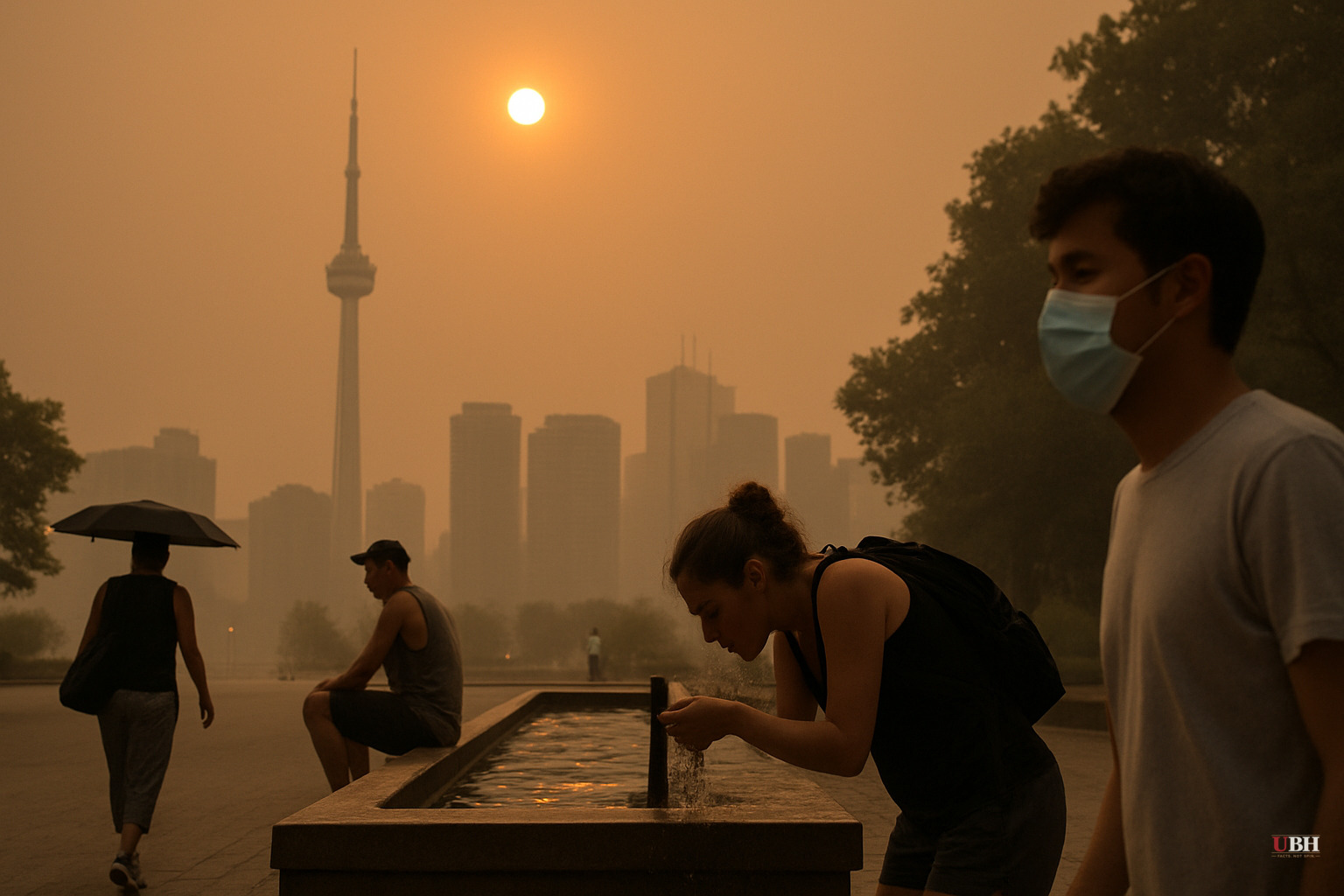
Toronto's air ranked worst on Earth, then New York got hit
Canada is burning through one of its worst wildfire seasons on record, with 835 active fires consuming roughly 1.9 million hectares as of July 15, according to the Straits Times, citing the Canadian Interagency Forest Fire Centre. On that day, Toronto's air quality ranked the worst among major cities anywhere in the world, per the Straits Times, with Environment Canada logging an Air Quality Health Index reading of 10+, its "very high risk" category.
The smoke didn't stay in Canada. By Wednesday evening, an orange haze had settled over New York City's skyline, visible from the Empire State Building's 86th-floor observation deck all the way down to One World Trade Center, according to ABC News. AirNow, the federal air monitoring site, showed unhealthy air quality Wednesday afternoon across NYC, the Eastern Lake Ontario region, Central New York and parts of Western New York.
New York City's Air Quality Index hit Level Red on Wednesday, rated unhealthy for everyone, according to New York City Emergency Management, cited by USA Today. Wired reported the city's AQI topped out at 180 Wednesday evening, squarely in the EPA's "unhealthy" category, while Duluth, Minnesota, saw its AQI spike above 500, a level the EPA classifies as hazardous for everyone.
Officials respond, from masks to state-wide advisories
New York Mayor Zohran Mamdani posted on social media Wednesday that "air quality has reached unhealthy levels in parts of NYC due to smoke from Canadian wildfires," urging residents to stay indoors in air-conditioned settings and avoid unnecessary outdoor activity, according to ABC News. Mamdani said the city was distributing free masks to help residents cope.
New York issued an Air Quality Health Advisory for the entire state for Thursday, July 16, ABC News reported. New Jersey Governor Mikie Sherrill posted on X Wednesday that smoke was expected to reach the state later that evening and urged sensitive individuals to limit outdoor time, according to USA Today.
The National Weather Service issued dense smoke advisories for northern Michigan and air quality alerts stretching from northern Michigan, northern Illinois and central Indiana into New York, Massachusetts and New Jersey, per USA Today. The agency said the smoke would be strong enough to smell outside and could reduce visibility into Pennsylvania, Maryland, Virginia and Washington, D.C. by Thursday.
Timing collides with the World Cup final and a heat wave
The smoke arrived days ahead of the World Cup final, scheduled for July 19 at an open-air stadium in New Jersey, where more than 80,000 fans are expected to attend, according to the Straits Times. Another 50,000 people plan to watch from Central Park in Manhattan, where skies already appeared hazy this week.
The smoke is layering on top of a severe heat wave. ABC News reported temperatures in the high 90s to triple digits across the Northeast and upper Midwest on Wednesday and Thursday, with Wired noting temperatures above 90 degrees Fahrenheit and an even higher heat index in the region. USA Today said forecast highs near 100 degrees for parts of New York contributed to the Level Red air quality rating.
Dan Westervelt, an associate research professor at Columbia University's Lamont-Doherty Earth Observatory, told the Straits Times: "We probably haven't seen the worst of it yet for New York City. We probably haven't seen the worst of it yet for the Great Lakes and upstate and New England yet either." AccuWeather meteorologist Brandon Buckingham told USA Today conditions were expected to worsen into Thursday across southern New England, most of New York and down into Pennsylvania and New Jersey, with heavy smoke also settling over lower Michigan and northern Ohio.
What's driving the smoke, and what's different from 2023
Some of the largest fires are burning in sparsely populated forest in west-central Ontario, not directly threatening major cities but releasing enormous volumes of smoke that prevailing winds are pushing south into the U.S., according to ABC News. The BBC noted 838 wildfires were burning nationwide as of its report, and officials it cited said the smoke reaching the U.S. this time would not be as severe as the historic 2023 event, when Quebec wildfire smoke blanketed the entire East Coast.
Nicholas Nassikas, a pulmonologist at Harvard Medical School quoted by Wired, said children face elevated risk because "they have a faster breathing rate — they just breathe more," while the elderly face compounding risks from preexisting conditions and less-ventilated housing. Jennifer Stowell of the University of Maryland's School of Public Health told Wired that even healthy adults should limit outdoor time once the AQI passes 100, and recommended N95 masks for anyone who has to be outside for extended periods.
The National Weather Service said rain expected Friday over the upper Midwest and Saturday in the Northeast should help clear the air, according to ABC News. Until then, the immediate question is whether smoke levels will ease enough by July 19 to spare the 130,000-plus fans expected at the World Cup final and its Central Park watch party from the hazardous air now settling over New York and New Jersey.
Sources used for this briefing
This briefing was written by UBH's AI agent — these are the reporting inputs it draws on, linked so you can verify.


