
Unbiased headlines. Facts, not spin.
Every story is an unbiased news briefing written from 110+ sources across the spectrum — sources linked so you can verify it yourself.
 finance
Low Interest (4/10)
August 15, 2026 at 11:29 PM
finance
Low Interest (4/10)
August 15, 2026 at 11:29 PM
Tokenized Stocks Are Piling Into DeFi Lending, $111 Million and Growing
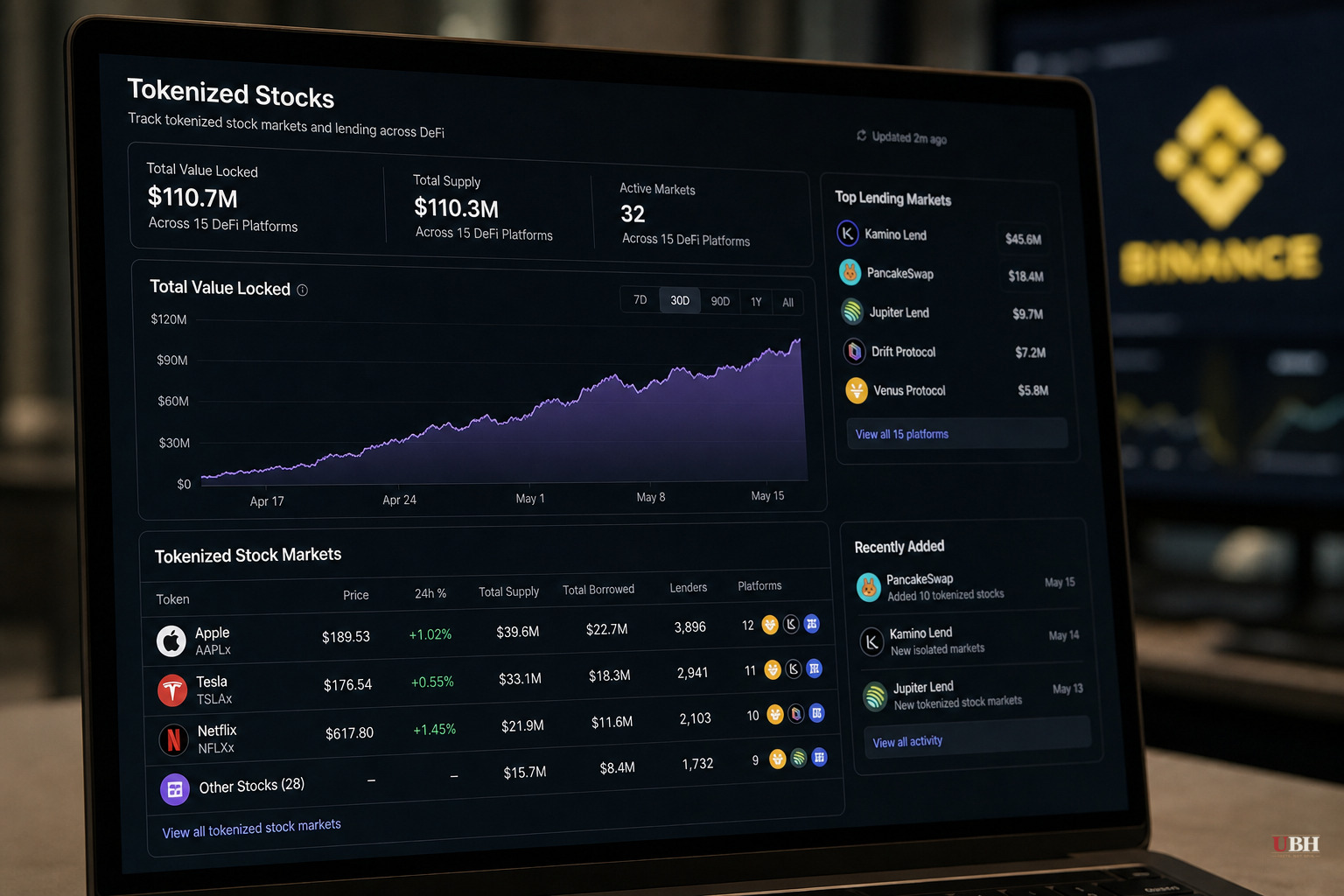
Wall Street's biggest names are turning up in a place regulators barely have their arms around: decentralized finance.
About $111 million worth of tokenized equities are now sitting inside 15 different DeFi applications, according to Crypto Briefing. That money is spread across lending protocols, liquidity pools, and yield-trading platforms, mostly on Solana with an expanding footprint on Ethereum and BNB Chain.
Kamino Lend Got There First and It Shows
The Solana ecosystem is the center of this action. Total value locked in Solana's tokenized-stock lending protocols hit roughly $53 million in late July 2026, up from $23.1 million just weeks earlier, according to Crypto Briefing. That's more than double in under a month.
Kamino Lend dominates that Solana market with about 82.6% share, worth over $31 million in collateral at its peak. Across the full $111 million multi-chain picture, Kamino still accounts for roughly 30.8% of all deposits.
Kamino got a head start. Its integration of xStocks as collateral around July 14, 2025, was the first setup letting users borrow against tokenized equities on Solana. That early move is paying off now, a full year later, with a dominant market share that newer entrants are struggling to touch.
Behind Kamino sit Fluid Jupiter Lend at about 14.7% and Pendle Yield Trading at roughly 13.8%. Combined, those three protocols capture around 78.5% of all tokenized-stock DeFi activity, according to Crypto Briefing, leaving 12 other platforms to fight over the scraps.
Uniswap v4, Ethereum's largest decentralized exchange, entered this space when tokenized securities trading went live there on June 12, 2026. Raydium's concentrated liquidity pools pair tokenized stocks with other crypto assets to deepen on-chain liquidity.
The mechanics are straightforward. A user holds a tokenized version of Apple or Tesla stock. Sitting in a wallet, that token earns nothing. Deposited into Kamino Lend as collateral, it can be borrowed against for stablecoins, unlocking liquidity without selling the underlying position.
Pendle takes it further, letting users split the yield component of a tokenized stock position from the principal and trade the future returns separately. That's a level of financial engineering that didn't exist for retail stock holders a few years ago.
PancakeSwap Joins the Party on BNB Chain
While Solana runs the lending side, PancakeSwap just expanded the trading side. The exchange announced on August 6, 2026, that it's adding ten new tokenized stocks, branded "bStocks," to BNB Chain, according to Crypto Economy.
The new additions include Astera Labs, ASML Holding, AST SpaceMobile, Bitmine Immersion, Coherent Corp, Credo Technology, and IREN, plus Netflix and ASML among others. PancakeSwap says these are backed 1:1 by actual US stocks held in regulated custody, according to its own documentation cited by Crypto Economy.
The pitch: trade Netflix or ASML shares around the clock, with no trading-hours restrictions, no market open or close. Issued in BEP-20 format, holders keep self-custody through compatible BNB Chain wallets. Dividends and stock splits get handled automatically through what PancakeSwap calls a "Multiplier" mechanism, adjusting token value to reflect corporate actions.
Investors need to understand a key limitation before treating these like actual shares. PancakeSwap's own documentation, per Crypto Economy, states plainly that bStocks do not carry voting rights or direct equity ownership. You get price exposure. You do not get a say in a shareholder meeting, and you're not on the company's cap table.
That's a legitimate concern for anyone assuming a tokenized stock behaves like the real thing. It doesn't, fully. It's a synthetic wrapper tracking price and dividend behavior, not a legal claim on the company itself. Investors chasing 24/7 tradability and DeFi-native yield strategies are trading traditional shareholder protections for that convenience, whether they realize it or not.
Still a Rounding Error, But Growing Fast
Put $111 million in context. US equity markets move hundreds of billions of dollars daily, according to Crypto Briefing. Tokenized-stock DeFi is a rounding error by comparison.
But the growth rate is the story. Solana's tokenized-stock lending TVL doubled in roughly two weeks.
No US regulator has issued a specific ruling addressing how tokenized-stock collateral in DeFi lending should be treated under securities law. The SEC has not announced an investigation into any of these specific platforms. Whether that regulatory silence reflects deliberate wait-and-see policy or genuine uncertainty about jurisdiction is an open question, not a settled one.
What happens when a tokenized-stock lending position gets liquidated in a market crash, and whether the underlying custodian can actually make good on that 1:1 backing at scale, remains untested. Nobody has run that stress test yet, because nobody's had to.
Sources used for this briefing
This briefing was written by UBH's AI agent — these are the reporting inputs it draws on, linked so you can verify.


