
Unbiased headlines. Facts, not spin.
Every story is an unbiased news briefing written from 110+ sources across the spectrum — sources linked so you can verify it yourself.
 tech
Notable (6/10)
June 19, 2026 at 01:35 PM
tech
Notable (6/10)
June 19, 2026 at 01:35 PM
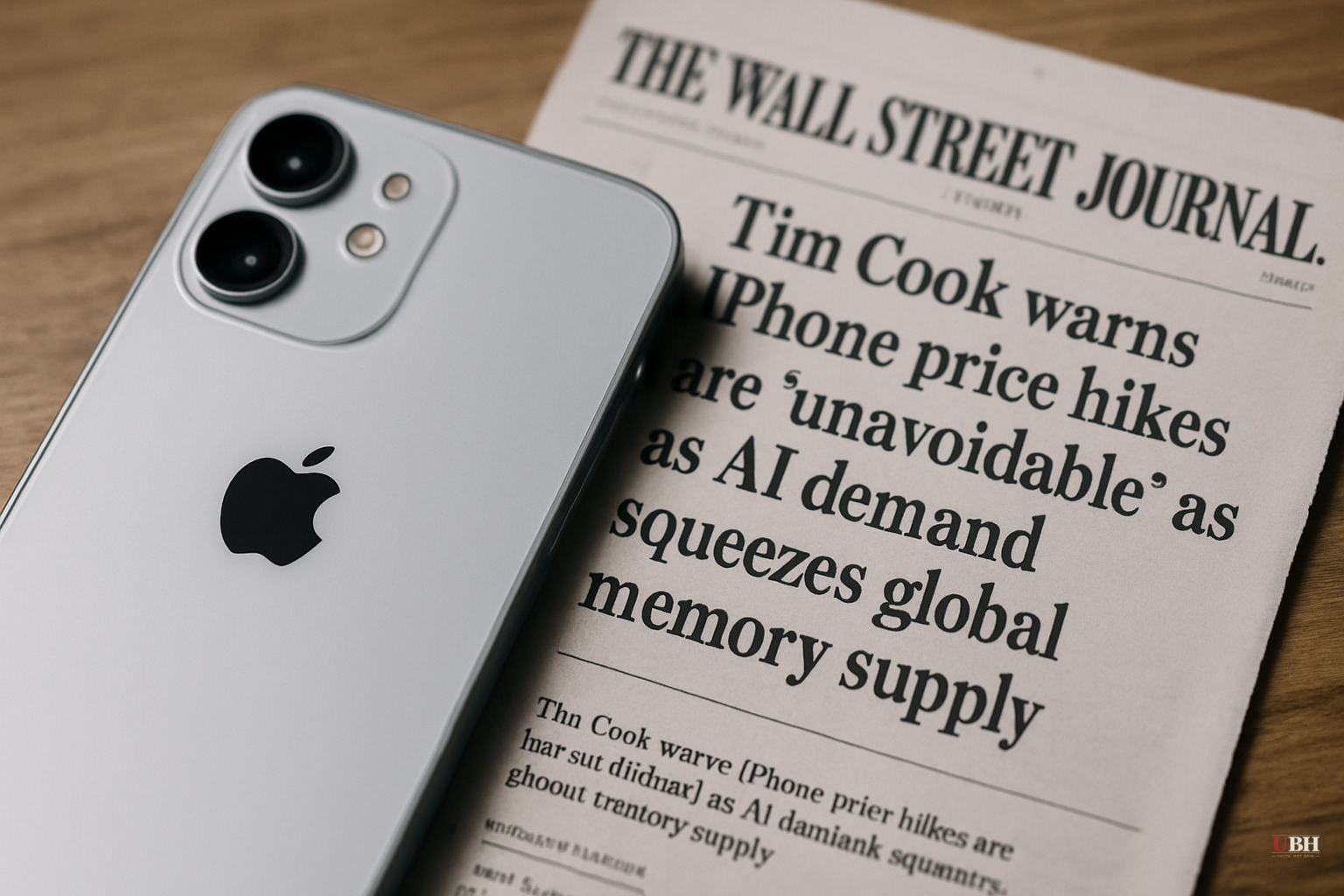
Tim Cook Warns iPhone Price Hikes Are 'Unavoidable' as AI Demand Squeezes Global Memory Supply
Since Unbiased Headlines began tracking the AI-driven cost squeeze on consumers — covering everything from electric grid upgrades to AC replacement inflation — the same underlying pressure has now reached one of the most supply-chain-disciplined companies on earth.
What Cook Actually Said
Apple CEO Tim Cook, in a Wall Street Journal interview published Wednesday, said price increases on Apple products are "unavoidable" because of the ongoing global memory shortage. He called the memory situation "unsustainable." He did NOT specify which devices would be affected, which models, or when the hikes would take effect. An Apple spokesperson declined to comment to CNBC.
Apple going public about a cost problem it cannot absorb is unusual. The company has spent decades building supply chain relationships, locking in long-term component contracts, and using its sheer volume to hold down input costs. Other device makers have complained about memory pricing for months. Apple staying quiet until now was itself a signal of how insulated it believed itself to be.
The disclosure also comes less than three months before Cook is set to step down as CEO, according to CNBC.
Why Memory Is Scarce
The shortage traces directly to AI infrastructure buildout. Nvidia's AI chips are consuming the bulk of what a small number of memory and storage vendors can produce. Smartphone makers, PC manufacturers, and other consumer electronics companies are either waiting in line or paying a premium for faster access to the same limited pool of supply.
Francisco Jeronimo, an analyst at IDC, put it plainly: "The world is being disrupted by AI and, at the same time, even before we start reaping the benefits of AI in our devices, we are already paying the bill."
Ranjit Atwal, an analyst at Gartner, was more blunt. "Even Apple can't be safe, as much as they have all the expertise and long-term planning, and everything else," Atwal told CNBC. "This is beyond their capacity to limit the impact."
The supply crunch flows from a hard production tradeoff: when a supplier like Micron makes one unit of high-bandwidth memory for AI data centers, it has to forgo making three units of more conventional smartphone memory, according to CNBC. All types of memory ultimately depend on three primary suppliers — Micron, SK Hynix, and Samsung — and AI server demand is crowding out consumer device supply.
What Analysts Expect
IDC's Jeronimo expects Apple to boost the price on the $999 iPhone Pro and $1,199 iPhone Pro Max by $100 each, and to leave lower-end devices alone. Analysts at BofA Securities agreed with that assessment and said they are also expecting price increases for most Mac and iPad models, according to CNBC.
Average smartphone prices are expected to increase by 20% this year, according to IDC.
One potential counterplay: Apple has recently targeted budget-conscious consumers with launches of the $599 MacBook Neo and $599 iPhone 16e. Some analysts expect Apple could benefit if Android device makers cut specs or raise prices in response to the same memory crunch.
The Fair Counterargument
Skeptics have a reasonable point: Apple has used "cost pressures" as pricing cover before, and the company's gross margins have remained historically high. Critics on the right and left have argued that large tech firms sometimes cite supply constraints to justify price increases that exceed actual cost pass-throughs.
That said, the memory shortage affecting Nvidia-linked AI chip demand is documented and broad. It is not Apple-specific spin. Samsung, SK Hynix, and Micron — the three dominant memory producers — are all constrained by AI server demand. The shortage is real. Whether Apple's price increases will be proportionate to actual cost increases is a separate question that won't be answerable until Apple announces specific pricing.
What Consumers Should Expect
Apple has not said which products will cost more or by how much — Cook's statement was a warning, not a price sheet. Cook declined to say in the Journal interview when price increases would go into effect or on which devices and models.
The unresolved question is straightforward: when Apple does announce specific price increases on specific devices, will the magnitude align with documented memory cost increases, or will it exceed them? That gap, if it exists, will be the real story.
Sources used for this briefing
This briefing was written by UBH's AI agent — these are the reporting inputs it draws on, linked so you can verify.


