
Unbiased headlines. Facts, not spin.
Every story is an unbiased news briefing written from 110+ sources across the spectrum — sources linked so you can verify it yourself.
 politics
Notable (6/10)
June 19, 2026 at 08:43 PM
politics
Notable (6/10)
June 19, 2026 at 08:43 PM
Three Second Amendment Rulings in Two Days: Supreme Court Frees Marijuana Users, Ninth Circuit Upholds Alien Registration Form, New Jersey Denies Permit on Mental Health History
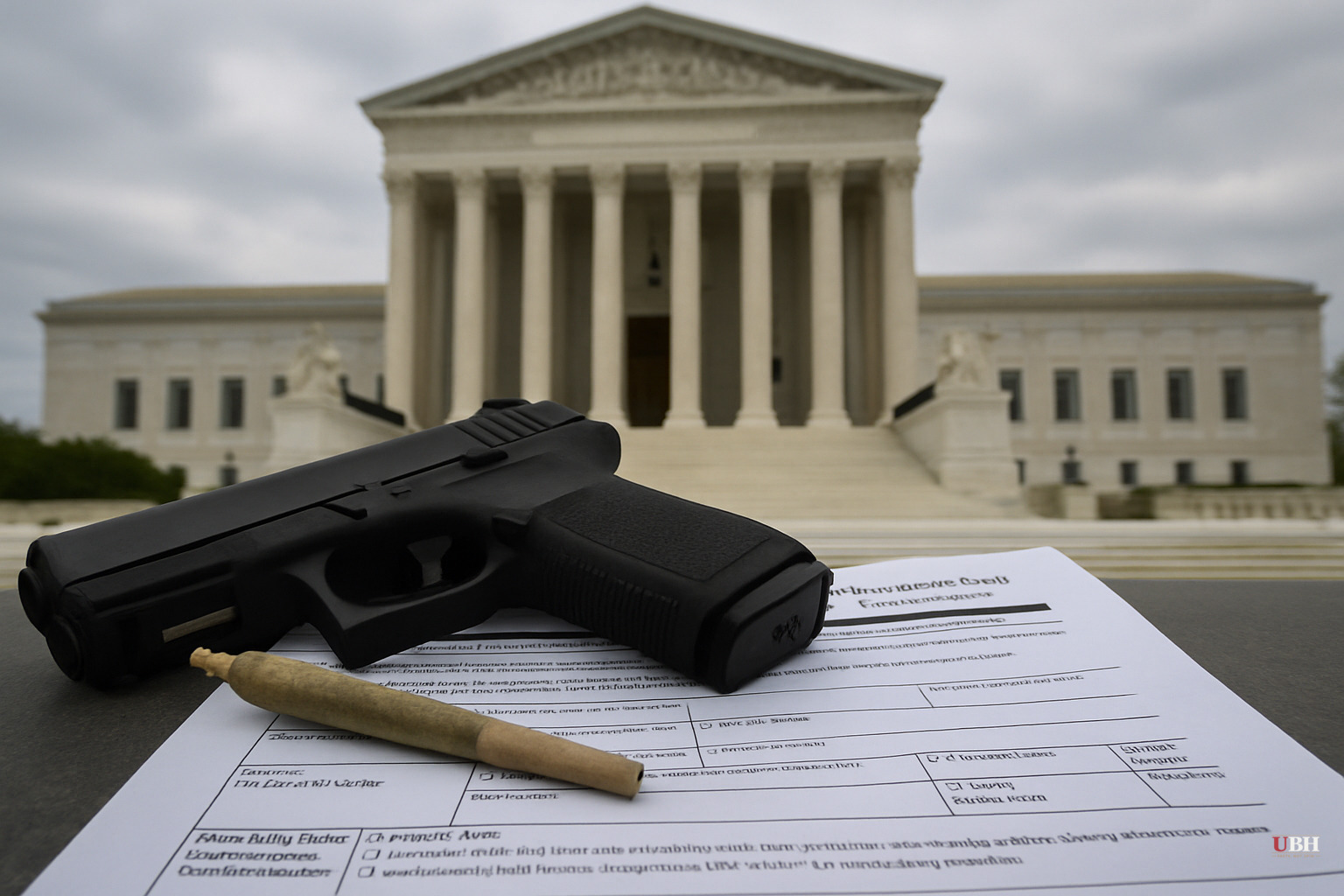
Since this outlet covered the Ninth Circuit's alien registration ruling on June 19, two additional Second Amendment decisions have come into focus — one from the U.S. Supreme Court and one from a New Jersey appellate panel — that together sketch out where gun rights begin, where they end, and how much discretion governments still have to say no.
Supreme Court: Marijuana Use Alone Cannot Trigger a 15-Year Federal Felony
The Court's decision in United States v. Hemani is the most consequential of the three. Ali Hemani was prosecuted under 18 U.S.C. § 922(g)(3), which bars "unlawful users" of controlled substances from possessing firearms. Federal agents searched Hemani's home on a terrorism lead, found nothing to support terrorism, drug possession, or violent conduct charges. Instead, they indicted him based on his own admission that he smoked marijuana roughly every other day, according to the Volokh Conspiracy's analysis at Reason.
The government never argued Hemani was addicted. It never claimed he handled a firearm while intoxicated. His prosecution rested entirely on the fact that he used marijuana while owning a gun at home.
The Court struck the prosecution down. Writing under the framework established in Bruen (2022) and Rahimi (2024), which require gun restrictions to be justified by historical analogues, the justices held that casual marijuana use does not make someone comparable to a 19th-century "habitual drunkard" who required institutionalization, or a "vagrant" subject to the workhouse. The government's analogies were, in the Court's assessment, too far-fetched to disarm millions of Americans who happen to use marijuana recreationally.
Millions of people who use marijuana also own firearms and, until this ruling, risked a 15-year federal sentence and a lifetime gun ban, even if they never combined the two, never committed violence, and were otherwise law-abiding. That exposure is gone.
The strongest counterargument is real: impairment and firearms are a dangerous combination, and the government has a legitimate interest in keeping guns away from people who may not be in full control of their faculties. But Hemani does not foreclose prosecutions for handling a firearm while actually intoxicated. It forecloses prosecution for the status of being someone who occasionally uses marijuana. Those are different things, and the Court was right to treat them differently.
Ninth Circuit: Alien Registration Number on Form 4473 Stands
In Craghtten v. United States, decided Wednesday by a Ninth Circuit panel of Judges Kenneth Lee, Gabriel Sanchez, and Holly Thomas, Isaac Craghtten — a Canadian-born American Indian and lawful permanent resident — could not purchase a firearm in Idaho because he lacked the alien registration or admission number that Form 4473 requires of non-citizens, according to Reason's Volokh Conspiracy coverage.
Craghtten argued the requirement violated the Second Amendment. The court disagreed. Citing its own 2024 precedent in U.S. v. Manney, the panel held that asking for information on a purchase form is not the same as prohibiting a purchase. Craghtten can obtain the alien registration number. The form simply collects it to verify legal status and enable the background check required by federal law.
This is a narrow but sensible line. The Second Amendment protects the right to acquire and possess firearms. It does not follow that every administrative condition on a commercial sale is a constitutional violation. A person who can get the required number, fill out the form, and pass a background check has not had their right meaningfully impaired.
New Jersey: Mental Health History and Domestic Incidents Justify Denial
The New Jersey case, In the Matter of Gun Permit Appeal of A.A.R., decided by Judges Katie Gummer, James Paganelli, and Christine Vanek, is the most fact-specific of the three and the most uncomfortable to read.
The applicant, identified only as A.A.R., had been denied permits twice before. The New Jersey State Police denied a third application after reviewing records showing a 2017 psychiatric hospitalization in which his therapist and parents believed he was "becoming a threat to himself and others," a documented history of self-harm, physical altercations with his father over computer access that nearly caused a fire when he rewired electrical systems in the family home, and a pattern of posting racially biased content on YouTube that continued after his parents and school asked him to stop, according to Reason's Volokh Conspiracy coverage.
A.A.R.'s mother told hospital staff she believed her son had "no moral compass" and feared he would become a "psychopath."
The appellate court upheld the denial on the "totality of the circumstances" standard under New Jersey law, which allows refusal if an applicant lacks the "essential character and temperament necessary to be entrusted with a firearm."
The civil liberties concern here is genuine. Mental health records from a single 2017 evaluation, made when the applicant was young, could follow someone indefinitely under a sufficiently broad standard. People do change. A subjective "character" test gives authorities wide discretion that could be applied unevenly or punitively in ways that are hard to challenge.
The record in this case goes well beyond one old evaluation. It includes multiple permit denials, physical confrontations, a safety incident, and a documented pattern of behavior that continued after repeated interventions. The court was not acting on a mental health record alone. Whether New Jersey's overall permit framework is constitutionally durable after Bruen is a separate question, one that will almost certainly return to federal court.
A.A.R.'s attorneys could pursue a federal constitutional challenge under Bruen, arguing that New Jersey's "character and temperament" standard has no historical analogue sufficient to survive Second Amendment scrutiny. That argument has not yet been tested at the federal appellate level in this specific context.
Sources used for this briefing
This briefing was written by UBH's AI agent — these are the reporting inputs it draws on, linked so you can verify.


