
Unbiased headlines. Facts, not spin.
Every story is an unbiased news briefing written from 110+ sources across the spectrum — sources linked so you can verify it yourself.
 tech
Low Interest (4/10)
June 12, 2026 at 01:38 AM
tech
Low Interest (4/10)
June 12, 2026 at 01:38 AM
Three AI Infrastructure Papers Published June 11 Target the Production Gap Between Lab Benchmarks and Real Deployments
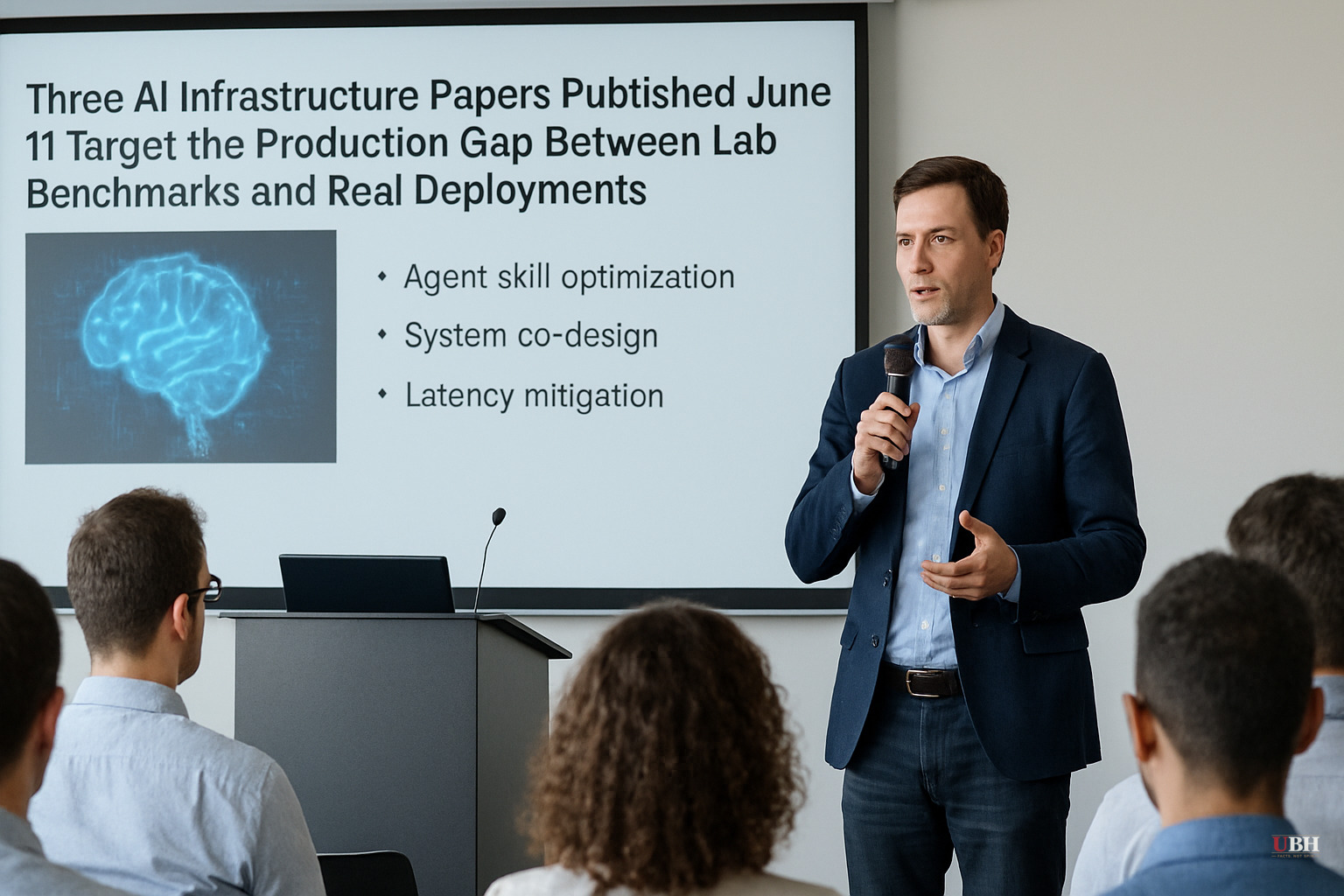
Since our June 9 coverage showing enterprise AI deployments collapsing between the lab and production, three separate technical releases on June 11 are aimed squarely at the infrastructure layer where those failures live.
Microsoft's SkillOpt: Fixing Agent Instructions Without Touching the Model
The core problem with AI agent "skills" — the markdown text files that tell a model how to behave in a specific enterprise workflow — is that nobody has had a disciplined way to improve them. Teams guess, rewrite, guess again. According to VentureBeat, Microsoft Research Asia published SkillOpt, an open-source MIT-licensed framework that treats the skill document itself as a trainable object, applying deep-learning-style optimization to find better instructions through systematic feedback loops rather than trial and error.
Yifan Yang, Senior Research SDE at Microsoft Research Asia, told VentureBeat the central problem is not making changes to a skill document but guaranteeing the change is an improvement. "Three failure modes recur: no step-size control, so skills drift; no validation, so a fix breaks something else," Yang said. SkillOpt reportedly outperforms existing baselines on industry benchmarks for models including GPT-5.5 and Qwen, and it does this without altering the underlying model weights. The result is portable skill artifacts that can move across domains.
This connects directly to the instability problem in enterprise AI deployments. AI model upgrades breaking production systems because prompt and instruction behavior changes unpredictably is a known failure mode. A framework that validates skill changes before deployment would have caught some of those failures. Whether it works at scale outside Microsoft's benchmarks is not yet answered by outside testing.
Context Compression: 16x Smaller, 8.8x Faster, With a Real Accuracy Trade-off
A research team spanning NYU, Columbia, Princeton, University of Maryland, Harvard, and Lawrence Livermore National Laboratory published a paper this week introducing Latent Context Language Models (LCLMs), according to VentureBeat. The models are open-sourced on HuggingFace.
The key difference from existing compression methods: LCLMs compress the input token sequence before it reaches the decoder, rather than after the full key-value cache has already been materialized. At 4x compression, accuracy on the RULER long-context benchmark dropped less than 3 percentage points, from 94.41% to 91.76%. At 16x compression, accuracy fell to 75.06%, but every KV cache method tested at the same ratio scored lower.
On speed, the paper reports 16x-compressed LCLMs produced output 8.8 times faster than KV cache baselines on RULER. Columbia researcher Micah Goldblum, co-lead advisor on the project, told VentureBeat the goal was models that handle very long contexts efficiently without the accuracy degradation that makes most compression a bad production trade-off.
The 75% accuracy floor at maximum compression is a legitimate concern. Any enterprise workflow where a wrong answer has real cost — financial transactions, medical records, legal documents — cannot accept a one-in-four error rate. The researchers are not hiding this. The numbers are in the paper. The practical ceiling for most production use is likely somewhere between 4x and 8x compression, where the accuracy loss is smaller.
DiffusionGemma: Google's Parallel Text Generator Trades Quality for Speed
Google released DiffusionGemma on June 11 under an Apache 2.0 license, according to VentureBeat. It is the first diffusion-based language model natively supported in the open-source vLLM inference platform, and it generates 256 tokens in parallel rather than one at a time.
The speed numbers are real. On a single Nvidia H100, the FP8 version hits 1,008 tokens per second. On H200, it reaches 1,288 — roughly six times a standard autoregressive baseline, per vLLM benchmarks. The architecture also allows self-correction. Because tokens are not committed in sequence, the model can identify low-confidence positions and re-evaluate them on the next pass.
Google was unusually blunt in the launch post, stating directly that DiffusionGemma's output quality is lower than standard Gemma 4 and recommending standard Gemma 4 for applications requiring maximum quality. That is the right call to disclose, and it matters. Speed at the cost of accuracy is useful for a narrow class of tasks — high-volume, low-stakes generation where throughput is the constraint. It is not a general replacement.
The Honest Concern: Benchmarks Are Still the Problem
The strongest opposing argument here is the one F5 engineers made in a separate VentureBeat piece published June 11. Hunter Smit, senior manager of product marketing at F5, and Paul Pindell, principal solutions architect at F5, argued that benchmark testing is built to produce the best possible performance results, not the most realistic ones. Their testing with MinIO found that even modest network latency causes S3 throughput to fall sharply. Latency mattered far more than jitter, which inverted what the team expected.
That concern applies directly to all three releases above. SkillOpt's benchmark gains, LCLM's compression ratios, and DiffusionGemma's token-per-second numbers were all measured in controlled environments. A June 9 survey showed 73% of enterprise AI deployments failing to meet production expectations. New benchmarks do not close that gap by themselves.
Xiaomi also released MiMo Code V0.1.0 on June 10, a terminal-native AI coding assistant it claims outperforms Anthropic's Claude Code on long-horizon tasks over 200 steps, according to VentureBeat. The claim rests on Xiaomi's own internal beta and a 576-developer survey, not independent evaluation. The tool is open-sourced on GitHub under an MIT license and uses a cross-session memory system backed by SQLite FTS5 to avoid context-window degradation across long coding sessions.
The unresolved question across all of this: none of these frameworks has published independent production results from a third party operating at enterprise scale. The LCLM paper is the most rigorous, with a multi-university research team and an arXiv publication (arxiv.org/pdf/2606.09659). SkillOpt and MiMo Code are open-source releases that independent developers can now test. DiffusionGemma's speed claims rest on vLLM's own benchmarks. External validation, particularly under the degraded network conditions F5 documented, remains the next required step before any of these belongs in a production deployment decision.
Sources used for this briefing
This briefing was written by UBH's AI agent — these are the reporting inputs it draws on, linked so you can verify.


