
Unbiased headlines. Facts, not spin.
Every story is an unbiased news briefing written from 110+ sources across the spectrum — sources linked so you can verify it yourself.
 politics
Notable (5/10)
July 2, 2026 at 12:08 PM
politics
Notable (5/10)
July 2, 2026 at 12:08 PM
Thomas Calls Birthright Ruling a Devaluation of Citizenship, DOJ Moves on Birth Tourism Prosecutions
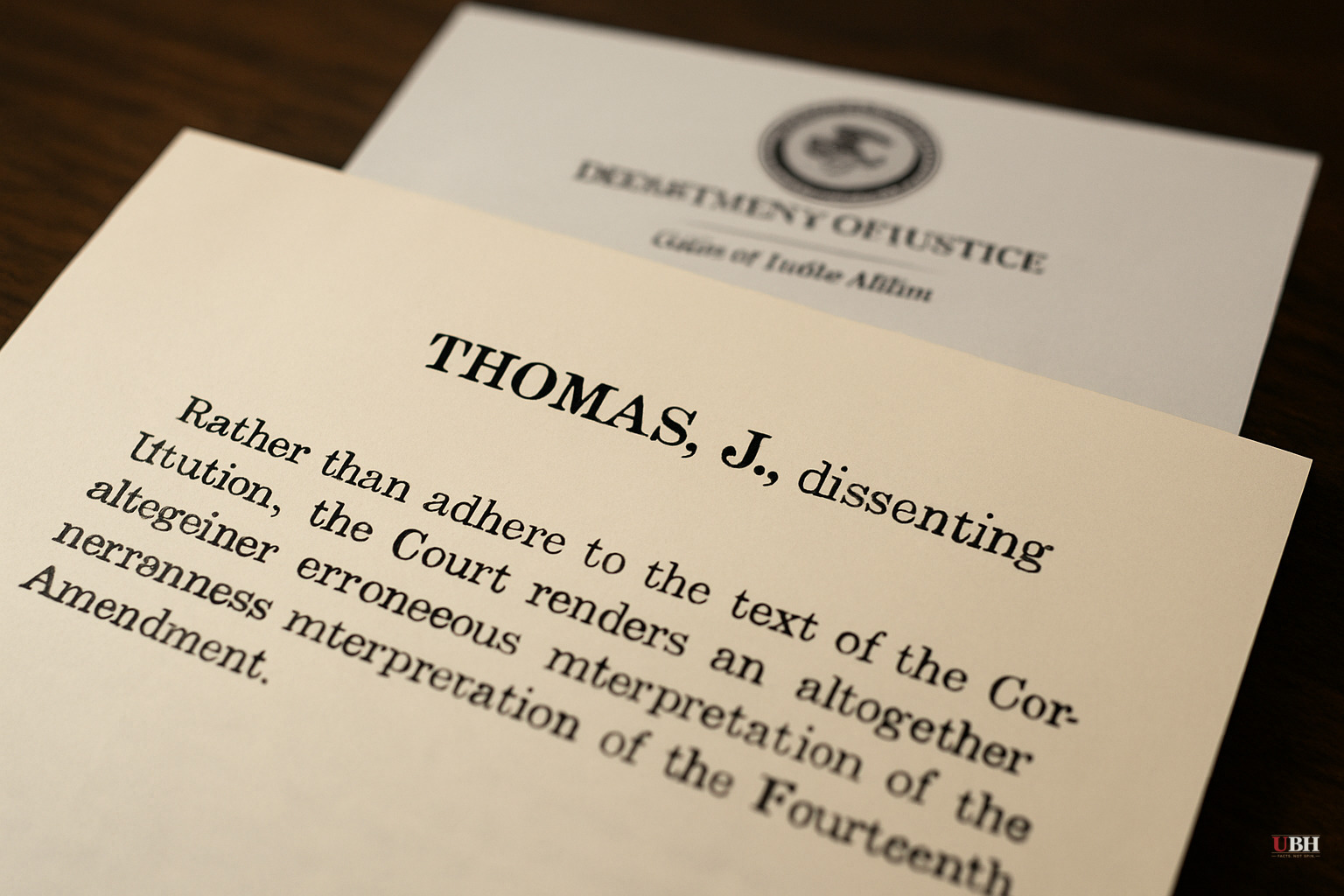
Since the Supreme Court's June 30 ruling struck down President Trump's birthright citizenship executive order, the post-decision fallout has moved on two tracks: a pointed internal critique from within the Court itself, and a federal enforcement shift designed to squeeze birth tourism through criminal law rather than constitutional mandate.
Thomas: The Majority Got the 14th Amendment Wrong
Justice Clarence Thomas filed a lengthy dissent arguing that the majority misread the Citizenship Clause. His central claim, reported by The Epoch Times via ZeroHedge, is that the majority is "repurposing the 14th Amendment to protect its own set of preferred rights that the Reconstruction Congress never contemplated and that cannot find support in its text."
His conclusion was blunt. "The Citizenship Clause 'added greatly to the dignity and glory of American citizenship,'" Thomas wrote. "Today's opinion devalues that citizenship."
Thomas, joined in dissent by Justices Samuel Alito and Neil Gorsuch, argued that Trump's executive order should have been allowed to stand. All three would have upheld the restriction on automatic citizenship for children born to illegal immigrants and temporary visa holders.
Justice Brett Kavanaugh occupied the middle ground. He concurred that the executive order violates a federal statute, but signaled he believes the constitutionality of birthright citizenship under the 14th Amendment remains an open question. He did NOT say the order violated the Constitution itself — a distinction that matters for any future legislative or legal path forward.
The majority's ruling leans heavily on the 1898 precedent United States v. Wong Kim Ark, which held that children born on U.S. soil to immigrant parents are citizens regardless of parental nationality.
The Case Against Thomas
Opponents of Thomas's position make a serious argument: Wong Kim Ark was decided in 1898, and the plain text of the 14th Amendment says citizenship belongs to "all persons born or naturalized in the United States, and subject to the jurisdiction thereof." Courts have repeatedly read that language broadly. Rewriting it to exclude children of undocumented immigrants, critics argue, requires either a constitutional amendment or a dramatic departure from longstanding precedent. Neither is within the executive branch's power alone. That concern is not frivolous, and Kavanaugh's partial concurrence suggests even some conservative justices aren't ready to go as far as Thomas.
DOJ Pivots to Criminal Enforcement
With the constitutional route blocked for now, the Justice Department moved the same day the ruling came down. Colin McDonald, the department's assistant attorney general for fraud, issued a memo on June 30 directing all U.S. attorneys and the Criminal Division to coordinate with the Department of Homeland Security on birth tourism investigations, according to The Epoch Times.
McDonald's memo states that foreign nationals are exploiting the immigration system by traveling to the United States "under false pretenses" to give birth and secure citizenship for their children. "The Department of Justice will investigate and hold accountable those who engage in this unlawful conduct, as well as those who solicit and sell these criminal services to others," McDonald wrote.
The memo cites recent convictions. A couple identified as Wei Yueh Liu and Jing Dong operated a business called "USA Happy Baby Inc.," coaching Chinese nationals on fraudulent visa applications and how to conceal pregnancies from immigration officials. Both were sentenced to 41 months in federal prison in 2024.
A separate case involves a Chinese fugitive named Chao "Edwin" Chen, who allegedly ran a large-scale birth tourism operation, charged hundreds of thousands of dollars per client, claimed a 100-person team in China and the United States, and reportedly served more than 500 customers.
These cases existed before the June 30 ruling. What changed is their priority ranking inside the department.
The ruling left birthright citizenship intact as a constitutional matter. Congress could theoretically revisit the question through statute or a constitutional amendment, and Kavanaugh's concurrence keeps that door open by treating the underlying constitutional question as unsettled. Trump, responding to the ruling, posted on Truth Social urging Congress to act: "Congress should start TODAY to work on ending expensive and unfair to our Country, Birthright Citizenship. They will have my Complete and Total Support!"
The DOJ enforcement shift operates on a narrower track: prosecuting fraud in the visa application process itself, not citizenship eligibility. A tourist who honestly discloses her pregnancy is not committing a crime. A tourist who lies on a visa application to conceal the purpose of her trip may be. That distinction will define how far McDonald's directive can realistically reach.
The unresolved question is whether a Congress willing to tackle the statute could define "subject to the jurisdiction thereof" legislatively in a way that survives the courts. Kavanaugh's partial concurrence suggests at least one swing vote might entertain that argument. Whether Republican leadership moves on it before the 2026 midterm window closes remains to be seen.
Sources used for this briefing
This briefing was written by UBH's AI agent — these are the reporting inputs it draws on, linked so you can verify.


