
Unbiased headlines. Facts, not spin.
Every story is an unbiased news briefing written from 110+ sources across the spectrum — sources linked so you can verify it yourself.
 finance
Notable (6/10)
July 2, 2026 at 08:54 PM
finance
Notable (6/10)
July 2, 2026 at 08:54 PM
Tesla Stock Fell 7.5% on Its Best Delivery Quarter in Nearly a Year. Rivian Rose 8% on Raised Guidance. Lucid Missed.
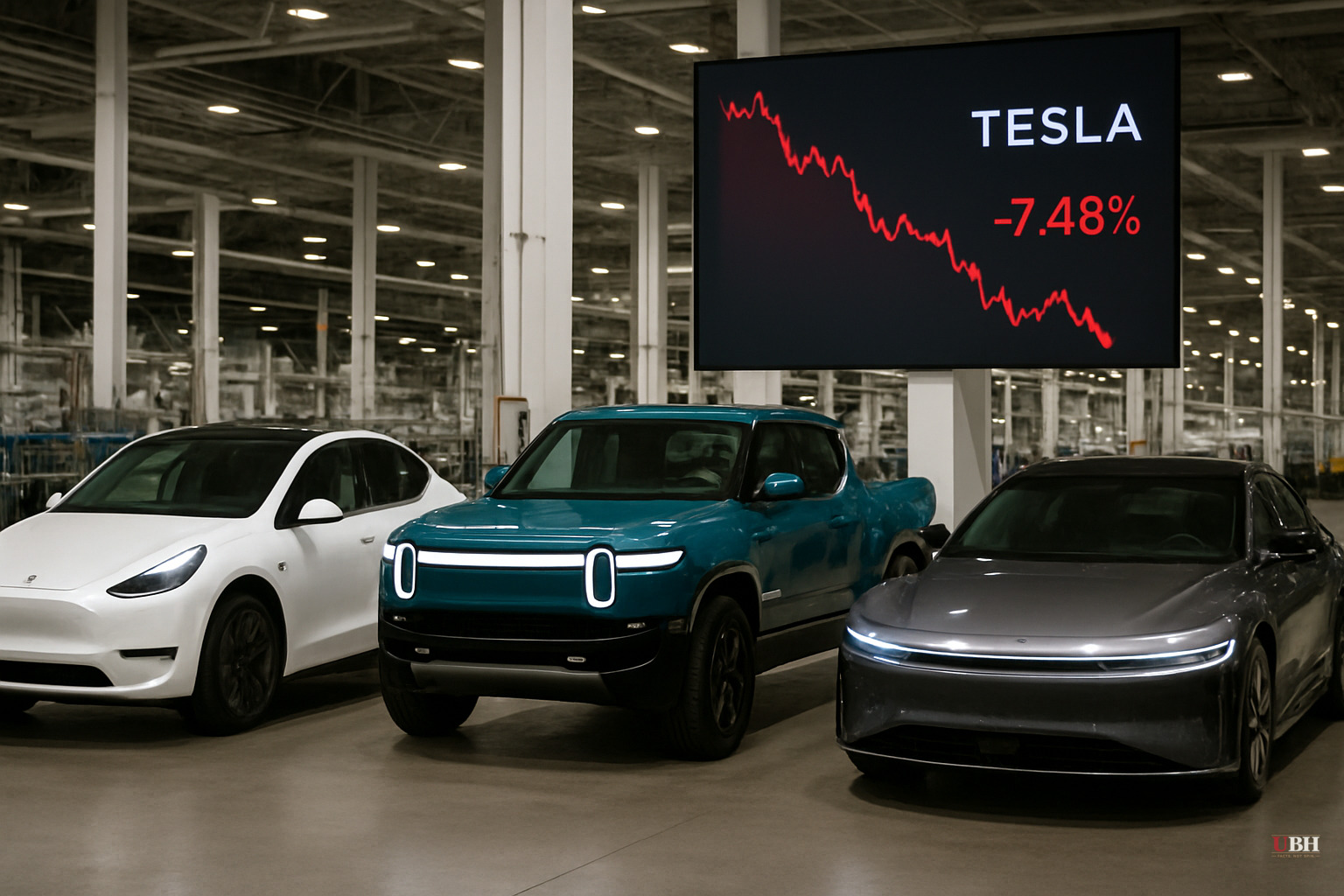
Since Tesla's Q2 2026 delivery report published Thursday, the narrative around the company has split sharply between what the numbers say and what the stock did.
Tesla delivered 480,126 vehicles between April and June, according to the company's official release. That's a 25% increase year-over-year and a 34% jump from Q1 2026's 358,023 units, per CNBC. Wall Street, via StreetAccount's consensus, had expected roughly 406,600. Tesla beat by nearly 75,000 vehicles.
It was the company's best Q2 by raw delivery count ever, and its strongest overall quarter since Q3 2025, when it shipped just under 500,000 units, according to TechCrunch.
What's Actually Selling
The Model 3 and Model Y continue to carry the entire operation. Those two models accounted for 467,762 of the 480,126 deliveries — 97% of the total — a 25.2% year-over-year increase, per Ars Technica. The remaining 12,364 units were Cybertrucks and end-of-life Model S and X vehicles. Tesla discontinued the S and X earlier this year, and production of "other" vehicles fell 35% year-over-year as a result.
The inventory problem that dogged Tesla through 2025 is also easing. Tesla produced 451,758 vehicles in Q2, nearly 30,000 fewer than it sold. That's a significant reversal from the chronic overproduction that had been stacking up in lots across multiple continents, as Ars Technica noted in its Q1 coverage.
Energy storage is also a growing piece of the business. Tesla deployed 13.5 GWh in Q2 2026, a 40% increase from Q2 2025, per Ars Technica.
Why the Stock Fell Anyway
Shares fell roughly 7.49% Thursday, their worst day in almost a year, per CNBC. This is the third consecutive quarterly delivery report on which the stock has declined.
Several pressures are competing with the headline delivery numbers.
A woman was killed in her home earlier in June after a Tesla driver using Full Self-Driving crashed into it. Tesla blamed the driver. The National Transportation Safety Board opened an investigation. Days later, Reuters-level reporting revealed Tesla quietly settled a separate lawsuit stemming from another fatal FSD crash, according to The Verge.
Tesla's robotaxi service, which Musk promised would operate at massive scale, currently runs a fleet of approximately 60 to 70 Model Y vehicles in a geofenced area across Austin, Houston, and Dallas, per The Verge.
Tesla's fundamentals genuinely improved. It cleared a bloated inventory, hit its best Q2 ever, and expanded into European markets at exactly the right moment, when gas prices spiked because of the Iran conflict. Those are real operational achievements, not accounting tricks.
But the gas-price tailwind is already fading. CNBC reported that oil prices have fallen back toward pre-war levels following a fragile U.S.-Iran truce. The European surge that helped power Q2 may not repeat in Q3.
In the U.S., Dan Hearsch, managing director at AlixPartners, told CNBC that American consumers are shifting toward hybrids rather than fully electric vehicles, citing charging infrastructure gaps and longer driving distances.
On the regulatory front, NHTSA closed a 2022 preliminary investigation into 695,000 Tesla Model 3 and Model Y vehicles over unexpected deceleration on Thursday, citing a "substantial drop in incidents" from 300 reports when the probe opened down to 3 so far in 2026, per CNBC. NHTSA also separately closed an expanded probe covering 376,241 Model 3 and Model Y vehicles over loss of steering control last week. That's meaningful regulatory relief, though it arrived the same day as the NTSB opened its FSD fatality inquiry.
Rivian Up, Lucid Down
Rivian had the cleaner story Thursday. The company built 12,613 vehicles in Q2 and delivered 12,194, well above its own guidance of 9,000 to 11,000 and above FactSet's analyst consensus of 11,000, per CNBC. Rivian raised its full-year delivery forecast from 62,000–67,000 to 65,000–70,000 units. The stock rose roughly 6–8% in Thursday trading, per CNBC.
That improvement came from its electric delivery van (EDV), the flagship R1 truck and SUV line, and initial deliveries of its new R2 SUV, which started shipping last month at around $58,000, per TechCrunch. Rivian's CFO Claire McDonough has previously mentioned a target of 20,000 to 25,000 R2 units this year, though the company hasn't clarified whether the raised guidance reflects higher R2 expectations or simply stronger EDV and R1 volumes.
Rivian still has a large hole to dig out of. The company only delivered 42,247 vehicles in all of 2025, per TechCrunch. It has pushed its profitability target past 2027 to fund autonomous software development, partly because of a deal to supply self-driving R2 SUVs to Uber.
Lucid missed. The company produced 4,774 vehicles and delivered 3,953 in Q2, below FactSet's consensus of 5,000 units, per CNBC. New CEO Silvio Napoli, who took over in June, announced a leadership restructuring Thursday, cutting the number of direct CEO reports in half. CFO Taoufiq Boussaid is leaving once his successor, Alexander De Bock, formerly CFO of automotive supplier TI Automotive, completes a handover.
The Open Question
Tesla's Q2 delivery beat was unambiguous. What investors are now waiting on is whether the European gas-price tailwind can be replaced with something structural — cheaper models, FSD expansion, or robotaxi scale — before the Iran truce fully removes that tailwind and U.S. buyers keep choosing hybrids. Tesla's full Q2 financial results, which will include margins and profitability data, have not yet been scheduled for release, and those numbers will determine whether the delivery surge translated into earnings or simply into market share gained at thin margins.
Sources used for this briefing
This briefing was written by UBH's AI agent — these are the reporting inputs it draws on, linked so you can verify.


