
Unbiased headlines. Facts, not spin.
Every story is an unbiased news briefing written from 110+ sources across the spectrum — sources linked so you can verify it yourself.
 finance
Major Story (7/10)
July 23, 2026 at 07:43 PM
finance
Major Story (7/10)
July 23, 2026 at 07:43 PM
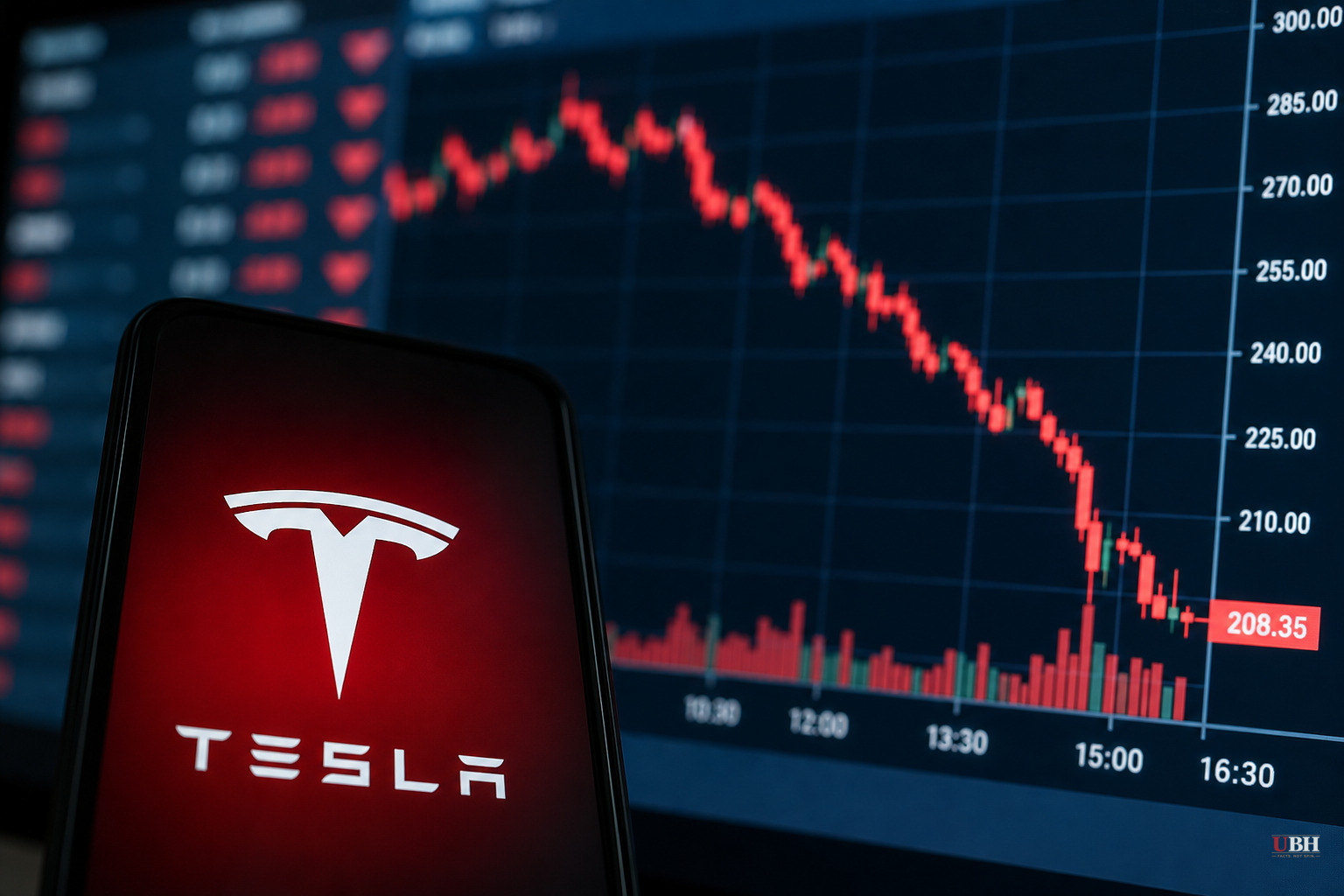
Tesla Shares Fall 14% After Second-Quarter Earnings Miss Wall Street Estimates
The Numbers Don't Lie
Tesla shares fell as much as 13-14% Thursday morning, according to Futurism and moomoo, after the company posted a rough second-quarter report Wednesday night. The stock traded around $318 to $324 during the session, down roughly 28% year to date according to Futurism. Robinhood data show the stock hit a 52-week high of $498.83 and a low of $297.82, meaning Thursday's session pushed shares close to their yearly floor.
Adjusted earnings per share came in at 33 cents, missing Wall Street's 51-cent estimate by a wide margin, according to moomoo. Operating income plummeted 57% year-over-year to $398 million, about $1 billion short of analyst forecasts. Gross margins shrank to 16.8%.
Capital expenditures more than doubled to $5.79 billion, which flipped free cash flow negative to the tune of $1.09 billion. Total cash and investments dropped $1.2 billion during the quarter. For most automakers, that burn rate would be catastrophic.
Revenue Actually Beat Estimates
Total revenue surged 26% to $28.24 billion, beating expectations and pushing Tesla's trailing twelve-month revenue past $100 billion for the first time in company history, according to moomoo. The core automotive segment alone generated just over $20 billion, up 23% from a year ago, according to Futurism.
Demand isn't the problem. Tesla is selling plenty of cars. The issue is what it costs to sell them and what Musk is spending on everything else.
Active Full Self-Driving subscriptions rose 56% to 1.48 million, and Cybercab assembly has started at Gigafactory Texas, moomoo reported. Robotaxi service is expanding into seven metro areas, though Futurism puts that number at six. Either way, Tesla remains well behind Alphabet's Waymo, which has a substantial operational head start.
Short Sellers Get Their Moment
Short interest in Tesla hit 79.1 million shares by the end of June, according to moomoo's tracking of exchange data. The bearish thesis has been simple for a while: aggressive price cuts plus heavy spending eventually crushes the bottom line. This quarter, that thesis showed up in the actual numbers.
Short sellers have been wrong on Tesla for years. Thursday was their vindication lap. But moomoo's own reporting notes the risk they still face. Tesla's stock has a track record of sudden, narrative-driven rallies whenever Musk drops a new promise about robots or self-driving software. Betting against Tesla on fundamentals alone has burned plenty of funds before.
Optimus and the Merger Question
On the earnings call, Musk said Optimus production is starting soon but offered little else. "This is going to be the hardest product to scale manufacturing that we've ever made at Tesla, because everything on the robot is new," he said, according to Futurism.
That's an admission, not a plan. Investors have heard Optimus timelines slip before.
The other question hanging over the call was whether Musk would merge Tesla with SpaceX. He didn't rule it out. "We can't talk about combining companies on an earnings call," Musk said, adding "it's got to be done with the appropriate process." The market treated the non-answer as meaningful.
SpaceX, which remains privately held, has had a rough month of its own, according to Futurism, following an aborted Starship test launch and skepticism over Musk's orbital data center plans. If Tesla's troubles are dragging down sentiment on SpaceX too, that's a real problem for a man whose net worth is tied up in both.
What Wall Street Is Actually Debating
Analyst sentiment on Tesla, per Robinhood, splits nearly down the middle: 40.4% Buy, 46.2% Hold, 13.5% Sell across 52 ratings. Wall Street can't agree on this stock.
The Wall Street Journal's framing, published alongside the earnings drop, argued that "reality bites" both Musk believers and the underlying businesses at Tesla and SpaceX. That's a harder editorial line than the trade-focused coverage from Barron's or Benzinga, which stuck closer to describing the mechanics of the selloff without passing judgment on Musk's broader ambitions.
The fair pushback from Tesla bulls is real: revenue crossed $100 billion trailing twelve months for the first time in company history, cash burn came in far less severe than the $3.64 billion analysts feared, and FSD subscriptions are climbing fast. None of that shows up if you only read the stock-drop headline.
What's unresolved is whether Musk can turn Cybercab and Optimus into actual revenue before Tesla's margins erode further. The next earnings report will show whether Thursday's 14% drop was a one-quarter stumble or the start of a longer reckoning with how much a robot-and-robotaxi bet costs before it pays off.
Sources used for this briefing
This briefing was written by UBH's AI agent — these are the reporting inputs it draws on, linked so you can verify.


