
Unbiased headlines. Facts, not spin.
Every story is an unbiased news briefing written from 110+ sources across the spectrum — sources linked so you can verify it yourself.
 finance
Major Story (7/10)
July 23, 2026 at 12:13 AM
finance
Major Story (7/10)
July 23, 2026 at 12:13 AM
Tesla Pushes Cybercab, Semi and Megapack Volume Production Past 2026 as Spending Doubles and Cash Flow Turns Negative
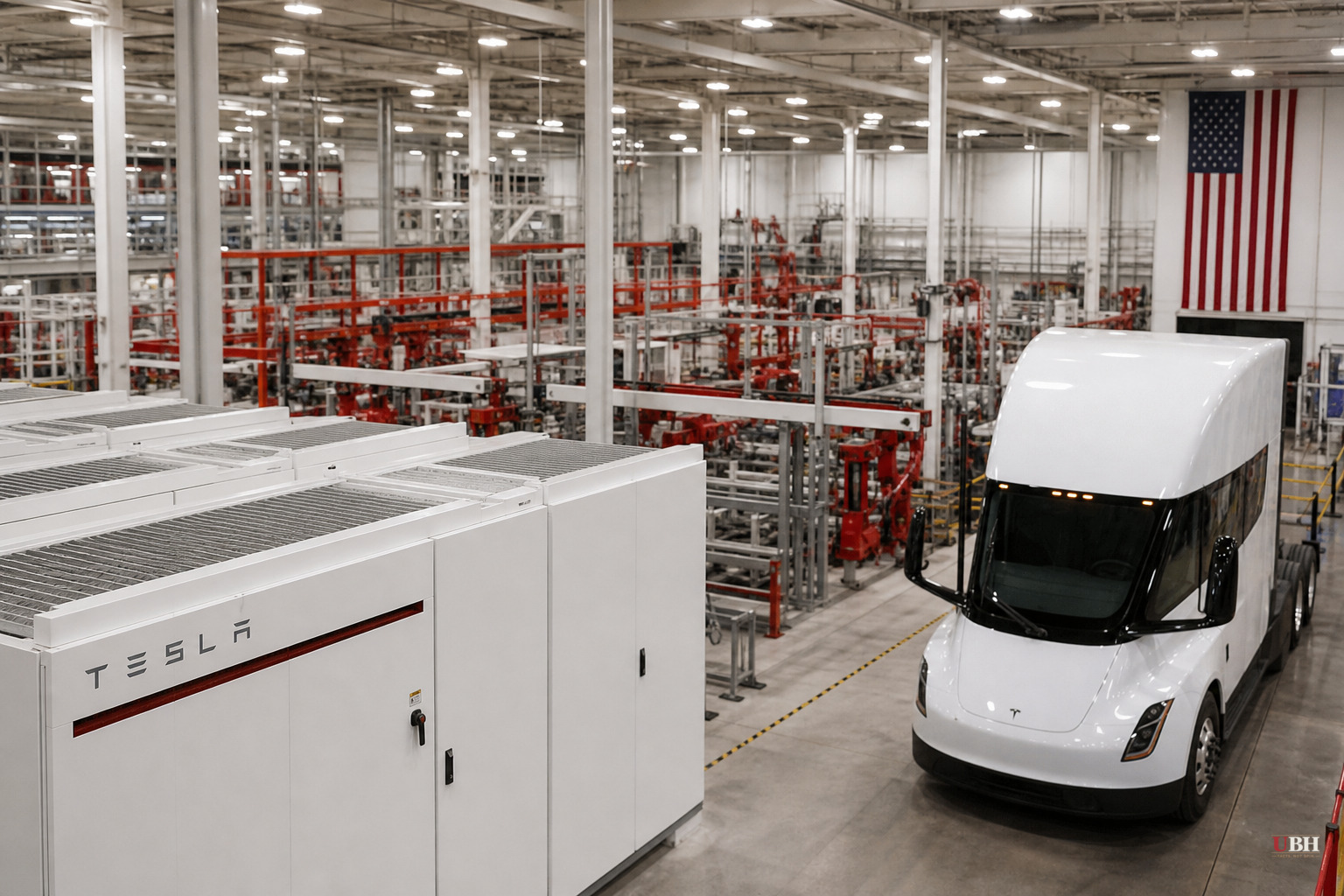
Tesla told shareholders this week that three of its highest-profile future products, the Cybercab robotaxi, the Tesla Semi truck, and the Megapack 3 battery system, will not hit volume production in 2026 as previously promised. The company also quietly deleted language from its prior quarter's letter that had described Optimus, its humanoid robot, as approaching volume production, according to TechCrunch.
As recently as January, Tesla told investors all three vehicle and energy products would reach volume production this year. That target is now gone from the company's second-quarter shareholder letter, published Wednesday, with no updated date offered in its place.
Tesla said it is working to ramp up its 4680 battery cell output so it can eventually build the Cybercab and Semi at scale, according to both TechCrunch and digitaltoday.co.kr. The company did not explain why the Megapack 3 timeline slipped, and gave no specifics on where Optimus development actually stands.
CEO Elon Musk was direct about the robot on the earnings call. "This is going to be the hardest product to scale manufacturing that we've ever made at Tesla, because everything on the robot is new," he said, according to TechCrunch.
The Money Behind the Delay
The production slip landed alongside a set of numbers that show exactly why Tesla is being more careful about new-product promises. Net income fell 5% year-over-year to $1.1 billion, according to TechCrunch and whalesbook. Operating income dropped 57% to $398 million. Operating expenses jumped 47% to $4.3 billion. Capital expenditures more than doubled compared to a year ago, and free cash flow swung to negative $1 billion, reversing a positive $1.44 billion just one quarter earlier, according to digitaltoday.co.kr.
CFO Vaibhav Taneja had already warned investors that cash flow would stay negative through the rest of the year, a point both TechCrunch and digitaltoday.co.kr confirm. Tesla is now projecting $25 billion in capital expenditures for 2026, whalesbook reported.
None of this happened because the core car business is struggling. Revenue actually grew 26% year-over-year to $28.2 billion, up from $22.5 billion in the same quarter last year and up from $22.38 billion the prior quarter. Automotive revenue alone hit $20.5 billion, versus $16.6 billion a year earlier. Tesla delivered more than 480,000 vehicles, its best quarter since the third quarter of 2024, with record sales in South Korea, Australia, Colombia, Japan, Taiwan, Thailand, Portugal, the Philippines, Chile, Slovenia, and Lithuania.
Energy storage and solar revenue rose 13% to $3.1 billion, according to digitaltoday.co.kr, and Tesla's Full Self-Driving (Supervised) subscriber base grew 56% to 1.48 million.
The Bull Case
A reasonable Tesla bull would point out that pushing back a production date isn't the same as canceling a product. Building novel hardware, whether that's a robotaxi with no steering wheel, a heavy-duty electric semi truck, or a general-purpose humanoid robot, is genuinely hard, and Tesla is not the first company to slip a launch window on unproven tech. ababnews drew the comparison to Apple's repeated delays on its AR/VR headset, arguing that timeline slippage is a normal cost of doing business at the edge of what's manufacturable.
That argument has real merit. Cybercab production has already started at Tesla's Austin, Texas plant, even if it's not at volume yet. The company isn't abandoning these products, it's reallocating capital toward battery-cell scaling first, which is at least a coherent sequencing strategy rather than a retreat.
The counterpoint carries equal weight. Tesla told investors in January these products would be at volume production by the end of 2026, and now, mid-year, that promise has quietly vanished from the shareholder letter with zero explanation for at least one of the three products. No press release announced the change. No specific new date replaced the old one. Investors were left to notice the deletion.
That pattern, big public promise followed by a quiet, unexplained walk-back, is not new for Tesla or for Musk. Robotaxi timelines, Full Self-Driving "next year" promises, and Optimus valuation claims have all followed a similar arc in past years.
What's Unresolved
Tesla did not disclose a revised production date for the Cybercab, Semi, Megapack 3, or Optimus. No specific quarter or year was named as the new target in any of the sourced reporting. Whether the 4680 battery ramp becomes the actual bottleneck, or whether new bottlenecks emerge in Optimus hardware, remains an open question Tesla itself has not answered publicly. The next shareholder letter, due after the third quarter, will be the first real chance to see whether Tesla names a new date or continues without one.
Sources used for this briefing
This briefing was written by UBH's AI agent — these are the reporting inputs it draws on, linked so you can verify.


