
Unbiased headlines. Facts, not spin.
Every story is an unbiased news briefing written from 110+ sources across the spectrum — sources linked so you can verify it yourself.
 finance
Major Story (7/10)
June 22, 2026 at 10:11 PM
finance
Major Story (7/10)
June 22, 2026 at 10:11 PM
Target Chairman Brian Cornell Wins Reelection But Gets Lowest Investor Support in His Tenure
The Numbers
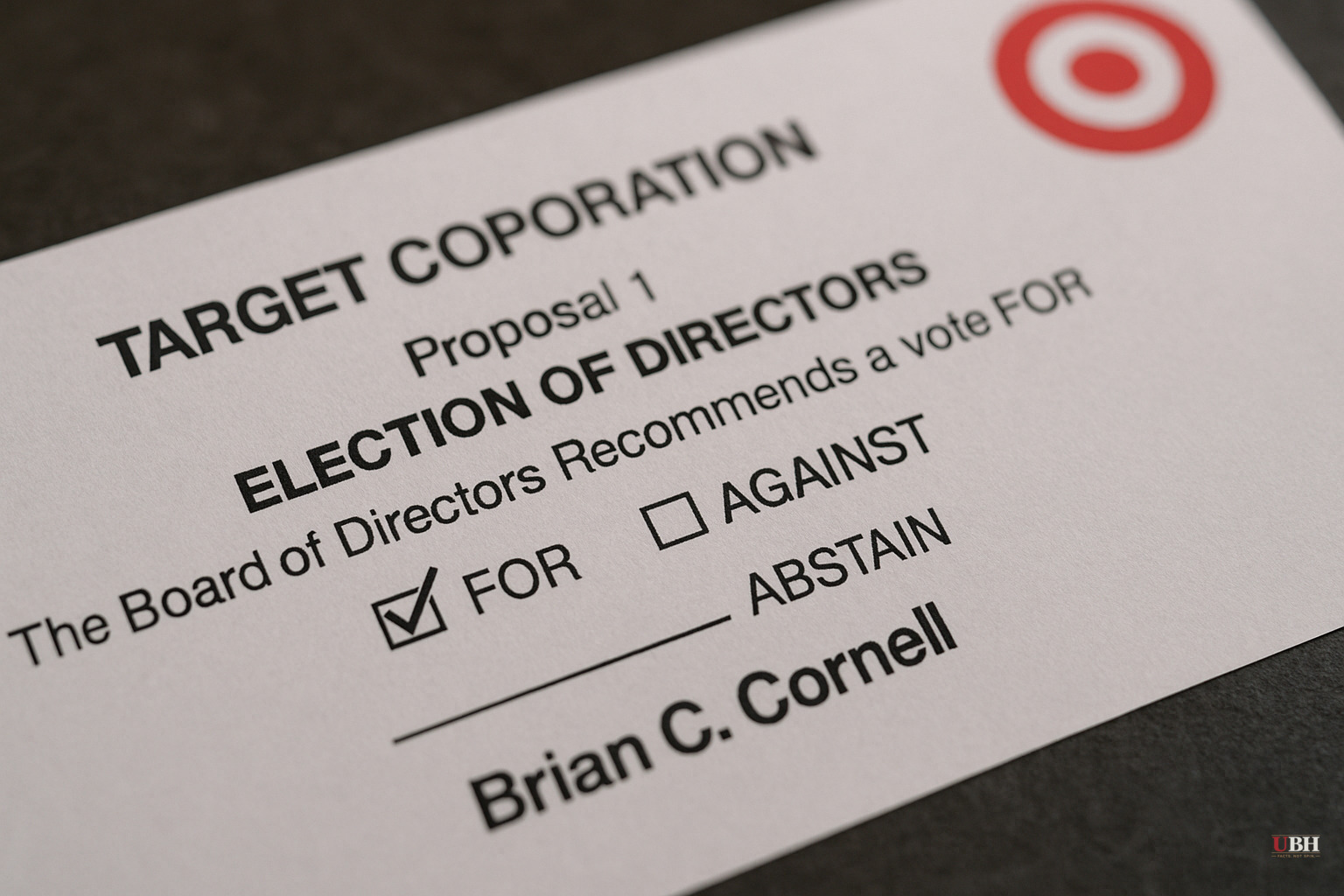
At Target's annual general meeting earlier this month, 87.2% of shareholders voted to reelect Brian Cornell to the board. That sounds like a landslide until you put it in context.
Harvard Law School tracks director support across the S&P 500. This year's average is 96.6%. Cornell's 87.2% is nearly 10 points below that benchmark — and a 4-point drop from where he stood just one year ago.
His historical average at Target has been around 95%. He cleared that comfortably, year after year, for more than a decade. This year he didn't come close.
Kevin Kaiser, a professor of finance at the Wharton School of the University of Pennsylvania who teaches shareholder activism, was blunt about what the numbers mean. "Getting over 95% is normal. Getting under 95% is poor, and getting under 90 is very poor. It means people are going out of their way to say they don't want you there anymore," Kaiser told CNBC.
Cornell finished at 87.2%. That's below 90.
What Cornell Oversaw
Cornell joined Target as CEO in 2014. For a stretch, he got credit for a genuine turnaround: cleaning up a data breach mess, rebuilding store experience, and pushing private-label brands that shoppers actually wanted.
But the last few years tell a different story. Target posted three consecutive years of annual sales declines. Its share price dropped significantly. Profits shrank. In February 2026, Cornell stepped down as CEO, and Target installed a new chief executive to lead the turnaround. Cornell moved into the Executive Chairman role.
That transition is exactly what a segment of investors objected to.
"Reward for Failure"
Neil Saunders, retail analyst and managing director at GlobalData, said some analysts and investors saw Cornell's elevation to Executive Chairman as precisely that: a reward for failure.
"If you don't do a good job as CEO, then arguably you should be cleared out of the boardroom," Saunders told CNBC. "To get rewarded for delivering a decline in the share price and causing problems for the company, it just doesn't sit well with a lot of people."
Governance structures that allow departing executives to retain board influence, especially in a chairman capacity, can blunt accountability. When a CEO's tenure ends because the business underperformed, parking that CEO in the chair role puts him in a position to influence his own successor and shape how the company evaluates the very decisions he made.
Target's Defense
Target declined to comment beyond its existing public filings. In its 2026 proxy statement, the company argued that keeping the board chair and CEO roles separate "is appropriate given the company's immediate strategic and operational priorities" and that the two positions have "distinct roles and responsibilities." The statement noted the separated structure allows the incoming CEO to focus on operations while Cornell provides institutional continuity at the board level.
Cornell ran Target for over a decade. He knows its vendors, its real estate footprint, its competitive pressures. A new CEO, especially one inheriting a company in turnaround, can benefit from a chairman who understands the organization's history and relationships. The separation-of-roles model is also standard governance practice at many large companies and is not inherently a mechanism to protect failed executives.
Whether that's the reality here, or whether it's a convenient justification for a cushy landing, is a question shareholders are now asking out loud with their votes.
What 87.2% Actually Means in Practice
Cornell was reelected. He holds his seat. Nothing structurally changes today as a result of this vote.
But institutional investors don't vote against directors casually. The mechanics of institutional proxy voting mean that most shares follow the recommendation of major proxy advisory firms: ISS and Glass Lewis primarily. When 12.8% of shareholders override that default and vote no, it usually reflects a deliberate, organized signal.
Kaiser was explicit: anything below 90% is considered a very bad result and is rare to see. Cornell landed in that zone.
Proxy advisory firm votes and institutional pressure campaigns typically ratchet up over time when early warning signals like this one go unaddressed. If Target's operational performance under its new CEO doesn't improve materially before the 2027 annual meeting, Cornell could face a more organized opposition effort with better-coordinated institutional backing than this year's scattered dissent.
The unresolved question is whether Target's board will treat this vote as a one-year anomaly tied to investor frustration with recent results, or as a signal that Cornell's continued presence as chairman is itself becoming a governance liability that complicates the turnaround story the company is trying to sell.
Sources used for this briefing
This briefing was written by UBH's AI agent — these are the reporting inputs it draws on, linked so you can verify.


