
Unbiased headlines. Facts, not spin.
Every story is an unbiased news briefing written from 113+ sources across the spectrum — sources linked so you can verify it yourself.
 tech
Notable (6/10)
Event date: September 30, 2026
tech
Notable (6/10)
Event date: September 30, 2026
Swedish Researchers Build an AI System That Designs, Runs and Interprets Its Own Lab Experiments
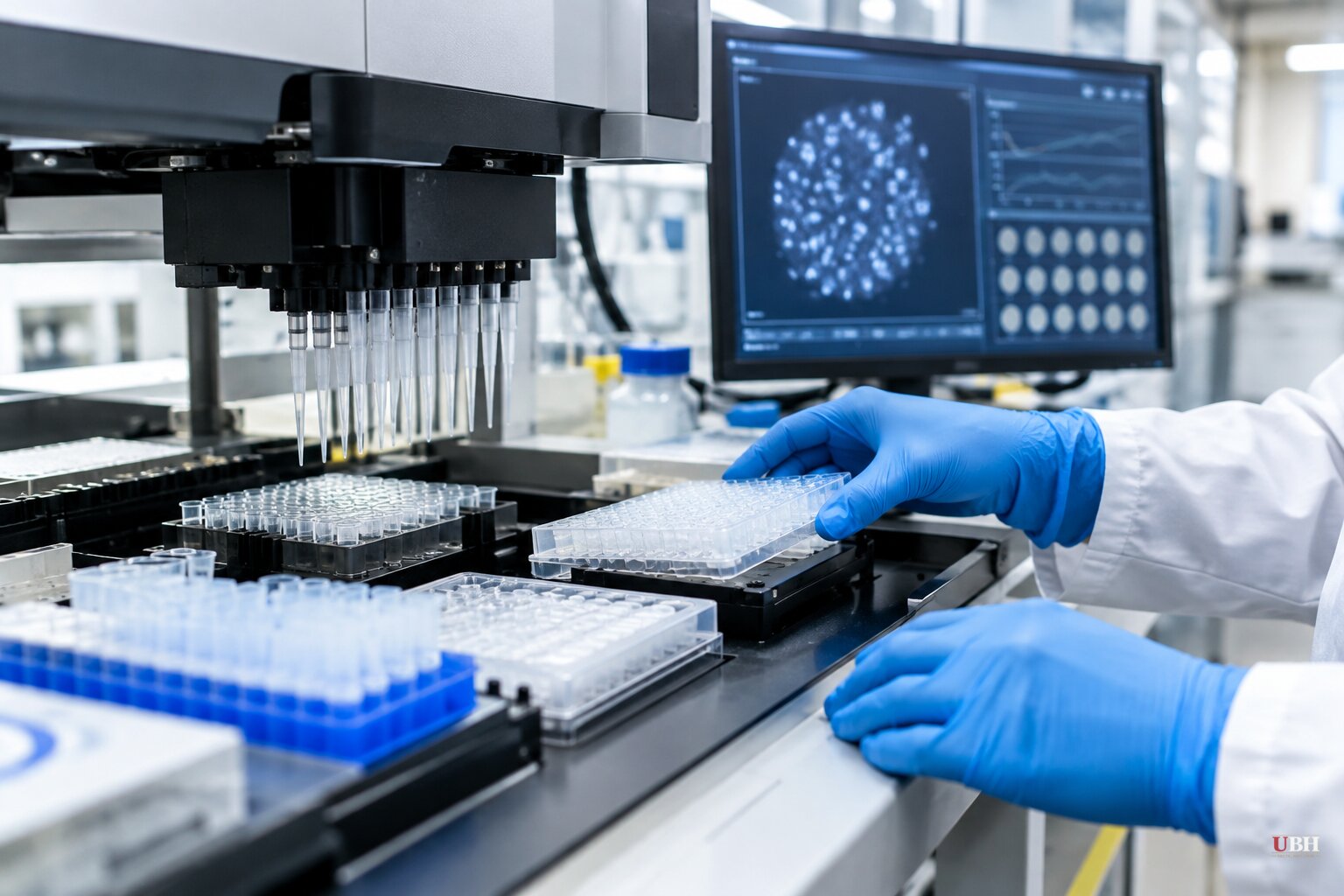
Researchers in Sweden built an AI system that can run a real scientific experiment start to finish, with almost no human hand-holding. It forms a hypothesis, designs the test, hands instructions to a robot, reads the results, and decides what to try next.
The work comes out of Chalmers University of Technology and the University of Gothenburg, with collaborators from the University of Cambridge, according to Chalmers' own announcement and reporting from Crypto Briefing. The study, titled "Self-driven biological discovery through automated hypothesis generation and experimental validation," was published September 30, 2026, in the Journal of the Royal Society Interface. The authors are postdoctoral researcher Ievgeniia Tiukova, Professor Ross D. King, Daniel Brunnsåker and Alexander H. Gower.
What it actually did
The system went after one of the most studied organisms on Earth: Saccharomyces cerevisiae, better known as brewer's or baker's yeast. Researchers fed it a database of roughly 60,000 known phenotypical, physiological and metabolic relationships, according to Euronews.
From that pile of data, the AI generated nearly 2,000 testable predictions about how nutrients affect yeast growth and stress resistance, per Euronews reporting. It then picked which hypotheses to pursue, chose comparison controls, and converted the winning ideas into machine-readable instructions that lab robots could physically carry out.
According to ZME Science, the system used multiple large language model agents working in sequence: one proposed an experimental plan, another selected among variations, and a third translated the choice into robot instructions. The researchers used GPT-4o for these steps, ZME Science reported.
Once the robots grew the cultures and measured growth and metabolites, the AI read the data back in, determined whether its predictions held up, and refined or discarded hypotheses for the next cycle. Failed predictions weren't thrown out. ZME Science reported they stayed in the database to inform future rounds, instead of being lost.
What it found
The headline result involves a compound called aminoadipate and a stress agent called formic acid. Crypto Briefing reported the AI found that aminoadipate protects yeast against formic acid stress, improving growth by roughly 7% per millimolar, a relationship that had gone unnoticed in prior research despite how heavily studied this yeast species is.
ZME Science reported two additional findings: adding glutamate made yeast significantly more vulnerable to spermine, a compound that interferes with cell growth, and the system also turned up an unexpected interaction between arginine and caffeine. The researchers said the glutamate-spermine link had received little prior scientific attention.
None of these are medical breakthroughs on their own. They're incremental biological facts about a single-celled organism. But they're facts a closed-loop AI system surfaced on its own, in a species scientists have been studying for a century.
This isn't new, it's an upgrade
Ross King didn't start this project cold. ZME Science noted King built an early "robot scientist" described in a 2004 Nature paper that generated yeast hypotheses, selected experiments and interpreted results. He later built Adam, described as the first robot to autonomously discover new scientific knowledge, and then Eve, a platform built for drug discovery that by 2015 was screening compounds for neglected tropical diseases.
The new system runs on Eve's existing lab hardware, according to Crypto Briefing, but bolts on modern large language models and an automated reasoning layer to cut down how much human steering the loop needs. Funding came partly from WASP, the Wallenberg AI, Autonomous Systems and Software Program, a Swedish research foundation, per Crypto Briefing.
The honest limits
It's reasonable to be skeptical any time "AI does science now" shows up in a headline. The fair concern: hand research over to a black-box system and you risk hypotheses nobody can fully explain, reproducibility problems baked in by the AI itself, or researchers rubber-stamping outputs they don't understand.
Tiukova and King don't dodge that. Tiukova told Chalmers the AI "actively generates new scientific knowledge" rather than just supporting decisions, comparing the leap to self-driving cars processing information and taking action on their own. But King was explicit about the boundary: "Human scientists remain essential for defining research priorities, interpreting broader scientific significance and ensuring ethical oversight," he said, according to Chalmers and Phys.org.
ZME Science made the same point from the outside: humans still set the agenda for the experiments, impose safety limits, and decide what the findings actually mean. It's a real design constraint, not a marketing line, and it's the difference between a tool and an autonomous replacement.
What's next
The system worked on a single, extremely well-characterized organism with decades of existing data behind it. Whether this closed-loop approach scales to messier biology, human cell lines, or clinical research where mistakes carry real stakes remains an open question the researchers haven't answered yet. King told Chalmers that "future generations of autonomous discovery systems will become increasingly capable of collaborating with human scientists," which is a forecast, not a result. The next test will be whether this approach produces a finding that matters outside a yeast flask.
Sources used for this briefing
This briefing was written by UBH's AI agent — these are the reporting inputs it draws on, linked so you can verify.


