
Unbiased headlines. Facts, not spin.
Every story is an unbiased news briefing written from 113+ sources across the spectrum — sources linked so you can verify it yourself.
 tech
Major Story (7/10)
Event date: September 30, 2026
tech
Major Story (7/10)
Event date: September 30, 2026
AI Token Bills Keep Climbing for Businesses as Senate Rejects Data Center Electricity Cost Bill
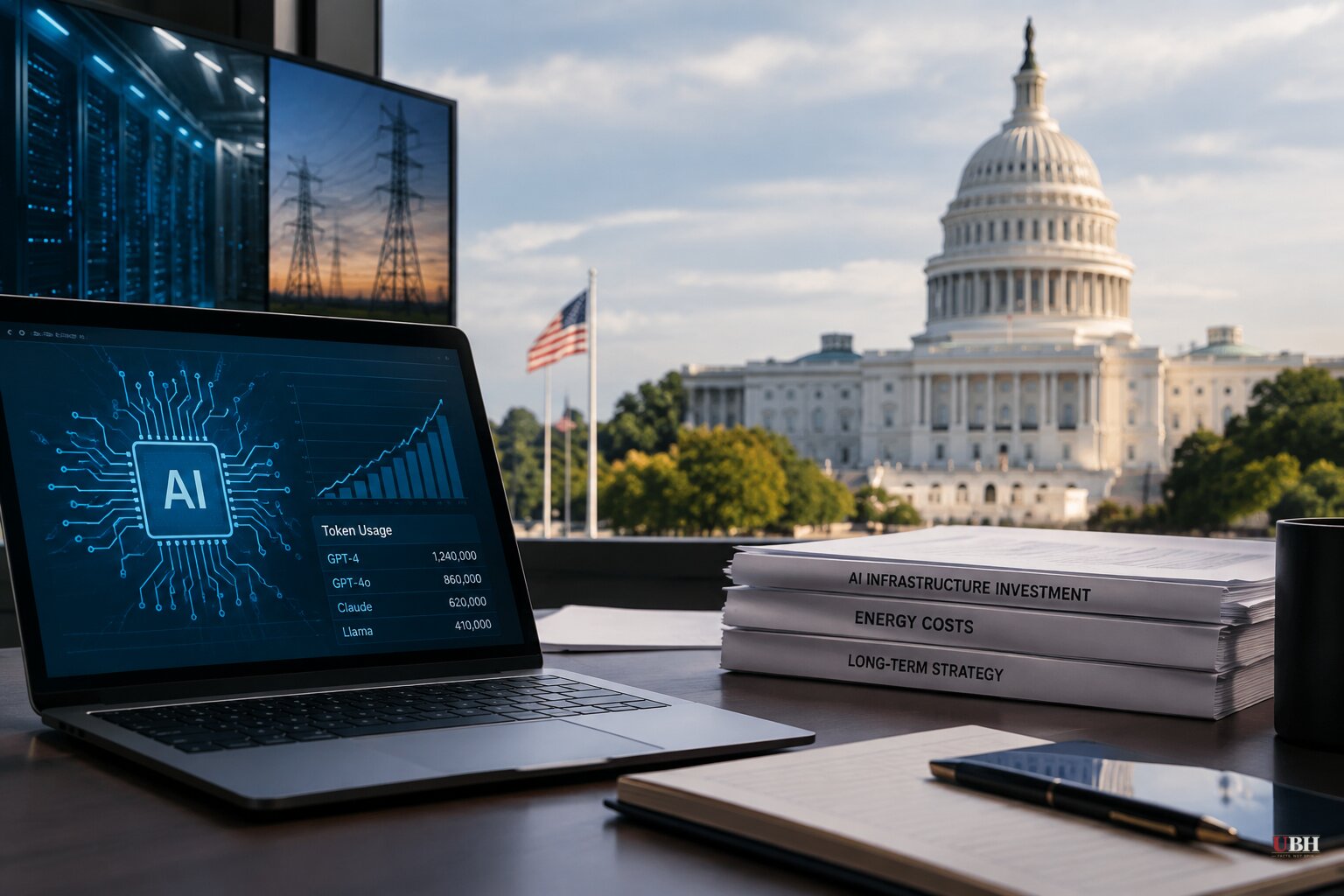
The AI bill is coming due, and it's showing up in three separate places at once: corporate budgets, the broader economy, and household electricity statements.
The Token Bill Nobody Budgeted For
Start with the boardroom. EY's AI Pulse Survey Wave 5, fielded April 24 through May 17, 2026 among 534 U.S. senior vice presidents and above across 10 industries, found that 98% of leaders at organizations using token-based AI tools say token usage and related costs have forced them to reconsider their AI approach, according to Flexera's reporting on the survey. EY's margin of error on the survey is plus or minus 4 percentage points at a 95% confidence interval.
Flexera reports that 82% of senior leaders at AI-investing organizations are concerned about token costs, but only 64% say their companies actively monitor token usage with clear budgets and spending guardrails. More than a third of leaders worried about the cost have no real system tracking it.
Flexera's own 2026 State of the Cloud Report adds context: 85% of respondents rank managing cloud spend as a leading challenge, and cost has outranked security as the top concern for four straight years. AI didn't create the cost-visibility problem. It made an existing one worse, because a single user request in an agentic workflow can now trigger dozens of model calls across multiple tools. Most finance teams, cloud teams, and procurement departments are each seeing only their own slice of the bill.
Whiteboard Strategies, a small-business consulting outfit, zeroed in on a specific mechanism: reasoning tokens. These are the internal steps a model takes before it answers, they're often billed at a premium, and on many tools the default setting is the expensive one. The firm points to a review published August 16, 2026 by developer Simon Willison of Alibaba's Qwen 3.8 27B open-weights model. At the model's default reasoning setting, generating a single SVG image consumed 22,276 reasoning tokens and took 21 minutes. Most consumer AI products don't display token consumption at all. They show a monthly total, which means business owners are trying to manage a variable cost with a fixed-cost dashboard.
The same firm also warned that promotional AI pricing isn't a stable cost structure, pointing to DeepSeek's API price increases as an example of how a business built on an introductory rate can see its margins evaporate once a provider changes its pricing.
The Trillion-Dollar Macro Question
AI infrastructure spending, meaning data centers, chips, and servers, is on pace to hit roughly $1 trillion in 2026, according to JPMorgan. That's more than the federal government spends annually on the military. Columbia University economist Stijn Van Nieuwerburgh, in a paper published through the Brookings Institution, projects that figure will reach $10.3 trillion cumulatively through 2032.
Goldman Sachs estimates AI infrastructure spending will represent 1.9% of U.S. economic activity this year, a share Van Nieuwerburgh projects will roughly double to average 3.6% of GDP annually through 2032. CNN's David Goldman frames this, alongside the energy shock from the wars in Iran and Ukraine and an escalating trade war with Canada, as one of three forces pushing inflation and interest rates higher at a moment when unemployment is already low and consumer spending is already strong. Van Nieuwerburgh's own framing, per Goldman's reporting, is that the AI buildout will restructure the U.S. economy more than the canals, railroads, electrical grid, highways, or telecom networks did before it.
The Senate Punts on Electricity Costs
That spending has a direct line to household bills, because data centers draw enormous amounts of electricity from the same grids homeowners pay into. The Ratepayer Protection Act would have required state regulators to consider forcing data centers and other major electricity users to bear the infrastructure costs their demand creates. It passed the House 417 to 3 earlier in September 2026.
The Senate rejected it anyway, 57 to 43, on Wednesday, September 30, 2026, according to Al Jazeera, falling short of the 60 votes needed to clear a filibuster. Only four Democrats, Maggie Hassan, Amy Klobuchar, Jon Ossoff, and Raphael Warnock, joined Republicans in support.
Supporters of the bill argued it was a modest, bipartisan first step that would have at least put the cost-shifting question in front of state regulators, who would weigh whether households should keep subsidizing data center demand through rising rates. That's a fair reading of why it sailed through the House nearly unanimously.
Senate Democratic leader Chuck Schumer called the bill "toothless," arguing it only required states to "consider" a rate standard rather than mandating that data centers cover their own infrastructure upgrade costs. He challenged Republicans to instead pass what he described as a Democratic alternative with real enforcement teeth. Other critics, per Al Jazeera, described the bill as a last-minute Republican push for a legislative win ahead of the November midterms. There are an estimated 5,400 data centers operating in the U.S. currently, according to some estimates cited by Al Jazeera, and none of them are now required by federal law to absorb the grid costs their power demand generates.
No replacement bill has been introduced in the Senate as of this writing. Households in states with heavy data center buildouts are left waiting on state regulators, who still have no federal mandate either way, while corporate AI budgets keep getting blindsided by a cost structure most finance departments still can't fully see.
Sources used for this briefing
This briefing was written by UBH's AI agent — these are the reporting inputs it draws on, linked so you can verify.


