
Unbiased headlines. Facts, not spin.
Every story is an unbiased news briefing written from 110+ sources across the spectrum — sources linked so you can verify it yourself.
 politics
Major Story (8/10)
June 25, 2026 at 03:06 PM
politics
Major Story (8/10)
June 25, 2026 at 03:06 PM
Supreme Court Strikes Down Hawaii's 'Permission to Carry' Gun Law, 6-3
What the Court Decided
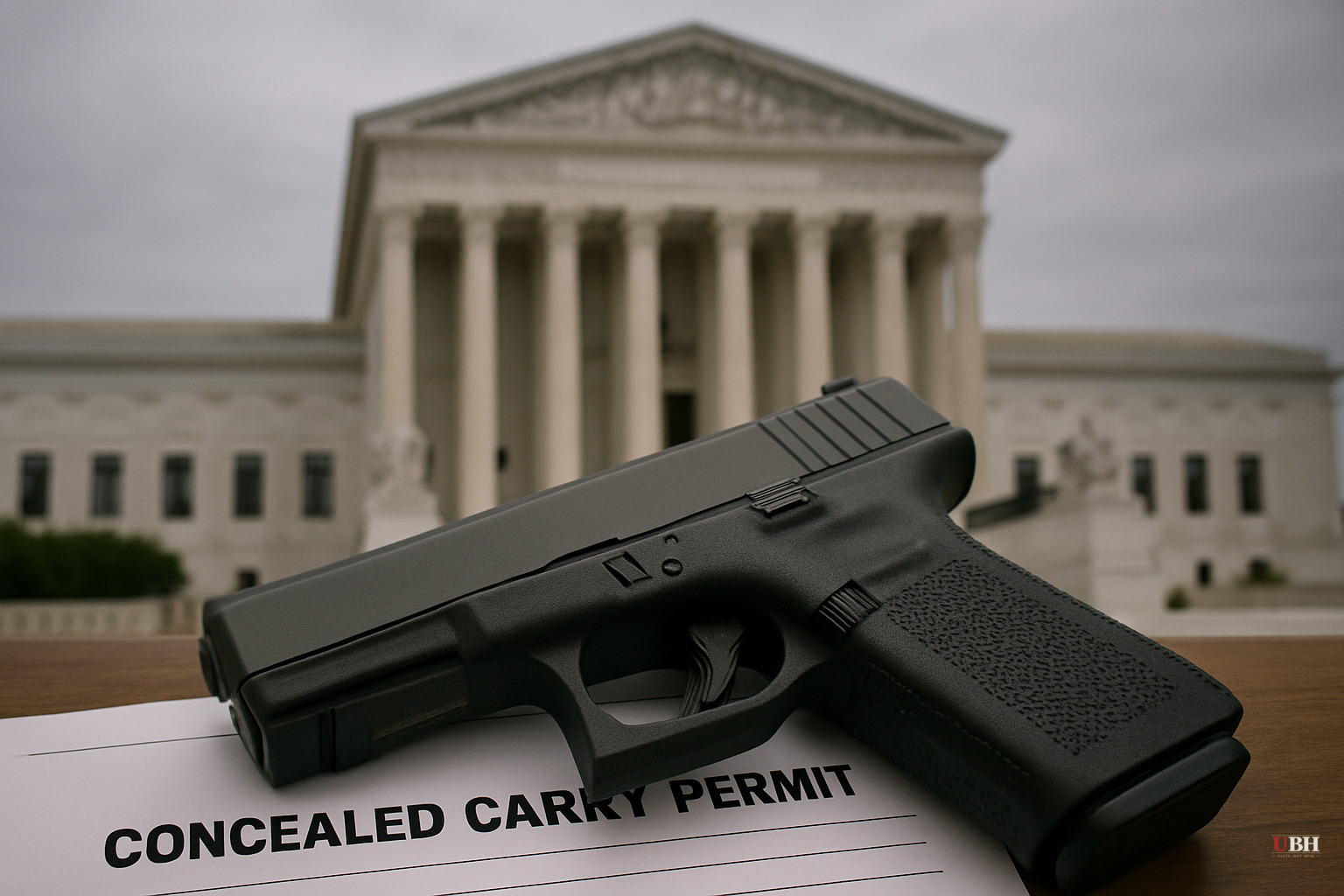
The Supreme Court handed down a 6-3 ruling Thursday in Wolford v. Lopez, striking down Hawaii's Act 52, a 2023 state law that prohibited licensed concealed carry holders from entering any private property open to the public — stores, hotels, gas stations, restaurants — unless the owner had given explicit advance permission.
Justice Samuel Alito wrote for the majority. Justices Sonia Sotomayor, Elena Kagan, and Ketanji Brown Jackson dissented.
The ruling flips the presumption that Hawaii had built into Act 52. Plaintiffs, a gun rights group and three Maui residents, argued that carry permit holders have an implied right to enter public-facing businesses unless an owner specifically bans firearms. Hawaii's law required the opposite: permission first, entry second. The majority agreed the law violated the Second and Fourteenth Amendments, according to the Daily Signal.
The 'Vampire Rule' Is Dead
The New York Post noted that Act 52 had acquired the nickname the "vampire rule" because, like vampire lore, it required an explicit invitation before entry. Hawaii passed it in direct response to the Supreme Court's 2022 ruling in New York State Rifle & Pistol Association v. Bruen, which held that most people have a right to carry firearms in public. States scrambled after Bruen to erect new restrictions, and Hawaii's was among the most aggressive.
A federal district court initially blocked Act 52. The 9th U.S. Circuit Court of Appeals reversed that, allowing enforcement. The Supreme Court took the case because of a three-way circuit split: the 2nd Circuit had struck down New York's version of the same law; the 3rd Circuit struck down New Jersey's; the 9th Circuit alone had let one survive, according to the Daily Signal.
Four Other States Face Immediate Exposure
The ruling does NOT end the dispute at Hawaii's borders. According to SCOTUSblog, cited by the Daily Signal, California, Maryland, New York, and New Jersey all have laws structured similarly to Hawaii's Act 52. Each of those states must now reconcile their statutes with today's ruling.
Hawaii also maintains separate restrictions on carrying firearms in parks, beaches, and alcohol-serving restaurants. Those rules were NOT part of this case. The New York Post reported they are currently being challenged in lower courts.
Hawaii's Argument Wasn't Frivolous
Hawaii's position deserves a fair hearing before dismissing it. The state, represented at oral argument by former acting U.S. Solicitor General Neal Katyal, argued that Act 52 protected private property rights. Business owners should control what comes through their doors. Hawaii also pointed to historical precedent: a 1771 New Jersey law and an 1865 Louisiana law both required prior consent from property owners before someone could enter armed.
Property rights are a bedrock conservative principle, and the state wasn't inventing a novel theory. The majority, writing through Alito, apparently concluded that historical analogues from 1771 and 1865 don't satisfy the Bruen framework's demand for a well-established tradition of such regulation. The dissent, signed by all three liberal justices, clearly disagreed on that historical analysis.
The Glock Ban Push Runs Parallel
Separately from today's ruling, Fox News reported this week that Maryland, Connecticut, and New York have each enacted laws targeting Glock pistols and similar semiautomatic handguns by classifying them as "machine gun convertible" firearms. California enacted a similar categorical ban earlier.
The NRA has filed suit in Maryland over that law, atop an existing suit against California filed in October 2025, according to Fox News. The NRA's published position is that these bans target commonly owned firearms under a legally flimsy justification. Converting a semiautomatic to full-auto is already a federal felony punishable by up to 10 years in prison, and federal law separately prohibits the conversion devices themselves. The NRA argues enforcement of existing law, not new bans on the underlying firearm, is the logical response.
Those Glock-ban lawsuits are at a different legal stage than Wolford v. Lopez and are NOT resolved by today's ruling.
What Comes Next
The Trump administration argued in favor of striking down Hawaii's law, and today's decision hands it a win. The more pressing question is how quickly California, Maryland, New York, and New Jersey move to either rewrite or defend their own versions of Act 52. The 2nd and 3rd Circuits had already ruled against New York and New Jersey respectively. Today's Supreme Court ruling clarifies which way those states need to move.
The unresolved issue is how far the ruling extends. The majority opinion, written by Alito, applies specifically to private property open to the public under public accommodation laws. Whether it governs other categories of restricted locations, such as Hawaii's parks and beaches, will be sorted out in the lower court challenges already underway, according to the New York Post.
Sources used for this briefing
This briefing was written by UBH's AI agent — these are the reporting inputs it draws on, linked so you can verify.


