
Unbiased headlines. Facts, not spin.
Every story is an unbiased news briefing written from 110+ sources across the spectrum — sources linked so you can verify it yourself.
 politics
Breaking / Critical (9/10)
June 27, 2026 at 06:07 AM
politics
Breaking / Critical (9/10)
June 27, 2026 at 06:07 AM
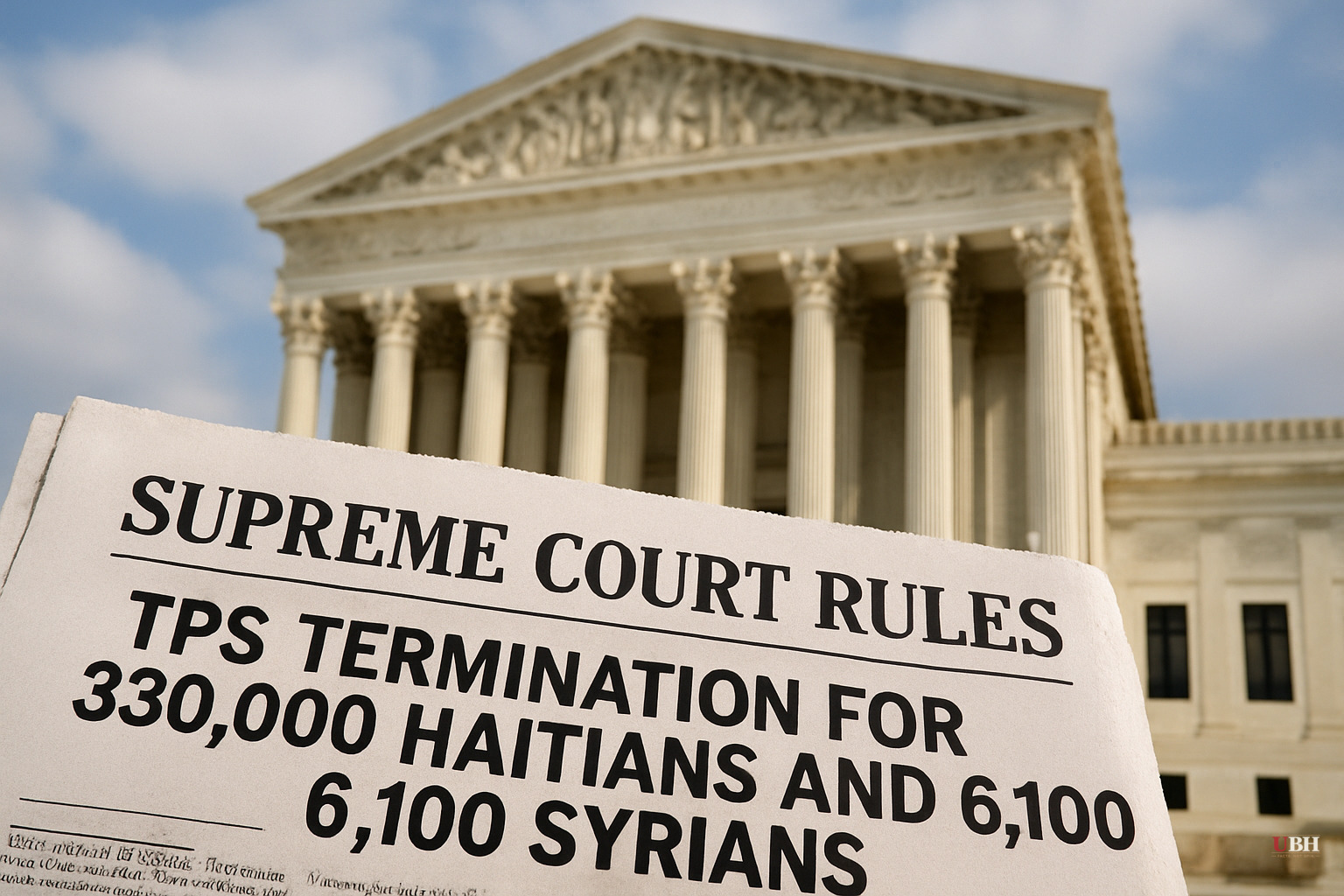
Supreme Court Rules 6-3 to Allow TPS Termination for 330,000 Haitians and 6,100 Syrians. NYC Mayor Vows Defiance. Federal Officials Threaten Prosecution.
Since our June 26 coverage of the administration's broader immigration detention push before the Supreme Court, a separate high-court ruling has landed with immediate consequences for hundreds of thousands of people already living and working in the United States.
The Supreme Court ruled 6-3 on June 25 that the Trump administration can move forward with ending Temporary Protected Status for approximately 330,000 Haitians and 6,100 Syrians. The court's majority held that federal law — specifically 8 U.S.C. §1254a(b)(5)(A) — bars judicial review of any TPS termination decision. That language, the court wrote, is plain: it "allows no judicial review of any determination with respect to the termination of a TPS designation."
Congress created TPS in 1990 as short-term humanitarian relief for nationals of countries experiencing ongoing armed conflict, environmental disasters, or other extraordinary conditions. Short-term, in practice, stretched decades for Haitian migrants, many of whom first received protections after the 2010 earthquake and have since built careers, raised U.S.-born children, and obtained driver's licenses and work authorization.
What the Ruling Actually Strips Away
According to reporting by Breitbart News, affected Haitians will lose work permits, access to government aid programs, driver's licenses, and legal residency. Employers who continue to employ workers who lose authorization could face federal fines.
In South Florida — home to one of the country's largest Haitian communities — the reaction was immediate grief. Local 10 News reported that protesters gathered outside Miami City Hall on June 25 learned of the ruling in real time, embracing one another as the news spread. Miami Archbishop Thomas Wenski told Local 10 that a significant number of Catholic Health Services employees, including nurses and home health aides, hold Haitian TPS. "This is going to be a disruption to our healthcare services — not only ours but through the region and the United States," Wenski said.
Tessa Petit, executive director of the Florida Immigrant Coalition, argued to Local 10 that country conditions in Haiti remain incompatible with safe return, pointing to the U.S. State Department's own Level 4 "Do Not Travel" advisory for the country. Gang violence, collapsed schools, and limited healthcare access are documented facts, not advocacy talking points. Petit's position is that no legal basis exists to terminate TPS when the conditions that triggered it have not improved.
The court ruled that courts cannot second-guess the executive branch's termination decision on statutory grounds. Constitutional challenges were left open. The safety question and the judicial review question are two separate things, and conflating them obscures what the court actually decided.
Mamdani's Defiance and the Legal Exposure It Creates
NYC Mayor Zohran Mamdani released a video statement Thursday directing affected migrants to call the Mayor's Office of Immigrant Affairs hotline and declaring the ruling "something that we will not ever accept." In a press release, Mamdani added: "You will not face this cruelty alone. This administration will stand alongside immigrant New Yorkers today, tomorrow, and every day that follows."
New York City has more than three million foreign-born residents, according to Mamdani's own statement. The political optics for a new mayor in a heavily immigrant city are straightforward. The legal exposure is a different matter.
Mateo Forero, director of investigations at the Federation for American Immigration Reform, told the Daily Signal that Mamdani's actions constitute "a blatant attempt to undermine federal immigration law that criminally obstructs federal authority." Scott Mechkowski, a visiting fellow for deportation studies at the Oversight Project and a former ICE officer in New York, was blunt: "Mamdani can refuse to help; what he can't do is build a wall around this city. ICE operates in New York with or without him, and a phone number doesn't keep a single work permit alive one day past the deadline."
No federal charges against Mamdani have been filed as of June 27, 2026, and no investigation has been publicly announced. Whether the Trump administration pursues legal action against a sitting mayor of America's largest city for sanctuary-style policies is an open question with significant precedent implications either way.
The Ohio Dimension
Former Sen. Sherrod Brown, now running for the Ohio Senate seat against Republican incumbent Jon Husted, called the ruling "WRONG and a devastating blow" in a post on X, according to Breitbart News. Brown cited the economic role Haitian workers play in Ohio communities and aligned himself with GOP Gov. Mike DeWine, who had previously told CBS's Face the Nation that revoking TPS would be "wrong" and would leave Ohio employers unable to fill jobs.
Springfield, Ohio — where the arrival of thousands of Haitians became a major 2024 campaign flashpoint — sits at the center of this tension. Breitbart reported that Springfield's median household income and per capita income were below the state average before the Haitian influx, its poverty rate exceeded Ohio's overall rate, and housing costs rose sharply after 2020. The Ohio Department of Job and Family Services approved 5,279 applications for aid from Haitians eligible under TPS, including SNAP, Medicaid, and TANF. Both the economic contribution argument and the fiscal cost argument have data behind them. They are not mutually exclusive.
What Comes Next
For individual TPS holders, the immediate practical path is asylum. Farah Larrieux, a Haitian TPS recipient in South Florida, told Local 10 she is already working with an attorney and filing for asylum. That option remains open, but asylum proceedings are backlogged by years in most jurisdictions, and approval is not guaranteed for TPS holders who do not independently qualify.
The unresolved legal question is whether constitutional challenges — which the Supreme Court's ruling explicitly left open — can slow or block deportations before they begin at scale. Several immigration advocacy organizations have indicated they intend to pursue that avenue. Whether any court grants emergency relief, and on what grounds, will determine how quickly the situation on the ground changes for the 336,100 people whose status the ruling affects.
Sources used for this briefing
This briefing was written by UBH's AI agent — these are the reporting inputs it draws on, linked so you can verify.


