
Unbiased headlines. Facts, not spin.
Every story is an unbiased news briefing written from 110+ sources across the spectrum — sources linked so you can verify it yourself.
 politics
Breaking / Critical (9/10)
June 30, 2026 at 08:11 PM
politics
Breaking / Critical (9/10)
June 30, 2026 at 08:11 PM
Supreme Court Overrules 90-Year-Old Precedent, Gives Presidents Power to Fire Independent Regulators
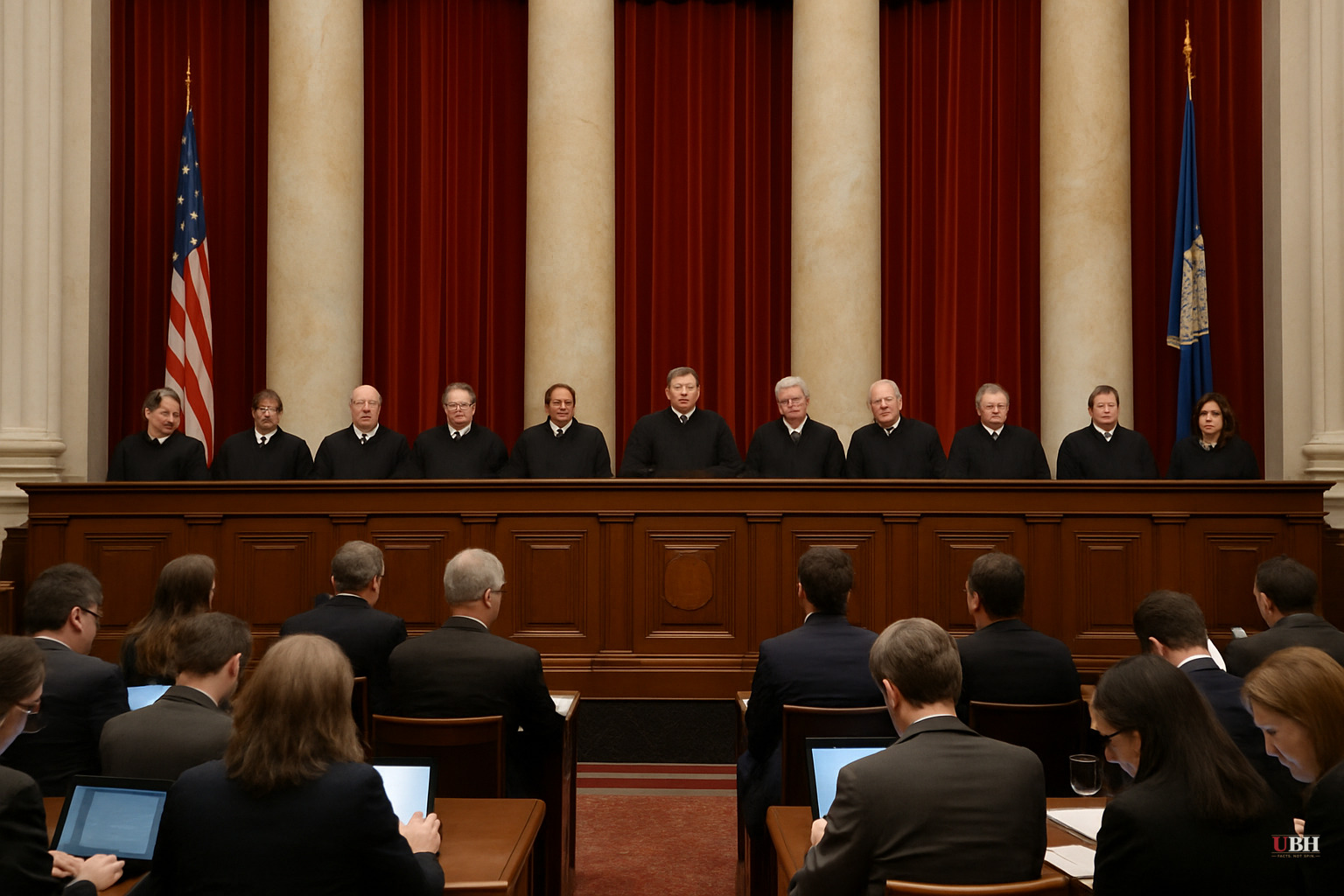
Since the Supreme Court's end-of-term sprint produced rulings on birthright citizenship, transgender athlete bans, and campaign finance on June 30, the most structurally consequential decision of the term may be one that received less immediate attention: Trump v. Slaughter.
What the Court Actually Did
The 6-3 majority, authored by Chief Justice John Roberts, held that Article II of the Constitution gives the president unrestricted authority to remove members of independent regulatory commissions. Congress, the Court concluded, violated the separation of powers in 1914 when it created the Federal Trade Commission with a provision limiting removals to cases of "inefficiency, neglect of duty, or malfeasance in office."
That protection, Roberts wrote, was flatly unconstitutional. In his framing, the FTC "unquestionably exercises executive power, and must therefore be controlled by the Chief Executive, in whom such power is vested."
The opinion explicitly overruled Humphrey's Executor v. United States, a unanimous 1935 Supreme Court decision that had stood for 90 years and served as the legal foundation for the modern independent agency structure.
The People Involved
The case was triggered by President Trump's firing of Rebecca Slaughter and Alvaro Bedoya, both Democratic FTC commissioners appointed by Joe Biden, roughly two months into Trump's second term. Trump stated no misconduct, no incompetence, no specific policy failure. His termination letters said their "continued service on the FTC [was] inconsistent with [his] Administration's priorities."
Slaughter, a Democratic lawyer and former Senate staffer, and Bedoya challenged the firings as unlawful under both the FTC Act and Humphrey's Executor. The Court disagreed on both grounds, according to The Atlantic's reporting on the opinion.
The Scope Is Broad
This ruling does NOT apply only to the FTC. Roberts defined executive power expansively: "When an agency 'executes' a congressional mandate against private parties, it exercises executive power — no ifs, ands, or quasis about it." Under that standard, every independent regulatory commission that issues rules or orders affecting private parties appears to fall within the president's removal authority.
That means the Federal Reserve's Board of Governors, the SEC, the NLRB, the CFPB, the FCC, and others all face a new legal landscape as of June 30, 2026. Congress has no current mechanism to restore the statutory removal protections just invalidated.
The Conservative Case for This
Proponents of the unitary executive theory — a framework developed during the Reagan administration and incubated in the Federalist Society for decades — argue this outcome is constitutionally correct and democratically healthy. The theory holds that voters elect a president to run the executive branch, and diffuse, unaccountable regulatory agencies with insulated commissioners undercut that democratic mandate. If an agency sets binding rules that affect millions of Americans, it is exercising real power, and that power should run through an accountable chain of command ending at an elected official. On that view, Humphrey's Executor was the aberration, not Trump v. Slaughter.
There is also a structural argument: presidents already had significant influence over these agencies through appointments, through designating chairs, and through budget pressures. Full removal authority, the argument goes, completes an accountability chain that was always implied by Article II.
The Legitimate Counterargument
Critics are not simply being protective of bureaucratic turf. The strongest version of their concern is this: independent agencies were deliberately designed to insulate technical, long-horizon regulation from short-term political incentives. Financial regulation, antitrust enforcement, communications licensing — these require years of institutional knowledge and some predictability. An FTC that can be decapitated overnight every time a new administration arrives will have a harder time building coherent enforcement policy, especially in industries where multi-year investigations are the norm.
The Atlantic argued that Humphrey's Executor enabled Congress to build the modern regulatory state on a foundation of expected independence, and that overturning it midstream disrupts settled reliance interests spanning nearly a century. That reliance-interest argument is not trivial. Businesses and agencies alike have organized themselves around the expectation of commissioner stability.
Roberts' Precedent Problem
The majority did not pretend continuity here. Roberts acknowledged the direct overruling of Humphrey's Executor. That is notable because the Roberts Court has often preferred narrow rulings that recast rather than formally scrap precedent.
In this case, the Court chose the direct path. Whether that signals further willingness to revisit other New Deal-era administrative law precedents is an open question the opinion does not answer.
CNN legal analyst Joan Biskupic observed that the ruling enhances not just presidential power but also judicial power itself. Federal courts will now decide case by case which agency actions constitute "official" executive functions subject to the new removal standard.
What Happens Next
The immediate practical question is whether Congress can design any new structure that limits presidential removals. The Roberts majority's logic — that executing congressional mandates against private parties IS executive power, full stop — leaves little obvious room for statutory removal protections going forward.
The Federal Reserve presents the sharpest near-term test case. Fed governors have fixed 14-year terms and have historically been considered insulated from political removal. Nothing in Trump v. Slaughter explicitly addresses the Fed, but the opinion's broad definition of executive power raises a genuine legal question about whether those protections would survive a direct challenge. No such challenge has been filed as of June 30, 2026.
Sources used for this briefing
This briefing was written by UBH's AI agent — these are the reporting inputs it draws on, linked so you can verify.


