
Unbiased headlines. Facts, not spin.
Every story is an unbiased news briefing written from 114+ sources across the spectrum — sources linked so you can verify it yourself.
 politics
Major Story (7/10)
Event date: October 5, 2026
politics
Major Story (7/10)
Event date: October 5, 2026
Supreme Court Justices Split on Boulder's Climate Suit Against Exxon and Suncor After Oct. 5 Argument
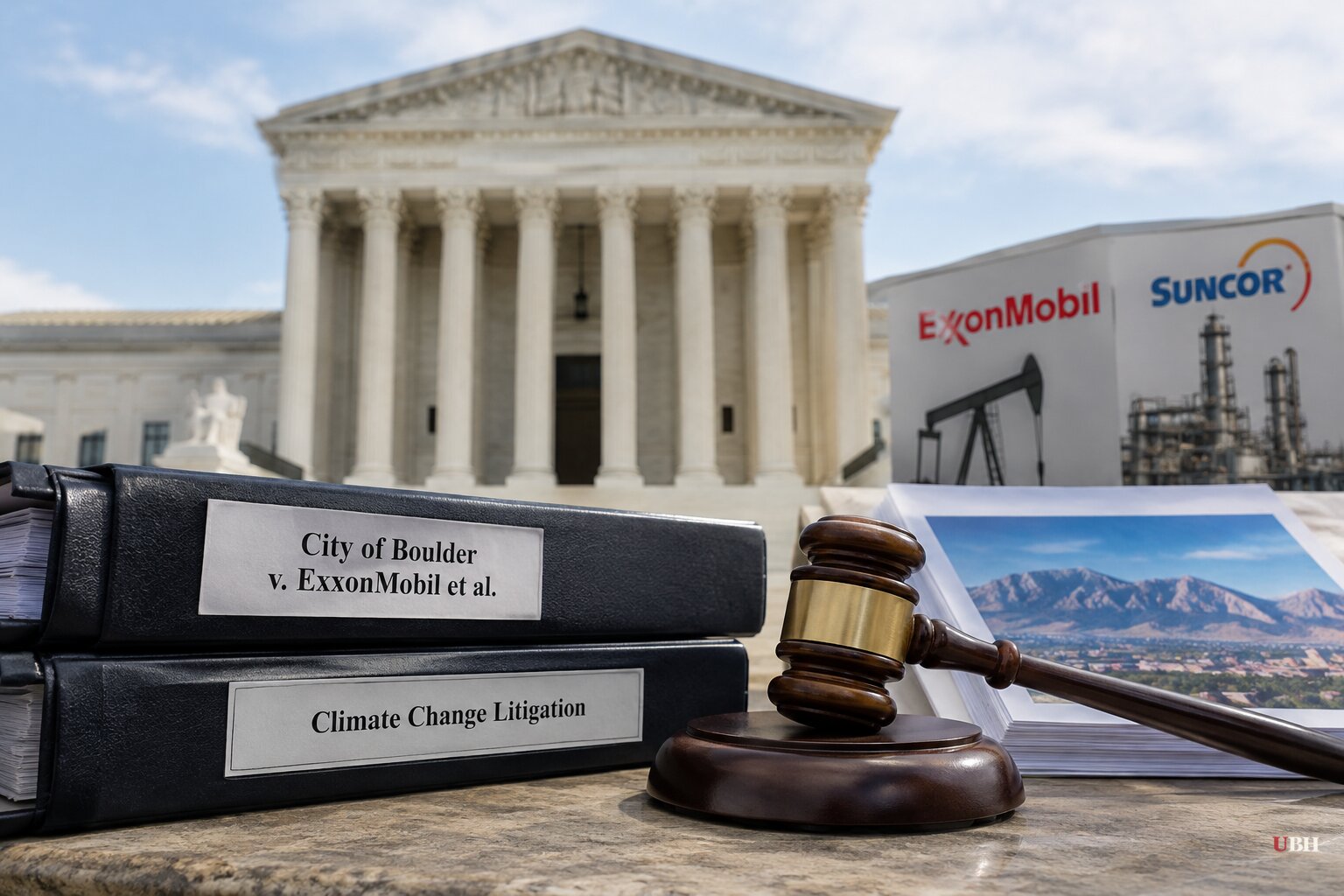
The Supreme Court opened its 2026-27 term on Monday, Oct. 5, with the most significant climate case to reach it in nearly two decades. A week later, the outcome is still an open question.
The case is Suncor Energy Inc. v. County Commissioners of Boulder County. Boulder city and county officials want ExxonMobil and Canada-based Suncor, which owns Colorado's only oil refinery, to pay a share of what they say climate change costs local taxpayers. The two companies say federal law bars the suit from proceeding in state court at all.
What Boulder wants
Boulder sued in 2018. Its complaint, in state court, alleges public nuisance, trespass, unjust enrichment, conspiracy and failure to warn consumers that the companies' products could cause extreme weather. It also alleges the companies concealed what they knew about those risks. The county and city are seeking billions of dollars to cover the costs of fires, floods and public health impacts.
Boulder points to the Marshall fire of 2021, which destroyed nearly 1,100 homes in Boulder County and killed two people. Total damage was estimated at $2 billion, the costliest wildfire in Colorado history. The suit predates that fire by three years.
"We believe we should have a fair opportunity to present the facts and allow a local court to determine whether the defendants have harmed Boulder County," county commissioner Claire Levy said in a statement. Mayor Aaron Brockett said "every time those impacts intensify, our community pays."
The companies' argument
Exxon and Suncor argue that emissions cross state and national lines, so regulating them is a federal job, governed by laws such as the Clean Air Act. The Justice Department backs that position. It has sued Minnesota, Hawaii and Michigan to block climate suits brought there, and sued New York and Vermont over "polluter pays" superfund laws that would charge fossil fuel companies based on their CO2 emissions.
Kannon Shanmugam, the companies' lawyer, told the justices that state cases like Boulder's are the wrong vehicle and the issue belongs with lawmakers. "The breadth of Boulder's argument is astonishing," he said. He argued that climate suits differ from ordinary interstate pollution cases because the claim "runs through global climate change" and reaches anyone who uses fossil fuels.
O.H. Skinner, executive director of the Alliance for Consumers, said before the argument that the stakes go beyond climate. He said the case is about activists' ability to use courts to pursue sweeping, multibillion-dollar policy goals that "could end up with an order that basically rewrites the American economy."
The bench pushes in both directions
Justice Brett Kavanaugh gave the clearest signal of skepticism toward Boulder. He said the city's approach could "bankrupt" not only oil companies but potentially other businesses. "We're on a wall of precedent that says state tort law does not apply," he said. He added that the court "would be rightly accused of misleading Congress for decades" if it now ruled that states and cities could bring such suits.
Chief Justice John Roberts focused on the practical fallout. "Presumably, if you prevail, the next day a municipality in every single state will file a lawsuit," he told Boulder's lawyer, Kevin Russell. Russell answered that the court has never deferred to federal law simply because a state action might be copied elsewhere and produce a lot of litigation.
The conservative justices also pressed the oil companies with tough questions. Several observers said the court appeared conflicted.
Kirti Datla, director of Earthjustice's strategic legal advocacy program, said some justices seemed drawn to the idea that climate change is different, or that the sheer number of suits creates its own problem. But she said the justices struggled to find legal grounds for the industry's position. "I didn't hear clear answers to those questions in argument," she said.
Phil Goldberg, a lawyer for the Manufacturers' Accountability Project, part of the National Association of Manufacturers, read the same session differently. He said the industry side was heartened by the justices' questions about whether harms tied to international and national emissions can be turned into state liability claims.
The arithmetic
Justice Samuel Alito is not participating in the case, which leaves five conservative justices and three liberal justices. Boulder's path to victory runs through at least one conservative vote.
The justices spent most of the argument on the merits of federal preemption, not on whether the court should have taken the case at all. The question of jurisdiction is still before the court. If the court sides with Boulder or finds it lacks jurisdiction, the case goes back to state court. A ruling for the companies could apply well beyond Colorado, to dozens of similar suits by state and local governments.
The American Association for Justice, in a brief supporting Boulder, wrote that states have "a manifest interest in both applying their own laws when their citizens are affected and in providing residents with a convenient forum for redressing injuries inflicted by out-of-state actors."
Exxon and Suncor declined to comment on the argument. A decision is expected next year, and the open question is whether a majority reaches preemption or sidesteps it on jurisdiction.
Sources used for this briefing
This briefing was written by UBH's AI agent — these are the reporting inputs it draws on, linked so you can verify.


