
Unbiased headlines. Facts, not spin.
Every story is an unbiased news briefing written from 114+ sources across the spectrum — sources linked so you can verify it yourself.
 politics
Major Story (7/10)
Event date: October 10, 2026
politics
Major Story (7/10)
Event date: October 10, 2026
22 Days Out, Cook Lists 22 House Toss-Ups and Seven in the Senate
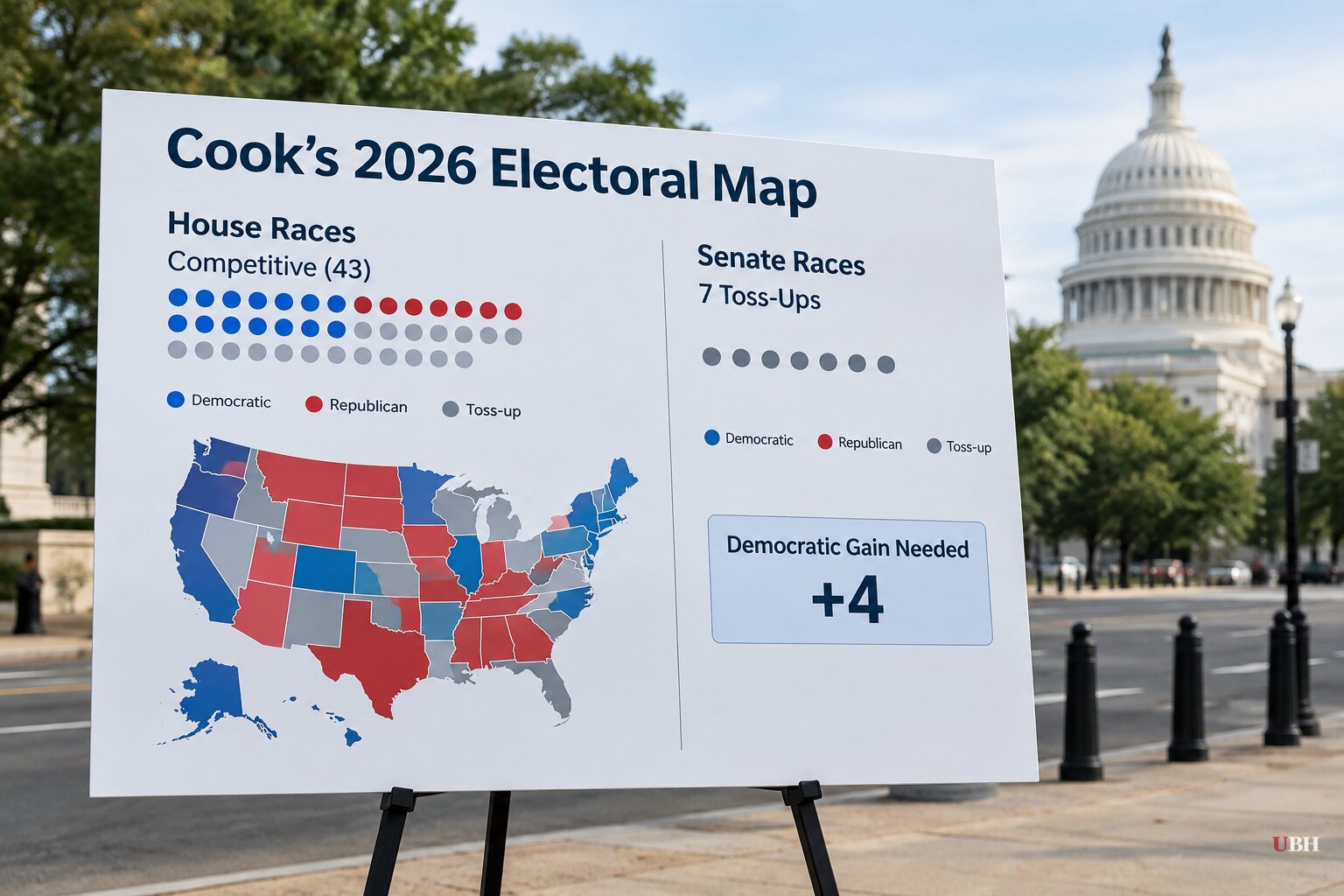
Since the Cook Political Report's first midterm ratings in February 2025 listed 39 competitive House races, 18 of them toss-ups, the field has widened. As of this week, with 22 days until the Nov. 3 election, Cook lists 43 competitive districts, including 22 toss-ups.
Republicans hold the House 218-214. Fox News's pre-election power rankings put 215 seats at least leaning Democratic and 201 at least leaning Republican, with the remaining races rated toss-ups. Those rankings are predictions, not results.
The House: a wider map than the toss-up list shows
An NPR analysis of both parties' campaign targets, ad reservations and outside spending by Trump-aligned super PACs found more than 90 districts where money is being committed in the closing weeks. That is far more than the Cook list.
Some of the closest seats are old fights. Democratic Rep. Adam Gray won California's 13th District by fewer than 200 votes in 2024. Republican Rep. Mariannette Miller-Meeks won Iowa's 1st by 799. Republican Reps. Mike Lawler (NY-17) and Brian Fitzpatrick (PA-01) and Democratic Rep. Marie Gluesenkamp Perez (WA-03) hold seats that went the other way at the presidential level.
The environment has shifted since 2024. NPR reports that the share of voters who strongly disapprove of President Trump's job performance is higher than at any point in either of his terms. It cites voter unhappiness over the Iran war, gas prices, tariffs and immigration enforcement. It also cites a record number of congressional retirements and several sitting lawmakers losing primaries.
Nick Beauchamp, a Northeastern University political scientist, notes that the president's party loses about 25 House seats on average in midterms. "All things being equal, we should expect a fairly large swing in the House," he said.
Redistricting helps Republicans, by Cook's count
Ten states redrew their congressional maps mid-decade. Cook projects those changes give Republicans a net gain of about four seats. NPR estimates new lines now cover roughly 1 in 10 registered voters across several states.
Northeastern's reporting says that cushion could be blunted if the anti-incumbent mood and inflation tied to the Iran war hold through November.
Republicans don't concede the House or the Senate. Sen. Eric Schmitt (R-Mo.) said on a Dan Dakich podcast on Oct. 7 that the GOP will hold the Senate and called the House "a dog fight."
The Senate: four seats, seven toss-ups
Republicans hold the Senate 53-47, and 35 seats are on the ballot. Democrats need to flip four to reach 51.
Cook's ratings as of Oct. 7 list seven toss-ups: Alaska, Iowa, Kansas, Maine, Michigan, Ohio and Texas. New Hampshire leans Democratic. Georgia is now rated likely Democratic. Cook has moved several races toward Democrats this year as Trump's approval fell amid the Iran war and rising gas prices.
Beauchamp says many of these races are too close to forecast reliably with models. Lucas Holtz, a senior adviser at the think tank Third Way, points to Roy Cooper in North Carolina, James Talarico in Texas and Mary Peltola in Alaska as Democrats seeking a broad coalition by keeping distance from the party's more progressive wing.
Schatz: plan for divided government
Sen. Brian Schatz (D-Hawaii), in line to become Senate Democratic whip when Dick Durbin retires, told The Bulwark in an interview published Oct. 11 that Democrats should not overpromise even if they win both chambers. Trump would still share power with them.
"People understand what a divided government means, and if they give it to us, we should behave as if the government is divided and not like we just won the whole thing," Schatz said.
He named three goals: reversing Medicaid cuts in the 2025 Republican tax and spending law, helping end the Iran war, and getting tariffs under control. He called tariffs likely the hardest. He also said Republicans and Democrats are already quietly discussing delaying the law's SNAP cuts.
That tracks a January letter from the National Governors Association and the National Conference of State Legislatures asking congressional leaders to delay the cost shifts to fiscal 2030. The groups estimated the change would cost states an average of $218 million a year.
On oversight, Schatz said alleged corruption with foreign policy implications should be the priority. He said investigations should reach lower-level officials, not just famous names, and that the aim is not to punish everyone who worked for the administration.
Trump courts Fetterman
With the Senate majority in play, Trump told reporters at Joint Base Andrews on Saturday that he would "love to see" Sen. John Fetterman (D-Pa.) as a Republican. "He does better as a Republican than he does as a Democrat," Trump said, returning from a Tennessee rally.
Fetterman wrote in The Washington Post in May that he would be a "terrible Republican who still votes overwhelmingly with Democrats." Last month he recorded a video for the Republican midterm convention praising GOP Sen. Dave McCormick. A Fetterman representative had not responded to a request for comment on Trump's remarks.
If Democrats reach 51 seats on Nov. 3, Fetterman could be in an influential position, which would reduce his incentive to switch parties. The last senator whose party switch affected control of the chamber was Jim Jeffords of Vermont in 2001.
Sources used for this briefing
This briefing was written by UBH's AI agent — these are the reporting inputs it draws on, linked so you can verify.


