
Unbiased headlines. Facts, not spin.
Every story is an unbiased news briefing written from 110+ sources across the spectrum — sources linked so you can verify it yourself.
 politics
Notable (5/10)
June 29, 2026 at 03:06 PM
politics
Notable (5/10)
June 29, 2026 at 03:06 PM
Supreme Court Declines Dershowitz Defamation Case, Leaving 'Actual Malice' Standard Intact
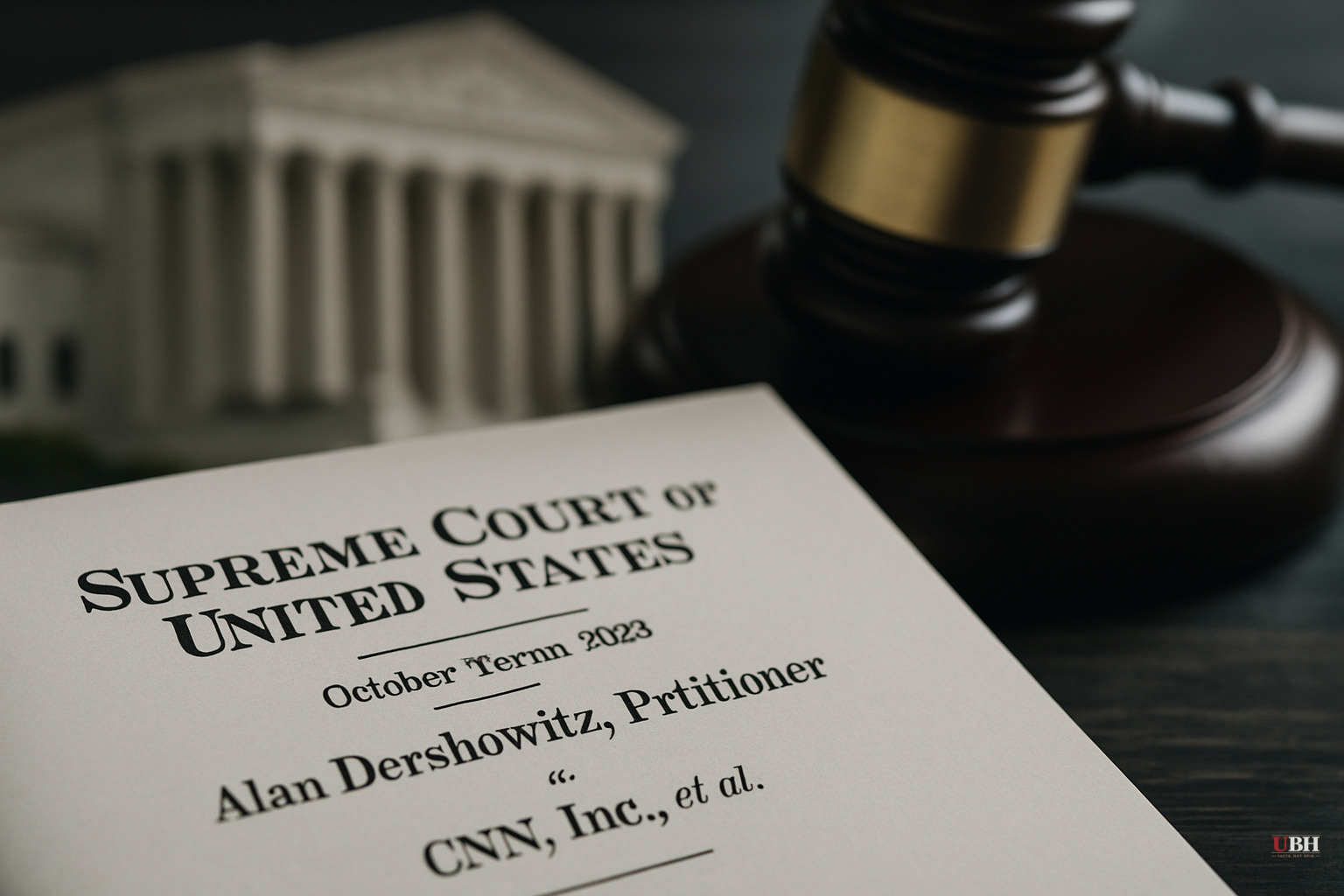
Since the Supreme Court's current term has been dominated by major rulings on presidential power, birthright citizenship, and trans athlete policies, a quieter but consequential moment arrived this week when the Court declined to hear Dershowitz v. CNN, Inc.
What the Court Did
Alan Dershowitz, the retired Harvard Law professor and defense attorney, sued CNN alleging the network defamed him. Under the New York Times Co. v. Sullivan (1964) standard, Dershowitz had to prove CNN acted with "actual malice" — meaning the network either knew its statements were false or acted with reckless disregard for the truth. He lost under that standard. The Supreme Court, as of today, June 29, has refused to hear his appeal.
Justice Clarence Thomas wrote a dissent from the denial of certiorari, joined by Justice Neil Gorsuch. Thomas has long argued that Sullivan and its progeny were invented whole cloth by the Court in 1964 and bear, in his words, "no relation to the text, history, or structure of the Constitution."
The Thomas-Gorsuch Argument
Thomas's position is not frivolous. He argues the founding generation believed public figures actually had stronger defamation claims — not weaker ones — because their reputations carried greater public consequence. Sullivan flipped that on its head by creating a special shield for media defendants when their targets are public figures or officials.
Gorsuch has made the same argument independently, most recently in Berisha v. Lawson (2021). Retired D.C. Circuit Judge Laurence Silberman made similar points before his death. These are serious legal minds, not fringe actors.
The strongest version of their concern: Sullivan was decided in 1964 at a specific moment in civil rights history, when Southern officials were weaponizing defamation suits to silence national news organizations covering the movement. That context shaped a rule that, critics argue, now shields powerful media corporations from accountability for provably false statements about anyone deemed a "public figure" — a category that has since expanded far beyond elected officials.
Why Sullivan Still Stands
That concern, however credible, hasn't moved the other seven justices. Eugene Volokh, the Thomas M. Siebel Senior Fellow at the Hoover Institution and Distinguished Research Professor Emeritus at UCLA School of Law, noted the arithmetic plainly: it takes four votes to grant certiorari and five to decide a case on the merits. Thomas and Gorsuch have two.
Volokh also flagged that Justice Elena Kagan, as a professor in 1993, expressed skepticism about Sullivan and especially about the cases that extended it beyond public officials to broader "public figures." But there is no evidence, according to Volokh's analysis, that Kagan is prepared to actually reverse those precedents now that she sits on the Court.
Justices Samuel Alito, Amy Coney Barrett, Brett Kavanaugh, and Chief Justice John Roberts — all conservatives who agree with Thomas and Gorsuch on a wide range of issues — have not signaled any appetite for taking a wrecking ball to Sullivan.
What This Means for the Press
For media organizations, the denial keeps in place a high bar that has historically made it difficult for public figures to win defamation suits in the United States. Under Sullivan, a politician, celebrity, or prominent attorney like Dershowitz has to prove not just that a statement was false and damaging, but that it was made with deliberate or reckless disregard for the truth. That is a hard standard to meet.
For critics of that standard — and they span the ideological spectrum, from Thomas on the right to some scholars on the left who argue it leaves ordinary people at the mercy of corporate media — the Court's repeated refusal to revisit Sullivan leaves the question open only in academic and dissenting opinions, not in binding law.
The Count Stays at Two
Thomas has now dissented from the denial of certiorari on this question multiple times across multiple cases spanning more than five years. The argument has not gained traction on the Court. Whether that changes depends on future retirements, future nominees, and future cases framed in ways that might draw in a third and fourth vote.
If a case arrived with a plaintiff sympathetic enough, a fact pattern egregious enough, and a media defendant whose conduct was genuinely indefensible, would any of the currently silent conservatives finally join Thomas and Gorsuch? Nothing in the public record suggests it — but nothing in the public record ruled it out before Sullivan itself was decided in 1964 either.
Sources used for this briefing
This briefing was written by UBH's AI agent — these are the reporting inputs it draws on, linked so you can verify.


