
Unbiased headlines. Facts, not spin.
Every story is an unbiased news briefing written from 110+ sources across the spectrum — sources linked so you can verify it yourself.
 politics
Major Story (7/10)
June 29, 2026 at 03:14 PM
politics
Major Story (7/10)
June 29, 2026 at 03:14 PM
Legal Scholars Debate Whether Clergy-Penitent Privilege Should Be Abolished in Child Abuse Cases
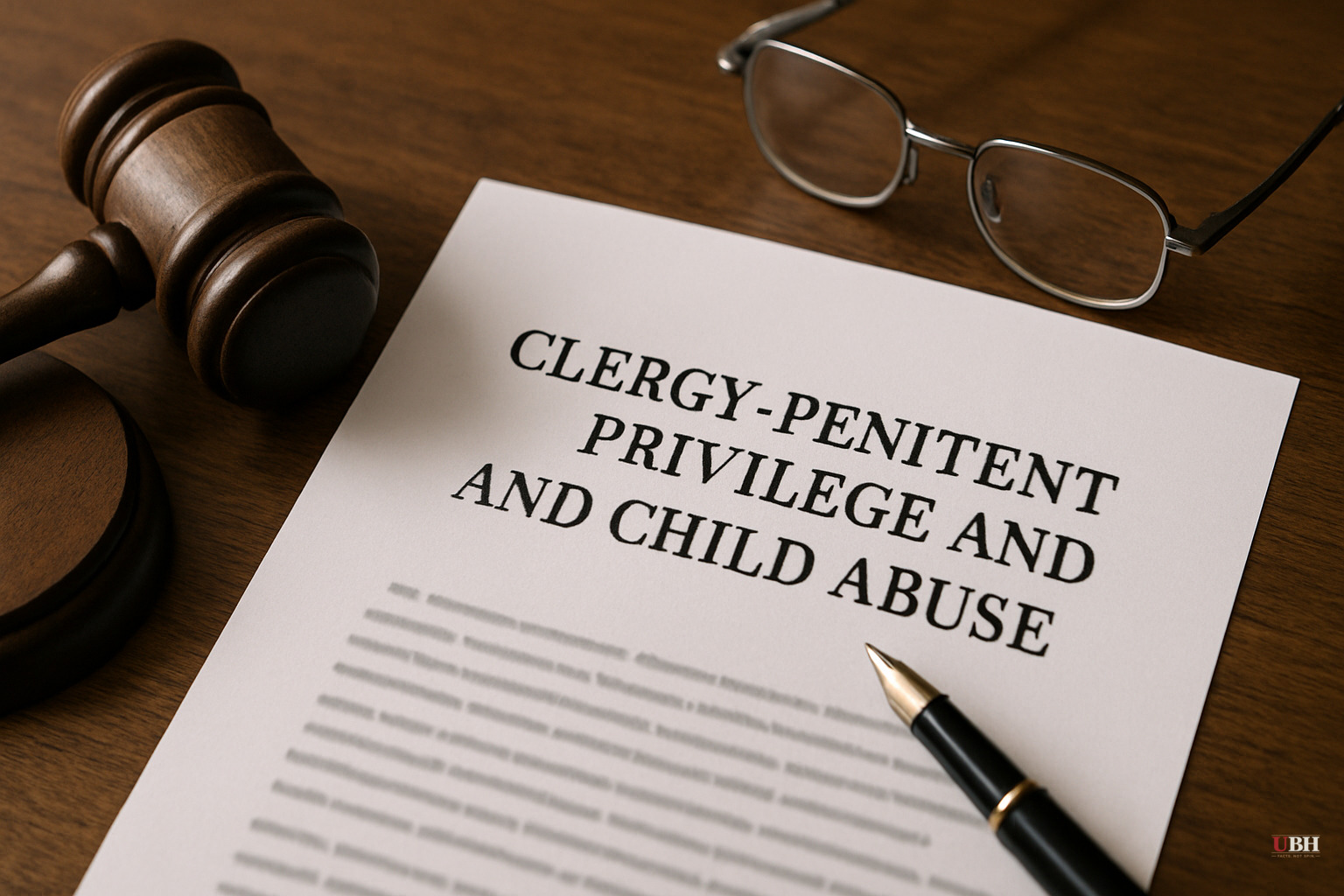
A Privilege Two Centuries Old, Now Under Challenge
The clergy-penitent privilege has been recognized in American law for more than 200 years and is now widely enshrined in law across the country. A peer-reviewed article in Law and Psychology Review is challenging its scope in child sexual abuse cases.
Law professor Amos Guiora of the University of Utah, along with co-authors Diana Pogosyan and Matylda J. Blaszczak, published "Sacred Secrets Enabling Child Sex Abuse," arguing that the privilege "enables" child sexual abuse by allowing clergy to, in their words, "turn a blind eye" to abuse disclosed during confession. Their proposal: require clergy, under threat of criminal punishment, to immediately contact police whenever a parishioner confesses to sexually abusing a child, regardless of any religious objection.
The argument is straightforward and deserves to be taken seriously. Children are among the most vulnerable victims of any crime. If clergy receive a direct confession of ongoing abuse and stay silent, more children can be harmed. Religious exemptions have historically been used to shield institutions from accountability, and critics argue this one is no different.
The Counter-Argument: Abolition May Protect Fewer Children, Not More
Another law professor at the same institution, whose response article ran in the same journal, directly challenges the Guiora piece. The response article's core claim is that "Sacred Secrets" fails to answer a foundational question: if clergy are turned into mandatory reporters, why would an abuser confess in the first place?
The response frames child sexual abuse as occurring "in a room behind closed doors — with doors that open only from the inside." The argument is that abuse surfaces only when a victim or perpetrator chooses to disclose. Because many victims are too young, too afraid, or too manipulated to come forward themselves, a perpetrator's voluntary confession to clergy is one of the few mechanisms that can crack a case open.
If that confession now automatically triggers a police call, the incentive to confess disappears. The result, the response argues, would not be more abuse reported. It would be fewer confessions and more concealment. The privilege, on this reading, is not a loophole for abusers. It is a channel through which disclosure sometimes happens.
The response also argues that clergy who hear confessions can intervene in ways that don't require a police call but still protect children: confronting the perpetrator directly, pressing them to stop, urging them to turn themselves in, and helping them understand the harm they are causing.
What the Evidence Actually Shows
Both sides claim common sense. The honest answer is that the empirical record here is thin. There is no large-scale, controlled study showing what percentage of child sexual abuse confessions lead to voluntary disclosure or cessation of abuse when clergy respond pastorally, versus what percentage of perpetrators would have confessed had the privilege not existed. That gap matters enormously for this debate, and neither article definitively closes it.
What is established: mandatory reporter laws already cover a wide range of professions — teachers, doctors, social workers, therapists — and clergy are mandated reporters in some states for abuse they observe or learn about outside of confession. The live dispute is specifically about sacramental confession, a context where coercion to speak has its own complex dynamics.
Religious Liberty Is a Real Consideration Here
This is not just an abstract policy argument. Compelling clergy to violate the seal of confession would directly conflict with Catholic canon law, under which a priest who reveals the contents of a confession faces automatic excommunication. Other traditions take similar, if less formally codified, positions on confessional privacy. A mandatory reporting law that criminally punishes clergy for silence is not a neutral policy adjustment. It is the state dictating the terms of a religious sacrament.
The response article also raises constitutional concerns, arguing that compelling clergy to report confessions is likely unconstitutional under the First Amendment's Free Exercise Clause and related doctrines. Courts have upheld mandatory reporter laws against First Amendment challenges in most jurisdictions, but the tradeoff is real, not hypothetical.
Where This Goes from Here
No federal legislation is currently pending on clergy mandatory reporting. State legislatures are the relevant battleground, and several have wrestled with this exact question over the past decade, particularly in the wake of the Catholic Church abuse scandals and the state-level grand jury reports that followed.
The Law and Psychology Review exchange does not resolve the policy question, but it does clarify the terms. The central unresolved empirical issue: whether eliminating the privilege would, on net, cause more perpetrators to confess because clergy could then act, or fewer because the incentive to disclose disappears. Until someone produces credible data on that specific mechanism, this debate is going to keep running on competing assumptions.
Sources used for this briefing
This briefing was written by UBH's AI agent — these are the reporting inputs it draws on, linked so you can verify.


