
Unbiased headlines. Facts, not spin.
Unbiased Headlines is an independently owned news organization. We bring you the facts, not opinions, written fresh from 110+ named sources. Sources linked so you can verify it yourself.
 health
Notable (6/10)
Event date: October 26, 2026 ·
Study: South Carolina Measles Outbreak Reached Washington State Through Five Separate Introductions, 26 Cases
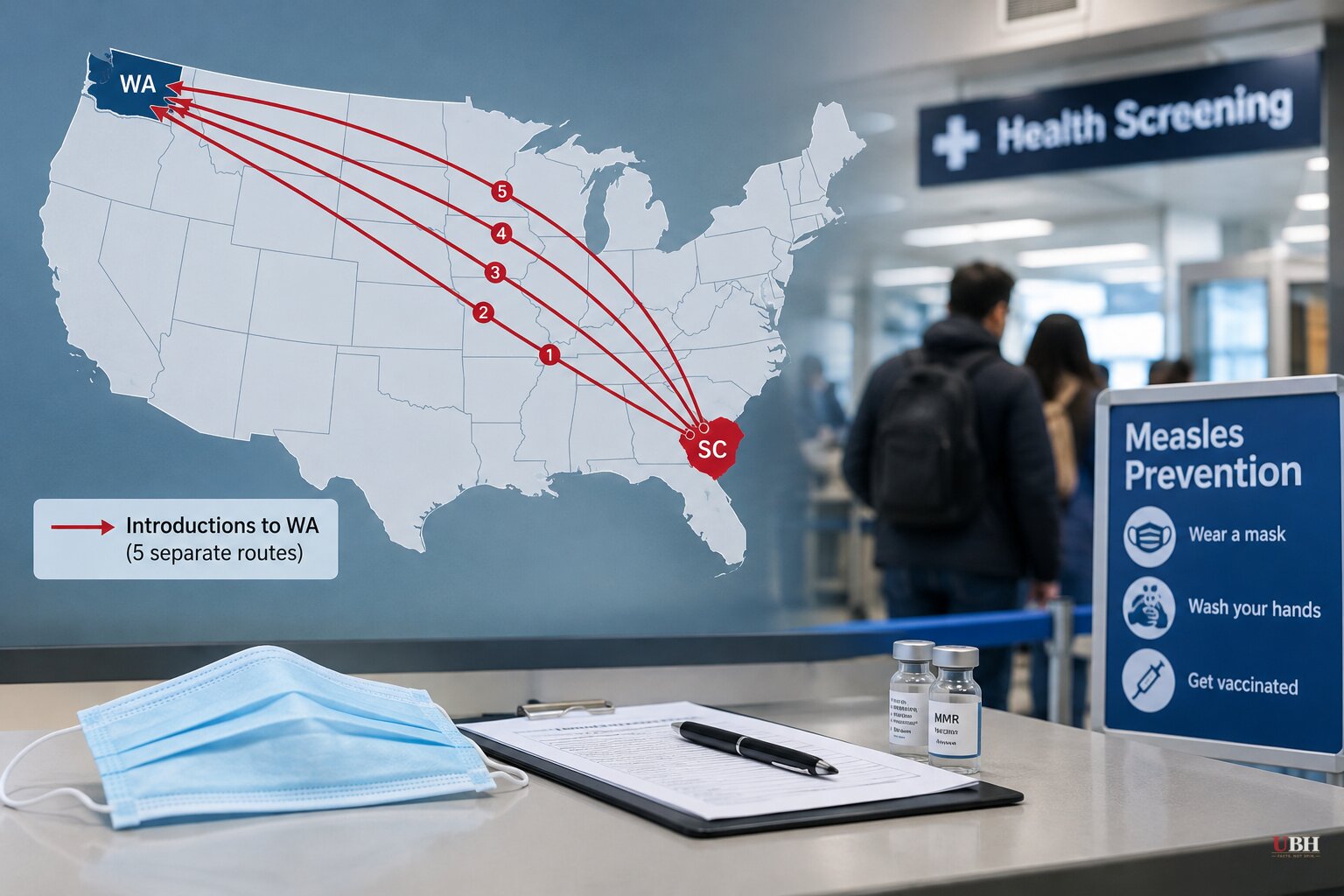
Measles did not walk into Washington state once. It walked in five times.
That is the finding of a report in NEJM Evidence by the Washington State Department of Health and the Centers for Disease Control and Prevention. Whole-genome sequencing, combined with contact tracing, showed that January cases in Washington came from five distinct introductions tied to South Carolina's outbreak, not one introduction followed by local spread. The total: 26 cases.
How the five introductions broke down
The first involved a resident who developed a rash on January 12 after visiting South Carolina and being exposed to someone with measles. Virus sequences closely matched South Carolina cases. One close contact also got sick. That made two cases.
The second was the largest: 14 cases. South Carolina residents visited Washington while contagious, and four people who had contact with them fell ill. Those four went on to visit schools, healthcare facilities and a church. Nine of their close contacts and one person exposed at a public location also got sick.
The third involved two Washington residents who returned from South Carolina and developed rashes on January 15 and 16. No further cases were linked to them.
The fourth was a single person who had traveled out of state. The report does not specify where the exposure happened. The fifth was tied to South Carolina through sequencing. A resident developed a rash January 19, visited a school and a healthcare facility while infectious, and six more people got sick. That made seven cases, in the same county as the fourth importation.
Of the 26 patients, 24 were unvaccinated. The vaccination status of the other two is unknown. None was hospitalized.
What stopped it
The authors credit a rapid response by local, state and federal officials. They say most patients followed isolation and quarantine guidance, which likely limited onward spread.
That is the unglamorous part of public health, and it worked. People who got sick stayed home, and contacts were found fast. No mandate drama required.
The authors also make a practical point. As jurisdictions brace for more importations from domestic outbreaks while watching for international ones, timely genome sequencing can help separate new introductions from local transmission and shape the response.
The national picture
South Carolina's outbreak began October 2, 2025, and reached 997 confirmed cases. It was the largest recorded since measles was declared eliminated in the U.S. in 2000, until Pennsylvania's outbreak, now past 1,300 cases, overtook it. As of October 22, Pennsylvania had reported 1,338 cases.
The CDC has confirmed 4,588 measles cases nationwide in 2026, more than double the 2,289 for all of 2025. The agency counts 43 new outbreaks this year. Of all cases, 96% (4,404) are outbreak-associated. Only 18 cases were reported among international visitors.
Health Secretary Robert F. Kennedy Jr. has taken a different view of the surge. According to reporting on his statements, he has described a "global pandemic" and said the United States is "doing better than any other country in the world in controlling the measles outbreak." The Washington findings and the CDC's own counts describe a different pattern: domestic travel between undervaccinated communities, not mainly imports from abroad. The study does not address Kennedy's claims directly. Washington's cases came from one U.S. state's outbreak.
Open questions on the death count
Pennsylvania health authorities have reported five measles-associated deaths and are investigating a sixth. The CDC has reported three measles deaths nationally. It has declined to say where the third occurred, so it is unclear whether Pennsylvania's deaths are in the federal tally.
Reuters has reported that Kennedy asked senior CDC officials in September to remove a measles death from the official count after questioning whether the disease contributed to it. That account rests on Reuters' reporting. HHS has not been quoted in these accounts as confirming it.
Counting is not a side issue. Federal officials are asking Americans to trust the numbers, and the CDC's own page says it includes only confirmed cases reported by jurisdictions, though it is aware of probable cases. The CDC has not said where the third death occurred, and Pennsylvania's investigation of a sixth death is still open.
Sources used for this briefing
6 links from 6 independent newsrooms (syndicated copies of the same report count once)
These are the sources it draws on, linked so you can verify.


