
Unbiased headlines. Facts, not spin.
Unbiased Headlines is an independently owned news organization. We bring you the facts, not opinions, written fresh from 110+ named sources. Sources linked so you can verify it yourself.
 health
Notable (6/10)
Study of 893,212 Medicaid Births Links Wildfire Smoke in Pregnancy to 30% Higher Autism Diagnosis Risk
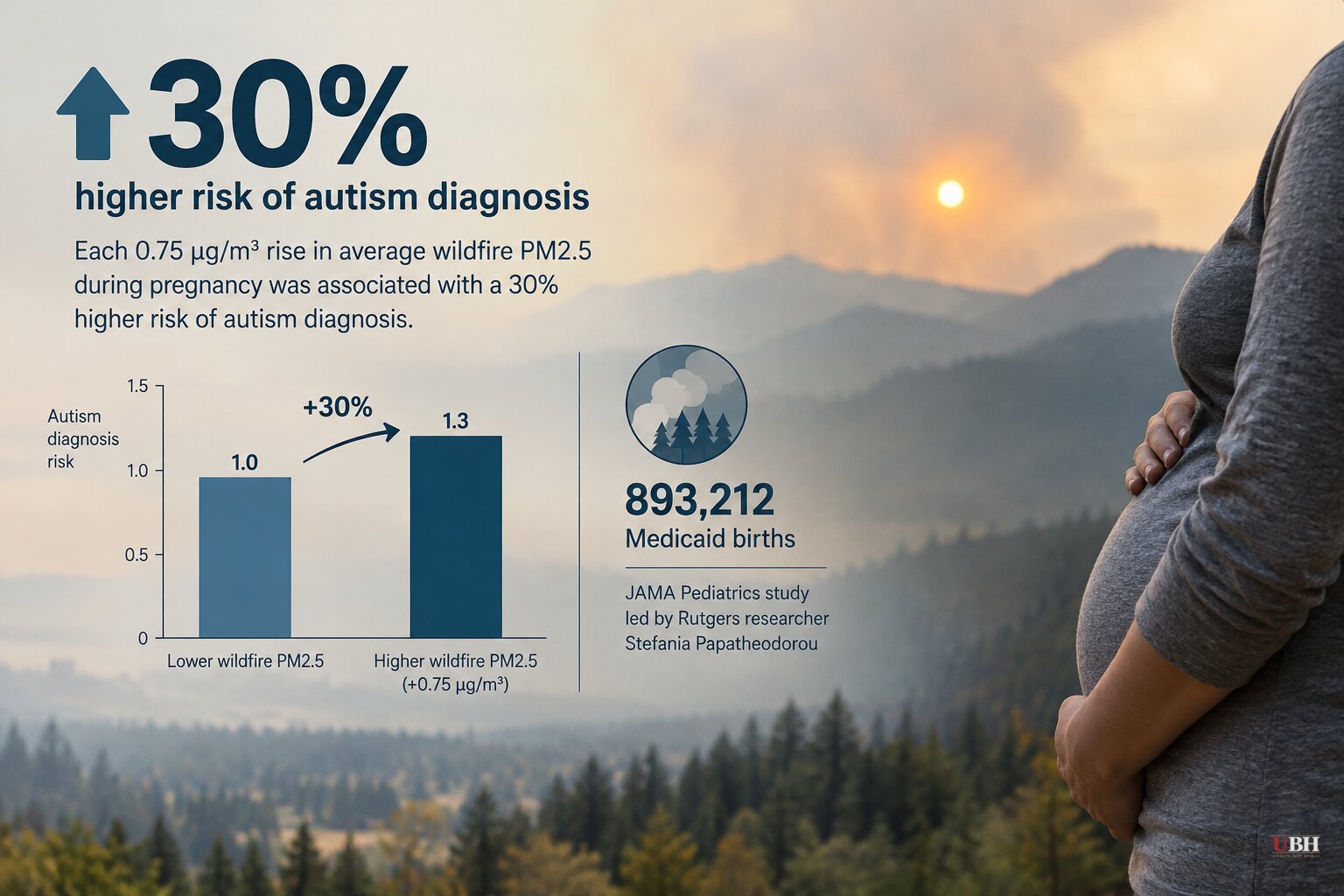
A large new study ties wildfire smoke during pregnancy to a higher chance that a child is later diagnosed with autism. It does not prove smoke causes autism.
The paper was published Oct. 26 in JAMA Pediatrics. Rutgers announced it Oct. 27.
What the researchers found
The team analyzed 893,212 mother-child pairs enrolled in Medicaid, with children born across the United States between 2007 and 2014. Children were followed for an average of 6.3 years.
For each mother's residential ZIP code, the researchers modeled weekly levels of fine particulate matter from wildfires. That is PM2.5, inhalable particles 2.5 micrometers or smaller.
Each 0.75-microgram-per-cubic-meter increase in the average concentration of wildfire PM2.5 during pregnancy was associated with a 30% higher risk of a subsequent autism diagnosis. The researchers measured diagnosis by age 8.
The association was strongest during the second and third trimesters, and especially for exposure after the 15th week of pregnancy.
The team also checked ADHD. The Harvard T.H. Chan School of Public Health, whose researchers co-authored the paper, said the study found no significant association between wildfire PM2.5 and ADHD.
PM2.5 from sources other than wildfires was also linked to autism diagnosis, but with a smaller increase in risk.
The authors' own limits
The study is observational. The researchers said it cannot establish that wildfire smoke causes autism, or how it might.
It also did not examine biological mechanisms. The authors point to one possible pathway: fine particles can penetrate deep into the lungs and drive inflammation throughout the body, which could affect pregnancy and fetal development.
The sample is Medicaid enrollees only, the public insurance program for lower-income Americans. The authors say that may limit how broadly the findings apply, given likely socioeconomic differences from the wider population.
Exposure was estimated by ZIP code, not measured on individual women. Where someone spends her day, or whether she is indoors during a smoke event, is not captured in a residential estimate.
Earlier research pointed different ways
Two previous studies, both limited to California, reached different conclusions about wildfire smoke and autism. This one widened the lens to the contiguous United States.
That gap is the reason to treat a single paper cautiously. A 30% relative increase is a statistical association within one insurance population, not a verdict on any individual pregnancy.
"Pregnancy is a period of rapid brain development, when environmental exposures may interfere with important developmental processes," said Stefania Papatheodorou, an epidemiologist at the Rutgers School of Public Health and lead author. She is also an adjunct associate professor of epidemiology at Harvard Chan.
She added that the findings suggest the middle and later stages of pregnancy "may be particularly relevant" for understanding the potential effects on the developing brain. Autism is also shaped by genetic and other factors, she said, and understanding how prenatal environmental exposures contribute alongside them "remains an important research priority."
Why the dates matter
The births in the study ended in 2014. The authors noted that major smoke events have come since. In 2023, smoke from Canadian wildfires affected air quality across New Jersey, New York and other parts of the United States.
Because the study examined births before those events, the authors called for research in more recent birth cohorts.
Harvard Chan's release says wildfires have increased in frequency, size and intensity in the U.S. and globally in recent years, and that evidence on prenatal smoke exposure and long-term neurodevelopmental outcomes has been limited.
What the authors recommend
The researchers advise pregnant women to be aware of wildfire events, limit time outdoors during smoke episodes, check local air-quality reports and follow guidance for sensitive groups when pollution is elevated.
"Wildfire smoke can travel far beyond the communities where fires are burning, and exposure may occur even when smoke is not visible," Papatheodorou said.
She also urged health care providers to bring environmental hazards into routine prenatal care. "Sometimes clinicians are not even aware of these risks," she said.
The paper also points to practical measures such as better air-quality forecasting and strategies to keep smoke out of indoor spaces.
It remains unclear whether the pattern holds in newer birth cohorts and in populations beyond Medicaid. The authors have asked for exactly that research, including births that overlap the recent large smoke events.
Sources used for this briefing
7 links from 7 independent newsrooms (syndicated copies of the same report count once)
These are the sources it draws on, linked so you can verify.


