
Unbiased headlines. Facts, not spin.
Unbiased Headlines is an independently owned news organization. We bring you the facts, not opinions, written fresh from 110+ named sources. Sources linked so you can verify it yourself.
 health
Notable (6/10)
Merck beats Q3 estimates and raises profit outlook as Keytruda Qlex sales reach $830 million
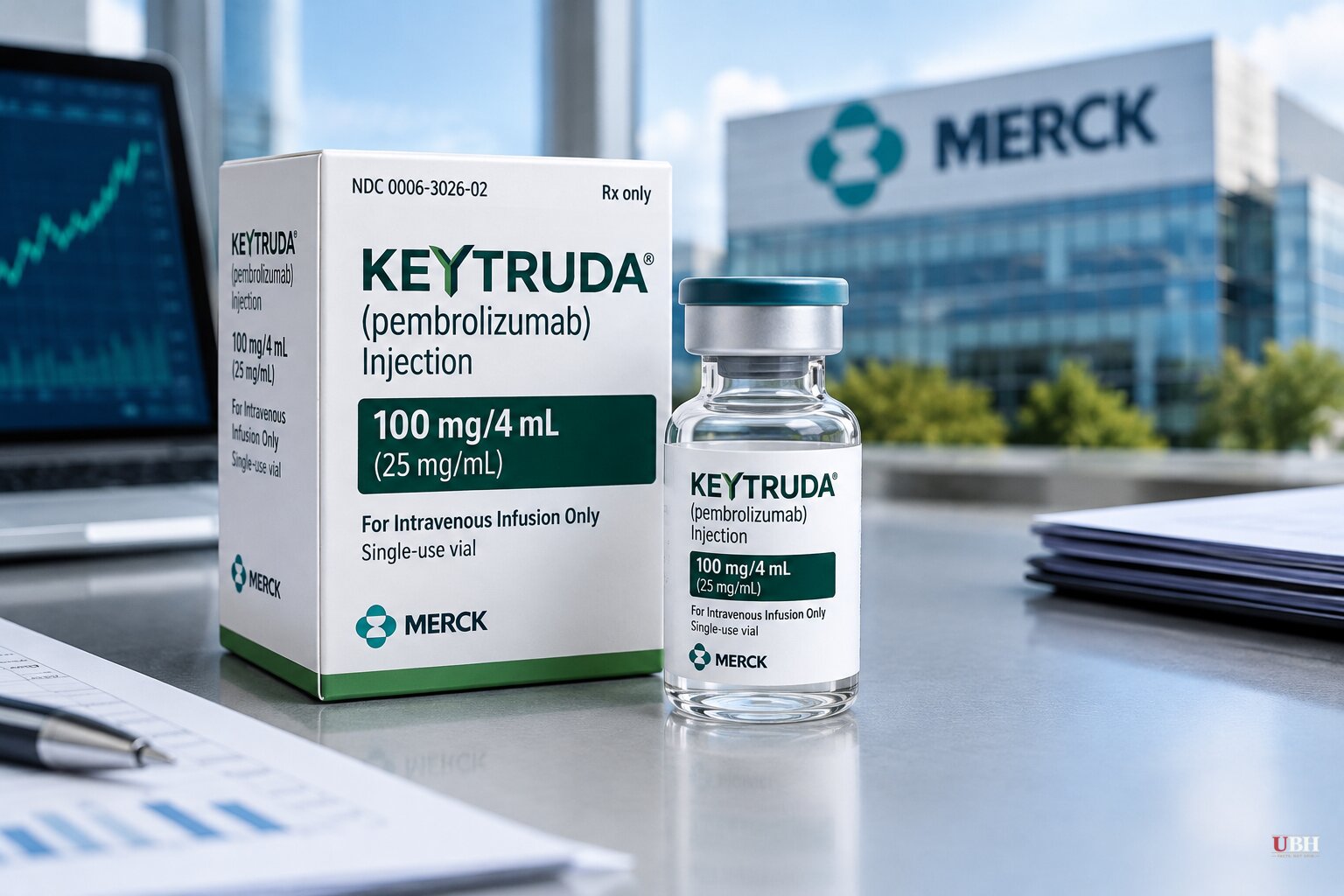
Merck beat Wall Street on both revenue and earnings today, Oct. 29, and lifted its full-year profit guidance. The cancer drug Keytruda and its new under-the-skin version, Keytruda Qlex, did most of the work.
Shares rose in premarket trading, by nearly 3% in one early report. The stock closed Wednesday at $140.93 and is up about 34% this year, ahead of the broader market.
The numbers
Revenue came in at $18.09 billion, up about 5% from a year ago. Analysts surveyed by LSEG expected roughly $17.3 billion.
Adjusted earnings were $2.49 per share against expectations of about $2.08.
The GAAP picture is weaker. Net income was $5.07 billion, or $2.04 per share, down from $5.79 billion, or $2.32 per share, in the year-earlier quarter. The adjusted figure excludes acquisition and restructuring costs.
Keytruda and Qlex
Keytruda sales rose 6% to $8.6 billion. Estimates varied: StreetAccount had $7.73 billion, while Reuters cited a consensus of $8.0 billion. Merck cleared both.
Qlex, the subcutaneous version approved late last year, brought in $830 million. That is its best quarter since launch. StreetAccount estimates had pegged it at $649 million.
This is the core of Merck's defense plan. The company wants to move patients from the intravenous version to Qlex, a more convenient injection, before key Keytruda patents begin expiring in 2028. If patients are already on Qlex when biosimilars arrive, Merck keeps more of the franchise.
Merck also said it expects Keytruda's growth to moderate as it nears peak revenue in certain indications and as it faces challenges in the German market.
Gardasil, Winrevair and a pull-forward
Gardasil sales rose 14% to just under $2 billion, against Wall Street estimates of about $1.8 billion. Reuters reported the increase was helped by early purchases by the U.S. Centers for Disease Control and Prevention. Gardasil had been hurt by weak demand in China in recent quarters.
Merck said about $550 million of its growth in the quarter came from drug purchases made earlier than expected. That is revenue pulled forward, and the company flagged it itself.
Winrevair, the pulmonary arterial hypertension drug, generated $694 million. Sales rose more than 90% from a year earlier, and analysts had expected $645 million.
The animal health business posted $1.68 billion, slightly below expectations. It was the one soft spot among the major lines.
Guidance
Merck now expects 2026 adjusted earnings of $2.77 to $2.82 per share, up from $2.66 to $2.76. That range already absorbs a one-time charge of $400 million, or 12 cents per share, tied to a licensing agreement with the Chinese cancer drugmaker SciBrunch.
The revenue forecast moved only at the bottom. Merck now expects $66.8 billion to $67.3 billion, versus $66.3 billion to $67.3 billion before. The top end did not budge.
Read alongside the $550 million in early purchases, the unchanged top end is telling. A raised floor with an unchanged ceiling is a company locking in a good quarter, not signaling a new run rate.
Life after Keytruda
CEO Rob Davis said on the earnings call that "2026 continues to be a year of substantial progress for our company," pointing to new product launches now underway.
Merck has spent billions on acquisitions and licensing deals to replace revenue it expects to lose to biosimilars. The SciBrunch deal is the latest example, and it carries a cost: that $400 million charge is in this year's numbers.
The pipeline got a boost last week. Merck and Moderna published data showing their mRNA cancer vaccine, combined with Keytruda, significantly cut the risk of death or recurrence in melanoma. It was the first positive late-stage trial result for an mRNA cancer vaccine.
Merck shares jumped 12% in August when the companies announced the trial's success without the underlying data. They dipped last week when the detailed results came out. Citi analysts said the data strengthens Merck's post-Keytruda story.
What to watch
The quarter is strong on its face. Qlex is converting patients faster than analysts modeled, and Gardasil is recovering.
The unresolved issue is the fourth quarter. With $550 million of this quarter's growth coming from earlier-than-expected purchases, the next report will show how much of that demand was simply moved up from the final three months of the year. Merck's own guidance, with its top-end revenue figure unchanged at $67.3 billion, is the number to check it against.
Sources used for this briefing
7 links from 6 independent newsrooms (syndicated copies of the same report count once)
These are the sources it draws on, linked so you can verify.


