
Unbiased headlines. Facts, not spin.
Unbiased Headlines is an independently owned news organization. We bring you the facts, not opinions, written fresh from 110+ named sources. Sources linked so you can verify it yourself.
 health
Notable (5/10)
Mouse Study Finds Psilocybin Grows New Brain Connections Without a Hallucination Marker
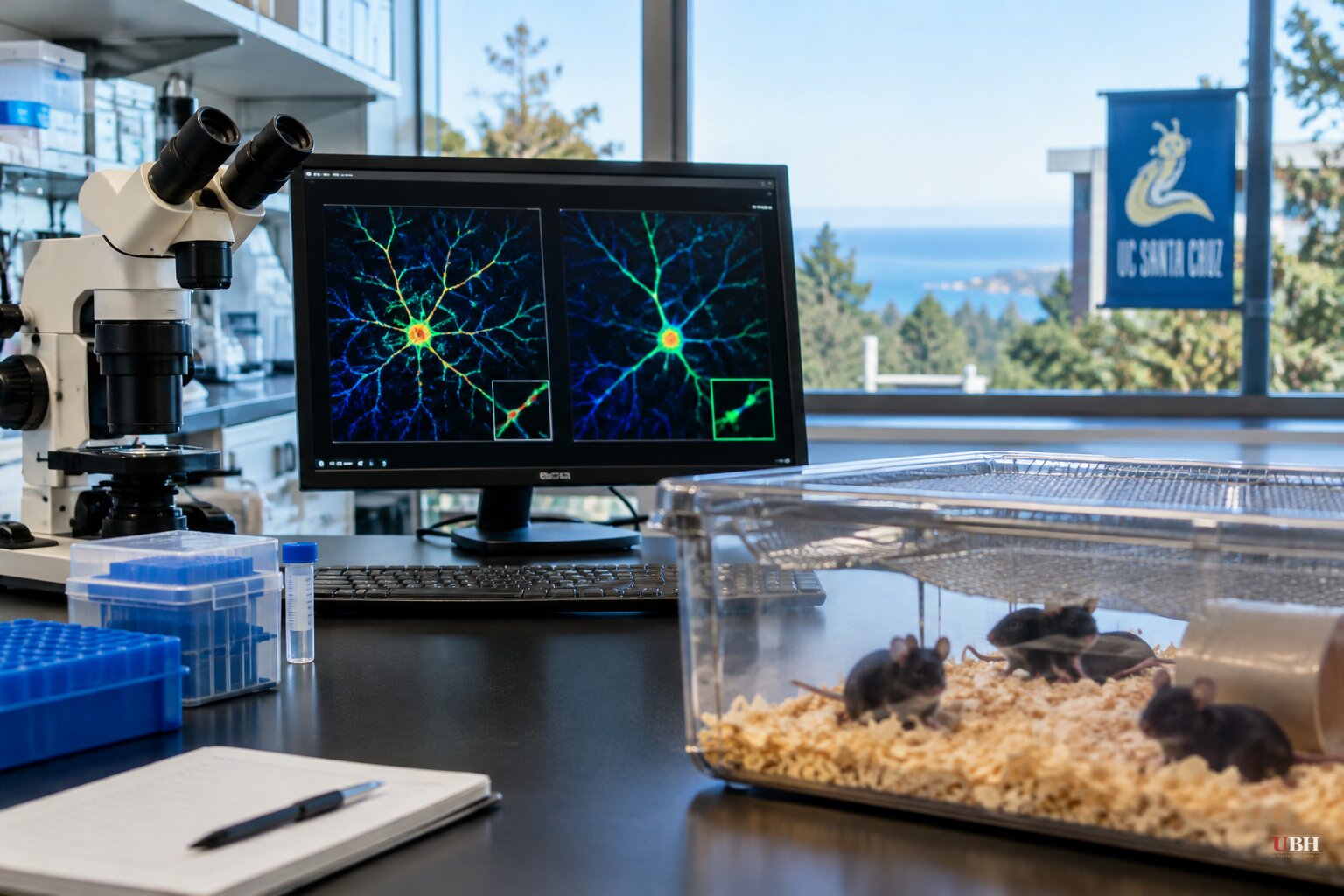
Brain research moved on three fronts this month: tools that edit connections between neurons, a mouse study on how psilocybin reshapes them, and a new grant to find the cells behind bipolar mood swings. None has produced a treatment. Each aims at the same target, the synapse.
Psilocybin in stressed and healthy mice
The study, published Oct. 15 in Nature Neuroscience, came from a team at the University of California, Santa Cruz. Senior author Yi Zuo, a professor of molecular, cell, and developmental biology, and lead author Jacob Baker, a Ph.D. student in her lab, used two-photon microscopy to track individual dendritic spines on living mouse brain cells over several weeks.
Spines are the small protrusions that receive signals from neighboring neurons at synapses. Within 24 hours of a psilocybin dose, the team saw a rapid rise in new spine formation.
The effect depended on the animal's condition. In mice put through unpredictable mild stress, a model that mimics aspects of human depressive states, psilocybin produced a significantly larger surge in new spines than in healthy controls. It also halted the excessive loss of existing connections.
In healthy mice the growth was temporary. Some connections that predated treatment were removed over three weeks, and overall connectivity drifted back toward baseline.
New spines normally start as short, unstable "stubby" shapes. Psilocybin pushed a significantly higher proportion to mature into large "mushroom" spines, which carry abundant neurotransmitter receptors and help sustain the strong signals involved in memory and mood.
"These newly formed connections can integrate into existing neural circuitry and persist over time," Baker said.
Rewiring without the trip
The team also identified a group of brain cells that supported new connections without triggering a rodent behavior used as a proxy for hallucinogenic activity. The researchers describe the finding as evidence that structural repair can be separated from the psychedelic effect.
That bears on an open debate. Psilocybin has Breakthrough Therapy designation from the U.S. Food and Drug Administration for treatment-resistant depression and major depressive disorder. Researchers have long argued over whether the acute psychedelic experience is required for lasting clinical benefit.
Zuo's team says the findings "challenge the prevailing view that psilocybin simply increases neural connectivity." Her statement: its effects "depend on the brain's underlying condition."
The limits are plain. These were mice. The hallucination measure is a behavioral proxy, not a report from a person describing an experience. The study does not show a non-hallucinogenic drug works in humans.
Tools that edit the wiring
A separate line of work goes further than watching circuits. Optogenetics, which uses light to switch brain cells on and off, won three scientists the 2026 Nobel Prize in Physiology or Medicine.
Sangkyu Lee, a neurobiologist at the Institute for Basic Science in South Korea, compares it to "controlling the volume of traffic on a road network that's already built." The better approach, he says, would be "changing the structure of the 'road' itself."
Researchers have since figured out how to add new connections and delete existing ones. They have used the techniques to change animals' behavior and even to implant memories.
Kafui Dzirasa, a psychiatrist at Duke University, reached what he calls "synaptic engineering" by accident. He had been trying to treat psychiatric conditions with brain-machine interfaces that picked up activity in one region and stimulated another, effectively wiring the two together. That proved impractical as a treatment. "We realized that's what a synapse does, so we thought, 'Why don't we just create a synapse?'" he said.
The potential targets include post-traumatic stress disorder, schizophrenia and obsessive-compulsive disorder. The work is at the stage of discovery and animal behavior, not clinical use.
Don Arnold, a neurobiologist at the University of Southern California, put the stakes this way: the idea that manipulating brain activity could make someone "happy or sad, or thirsty or hungry, is incredible when you think about the ramifications."
Hunting for bipolar mood-switch cells
In a third effort, Breakthrough Discoveries for thriving with Bipolar Disorder (BD²), a nonprofit that funds bipolar research, awarded three Discovery Research grants. Each team gets $4.5 million over three years.
One goes to Christopher R.K. Ching of the Stevens Neuroimaging and Informatics Institute at the Keck School of Medicine of USC, with co-principal investigators Laramie Duncan of Stanford and Fernando Goes of Johns Hopkins.
Nearly 3% of people worldwide live with bipolar disorder, and scientists still know little about the biology behind its swings between depression and mania.
A 2025 Nature Neuroscience study by Duncan and colleagues tied neurons in the retrosplenial cortex to bipolar disorder. The team calls them "retrosplenial switch cells" and hypothesizes that dysfunction in them contributes to mood switching. That is a hypothesis, and the new project is built to test it.
The work has three parts:
- Molecular labeling of donated brain tissue from people with and without bipolar disorder, to find which cells differ.
- Genetic risk scores from the BD² Integrated Network, a study recruiting 4,000 people with bipolar disorder, to test whether they predict mood switching and treatment response.
- Analysis of brain scans from the same cohort to see how the retrosplenial cortex connects with other regions.
The grant runs three years, so results on whether the switch-cell idea holds up in human tissue and imaging data are not expected before then.
Sources used for this briefing
4 links from 4 independent newsrooms (syndicated copies of the same report count once)
These are the sources it draws on, linked so you can verify.


