
Unbiased headlines. Facts, not spin.
Unbiased Headlines is an independently owned news organization. We bring you the facts, not opinions, written fresh from 110+ named sources. Sources linked so you can verify it yourself.
 health
Notable (6/10)
Study Estimates Potassium-Enriched Salt Could Prevent 2.96 Million Deaths a Year Worldwide
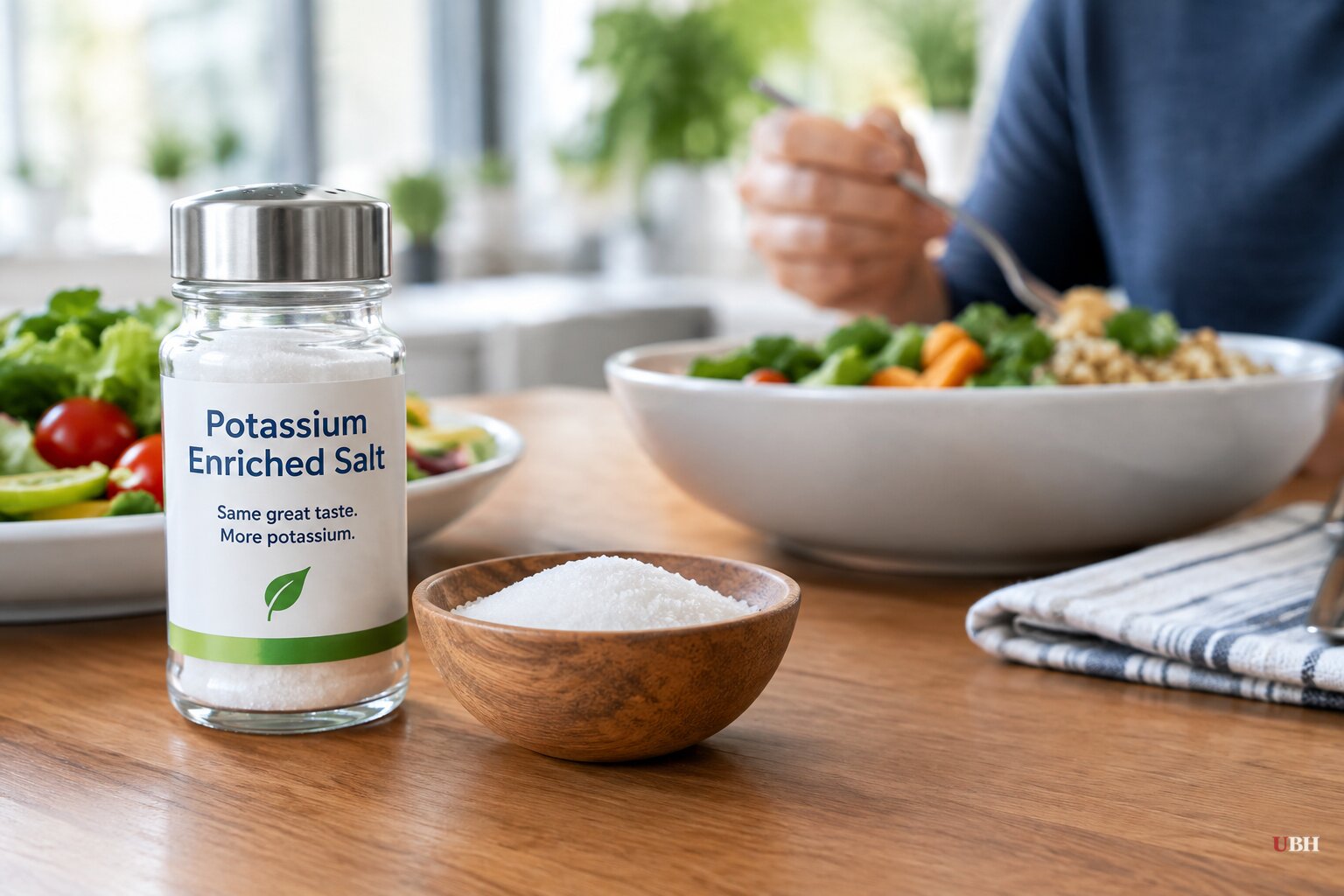
A swap on the kitchen shelf could be worth millions of lives. That is the claim in a new study published in the journal Nature Health, led by The George Institute for Global Health in Australia.
The researchers modelled what would happen if 193 countries switched from regular table salt to potassium-enriched salt. Their estimate: 2.96 million deaths and 10.17 million new cases of cardiovascular disease and chronic kidney disease prevented every year.
These are projections from scenarios, not outcomes anyone has counted.
What potassium-enriched salt is
The product replaces some of the sodium chloride in table salt with potassium chloride. According to the researchers, it looks, tastes and cooks like regular salt. It is sold in many supermarkets, including under brands such as LoSalt in Britain.
The logic is simple. Too much sodium raises blood pressure, and too little potassium does the same. Bruce Neal, senior professorial fellow at The George Institute, said the switch "addresses both these dietary issues at the same time."
The World Health Organization endorsed potassium-enriched salt in 2025 to reduce blood pressure and cardiovascular risk.
The numbers
The stakes are large. About one in three adults aged 30 to 79 worldwide, roughly 1.4 billion people, has high blood pressure, according to the WHO. Cardiovascular disease killed 19.2 million people in 2023, up nearly 50% in 30 years.
The study broke the estimate into scenarios:
- Household cooking salt only: 1.85 million deaths and 6.19 million cases prevented per year.
- Salt in processed and restaurant food: a further 1.56 million deaths and 5.46 million cases.
- People with high blood pressure only: if 80% switched at home, almost 600,000 deaths and 1.7 million cases prevented annually.
Neal said the gains could avert as many as one in 10 cardiovascular deaths in most countries.
China would see the largest effect, with an estimated 1.08 million deaths prevented a year from a complete switch. India follows with almost 400,000. For the United Kingdom, the team estimated 12,951 deaths and almost 60,000 cases prevented annually. More than 14 million Britons are thought to have high blood pressure.
The catch is industry, not the pantry
In Europe and North America, more than 70% of dietary salt comes from processed foods and restaurant meals, not the shaker at home, according to Neal. That limits what a shopper can do alone.
"To realise the maximum benefits from switching to potassium-enriched salt, we need to see the food industry in Europe and North America ... get on board," Neal said.
He was frank about the odds. "While a global shift from regular salt to a potassium-enriched substitute is aspirational, this is a starting point to get countries thinking about the opportunity," he said. He added that the potential is "much greater" and the cost "much lower" than many drug-based treatments.
The kidney risk
Potassium is not harmless for everyone. The main concern the researchers address is hyperkalemia, dangerously high blood potassium, in people with advanced kidney disease.
The study found that even among patients with advanced kidney disease, the benefits outweighed the risks. Nephrologist Vivek Jha, a senior professorial fellow at The George Institute in India, did not wave the problem away.
"People with serious kidney disease and those taking medications that significantly raise blood potassium levels need to take precautions," Jha said. "Risks for this group can be managed effectively through patient education, product labeling and clinical oversight."
Any broad rollout would have to account for that caveat. A product swapped silently into processed food reaches people who never chose it and may never read a label. Jha's own prescription of labeling and clinical oversight points to how much hangs on implementation.
What the study does and does not show
The figures come from modelling across hypothetical scenarios, including a full global switch that the authors themselves call aspirational. Even the smallest scenario showed health gains, the authors said, but the largest numbers assume near-universal adoption.
The cost-versus-drugs comparison is Neal's characterization. Nothing in the study announcement puts a price on the global scenario.
The one piece that needs no government or industry action is the household switch, which is a purchase anyone can make. That alone accounts for 1.85 million of the estimated deaths in the model.
The larger question is whether food manufacturers in Europe and North America will reformulate. Neal has asked them to. No company has been named as agreeing to do so.
Sources used for this briefing
5 links from 5 independent newsrooms (syndicated copies of the same report count once)
These are the sources it draws on, linked so you can verify.


