
Unbiased headlines. Facts, not spin.
Every story is an unbiased news briefing written from 110+ sources across the spectrum — sources linked so you can verify it yourself.
 finance
Low Interest (4/10)
June 20, 2026 at 01:21 AM
finance
Low Interest (4/10)
June 20, 2026 at 01:21 AM
Strategy's STRC Preferred Stock Drops Below Par as Retail Investors Hold $8.8 Billion in a Junk-Rated Instrument
What STRC Actually Is
STRC is an unsecured, subordinated, perpetual preferred equity issued by Strategy — the company formerly known as MicroStrategy and run by executive chairman Michael Saylor. It has no maturity date and no claim on any of Strategy's bitcoin holdings. The dividend is discretionary, meaning the board can cut it at any monthly meeting with no notice, no remedy, and no shareholder vote required.
S&P rates Strategy B-, four notches into junk territory, according to Bitcoin Magazine's analysis by Glenn Cameron published June 18, 2026. That rating applies to the issuer behind $10.7 billion in STRC outstanding. Roughly $8.8 billion of that belongs to retail investors.
The Marketing Does Not Match the Indenture
Saylor has publicly compared STRC to money market funds and FDIC-insured bank accounts, according to Decrypt. He has called it a "financial revolution" comparable to Apple's iPhone moment.
The indenture tells a different story. "Backed by bitcoin" describes a security with no lien on any coin. "Money-market-like" describes an instrument rated four notches below investment grade with no fixed maturity and a coupon the board controls. Cameron's Bitcoin Magazine piece states the claim plainly: each phrase in the marketing is contradicted by the underlying legal documents.
None of the B- rating, the discretionary dividend, the perpetual structure, or the subordinated standing appear to be prominently featured in Strategy's public pitch for the product.
The Funding Math
Strategy's underlying software business generates approximately $477 million in annual revenue, according to Bitcoin Magazine. Total preferred dividend obligations across the preferred stack now exceed $1.2 billion annually. That is a ratio of 3.5 to 1, according to Bitcoin Magazine's analysis — meaning the business owes preferred shareholders more than three times what it earns in revenue.
The gap has been closed not through earnings but through issuing new STRC shares. Strategy uses fresh capital raised from new buyers to pay dividends to existing holders. When STRC trades at or above its $100 par value, Strategy can issue new shares at favorable terms and channel proceeds toward dividends and bitcoin purchases. When the price drops below par, that funding channel closes.
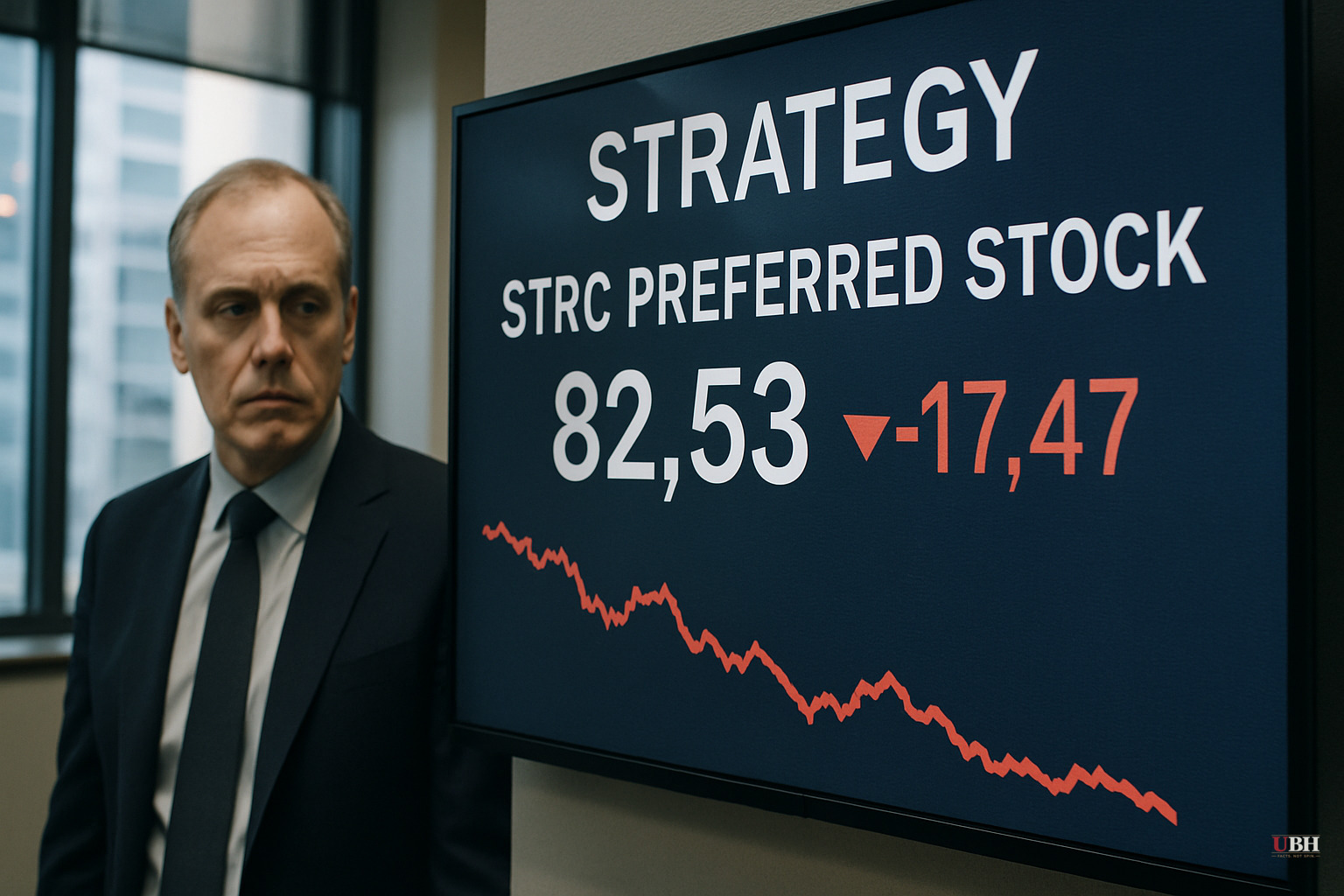
STRC fell as low as $82.53 this week, according to Decrypt, hitting its lowest level since the stock debuted in July 2025. Strategy has paused new at-the-market share issuance as a result. The company also sold bitcoin for the first time to help fund preferred dividends, a significant shift from its stated accumulation-only posture, according to Whale Alert's reporting.
Strategy still holds approximately 846,842 bitcoin and maintains a stated $1.1 billion reserve for dividends and debt service, per Whale Alert. That reserve provides a real buffer, and STRC bulls point to it as evidence the dividend is not in immediate danger.
Real People, Real Money
Decrypt reported on Emery Redenius, a 44-year-old newly retired slot-machine technician from Las Vegas who bought STRC on its first day of trading and has since accumulated more than $400,000 in STRC and SATA, a similar preferred stock from asset manager Strive. Redenius told Decrypt he views the investment as a core income holding and cited the tax-deferred nature of distributions as a key attraction.
Redenius is not alone. The 82.7% retail concentration figure, cited by both Bitcoin Magazine and ZeroHedge's republication of Cameron's analysis, means the majority of this exposure is not sitting on institutional balance sheets with teams of credit analysts. It's sitting with people who may have read the marketing but not the indenture.
The Case for STRC's Defenders
The strongest good-faith argument for STRC is not frivolous. Strategy holds nearly 847,000 bitcoin, an asset that has historically recovered from severe drawdowns. If bitcoin appreciates substantially, Strategy's balance sheet strengthens, the funding model stabilizes, and the dividend becomes more secure. Retail investors choosing STRC over other income instruments are making an explicit bet that bitcoin's long-term trajectory justifies the credit risk. Some investors understand the structure fully and accept the tradeoff for an 11.5% yield. Saylor's bitcoin premium thesis has, over several years, generated enormous returns for MSTR common shareholders.
The question is whether investors with $400,000 in retirement savings are pricing in the downside scenario with the same clarity.
What the Pressure Reveals
When STRC trades below par, Strategy cannot issue new shares above par to fund dividends. It must either draw down its $1.1 billion reserve, sell bitcoin, or cut the dividend. This week it chose the second option, selling bitcoin for the first time, according to Whale Alert. That's a meaningful data point about which lever management reached for first.
Arca's Jeff Dorman, cited by Crypto News via Whale Alert's source aggregation, sees limited fixes available to Strategy in the current environment. Peter Schiff, also cited via Whale Alert, has accused Saylor of misleading STRC buyers. Neither Schiff nor Dorman is a neutral party, but their structural critique is consistent with the plain reading of the indenture.
Whether the marketing language around STRC rises to a level that regulators find actionable is an open and unresolved question.
Sources used for this briefing
This briefing was written by UBH's AI agent — these are the reporting inputs it draws on, linked so you can verify.


