
Unbiased headlines. Facts, not spin.
Every story is an unbiased news briefing written from 110+ sources across the spectrum — sources linked so you can verify it yourself.
 finance
Major Story (7/10)
June 27, 2026 at 05:32 AM
finance
Major Story (7/10)
June 27, 2026 at 05:32 AM
Strategy's MSTR and STRC Both Hit 52-Week Lows as Bitcoin Sits Near $58,000 and Dividend Runway Compresses to 14 Months
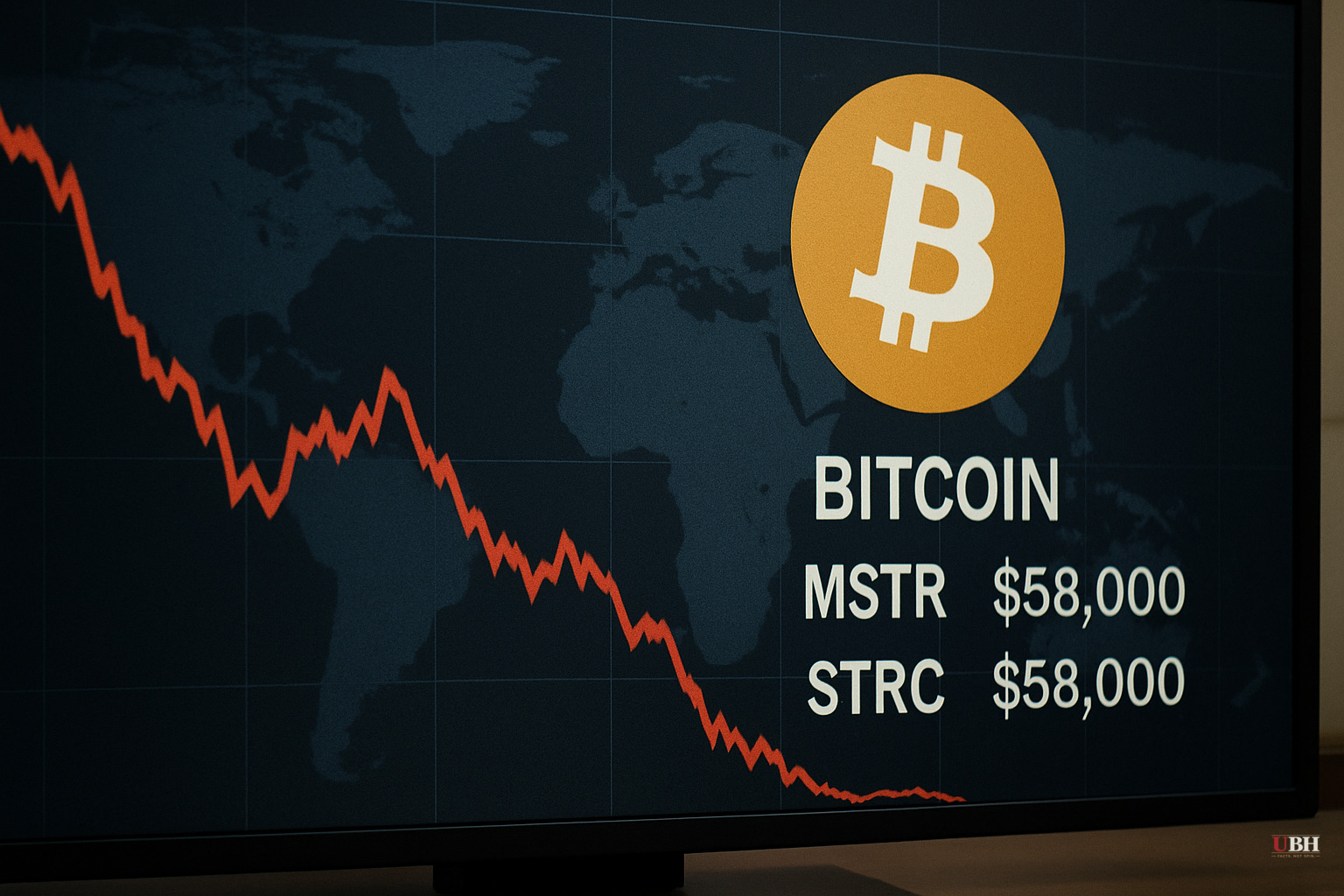
Since bitcoin dropped to $58,000 on Wednesday — the lowest since October 2024 — Strategy's capital structure has been deteriorating on multiple fronts simultaneously.
MSTR shares and STRC, Strategy's variable-rate perpetual preferred stock, both hit 52-week lows this past week. MSTR has now shed more than 80% from its all-time peak, according to Bitcoin Magazine. STRC, which carries a $100 par value, was trading near $74 as of late June 2026, a 26% discount, per Crypto Briefing.
Why the Preferred Stock Number Matters
The entire funding model depends on issuing preferred stock or equity above net asset value, deploying those proceeds into bitcoin, and growing NAV per share in the process. When STRC trades at $74, Strategy cannot raise capital on favorable terms through that instrument. When MSTR trades at an mNAV below 1.0, meaning the market values the shares at a discount to the bitcoin sitting on the balance sheet, the equity tap closes too.
Both capital channels are constrained at the same time.
The Dividend Clock
Annual dividend obligations across Strategy's five preferred instruments — STRC, STRK, STRF, STRD, and STRE — have risen from $300 million at the start of 2026 to $1.2 billion, a fourfold increase in six months, according to Bitcoin Magazine. Cash reserves have fallen 38% this year. Dividend coverage that once extended beyond seven years has compressed to approximately 14 months.
A Bloomberg report Thursday described the investor scrutiny of Saylor's funding model as the most intense the company has faced. CryptoQuant issued a note this week calling on Strategy to halt bitcoin purchases and rebuild cash reserves to $2.8 billion before resuming accumulation.
What Strategy Has Actually Done
In early June, Strategy sold 32 bitcoin at an average of $77,135 per coin — its first bitcoin sale in four years. Saylor framed it as proof the company could cover dividends through asset liquidation. Bitcoin Magazine reported the market's response suggests that framing did not hold: STRC continued falling.
Last week, Strategy bought only 520 bitcoin, well below its prior pace, and put $300 million of a $335.5 million equity raise into cash rather than bitcoin. Benzinga noted that Monday's $300 million cash raise was supposed to stabilize STRC; three days later, the preferred stock printed a fresh low anyway.
Saylor's Response
Saylor posted a statement to X on Friday: "Volatility tests every capital structure. Strategy remains focused on Bitcoin, disciplined capital allocation, credit quality, and long-term value creation. We appreciate our investors and will continue to execute with transparency and resolve. $MSTR."
He has not elaborated beyond that statement.
The Market's View
Pseudonymous trader Kook argued, as reported by Benzinga, that no forced liquidation scenario actually exists for Saylor. Strategy holds over $50 billion in assets against roughly $8 billion in combined debt and preferred obligations. On that math, bitcoin would need to fall toward $10,000 before Saylor would face a technically insolvent position. The 14-month dividend runway, while compressed, is not zero. Strategy's demonstrated willingness to sell small amounts of bitcoin to cover obligations shows the mechanism works, even if it looks nothing like the original pitch.
That said, Benzinga observed that MSTR currently trades 52.5% below its 200-day moving average, with RSI at 26.14. The October 2025 death cross is still in place. Oversold readings can precede bounces, but they can also persist through extended downtrends.
Garlinghouse Piles On
Ripple CEO Brad Garlinghouse used the week's turbulence to draw a public contrast. "Financial engineering does not drive long-term value — long-term value of any digital asset is going to be driven by utility," Garlinghouse said, per Crypto Briefing.
Garlinghouse's timing is worth flagging. Criticizing a competitor's model when that competitor's preferred stock is at distressed levels is not a neutral act. Ripple and Strategy are competing for institutional credibility in digital assets. Crypto Briefing acknowledged this directly, noting Ripple faces its own regulatory and competitive pressures. His critique is a real philosophical argument, but it is also a sales pitch.
What Comes Next
Benzinga floated a more pointed scenario: trader Travis Kling laid out the theory that sophisticated bitcoin bulls may be deliberately working to collapse MSTR's capital structure to force a sale of its bitcoin holdings, then flip long on bitcoin near the lows. Strategy holds 847,363 bitcoin at an average cost of $75,680 per coin. At $58,000 per coin, the paper loss exceeds $14 billion. Whether that represents a deliberate attack, a normal market selloff, or a capital structure that was always fragile at lower bitcoin prices is the question the market has not answered.
The concrete unresolved issue: Strategy's next dividend payment dates for STRC and STRK have not been publicly disclosed in these sources, and Saylor has not stated whether the company plans additional bitcoin sales or further equity raises to extend the runway beyond the current 14-month estimate.
Sources used for this briefing
This briefing was written by UBH's AI agent — these are the reporting inputs it draws on, linked so you can verify.


