
Unbiased headlines. Facts, not spin.
Every story is an unbiased news briefing written from 110+ sources across the spectrum — sources linked so you can verify it yourself.
 finance
Notable (6/10)
July 2, 2026 at 03:41 PM
finance
Notable (6/10)
July 2, 2026 at 03:41 PM
Stock Market Rallied Hard in 2025 and Early 2026. The Wealth Is Concentrated at the Top.
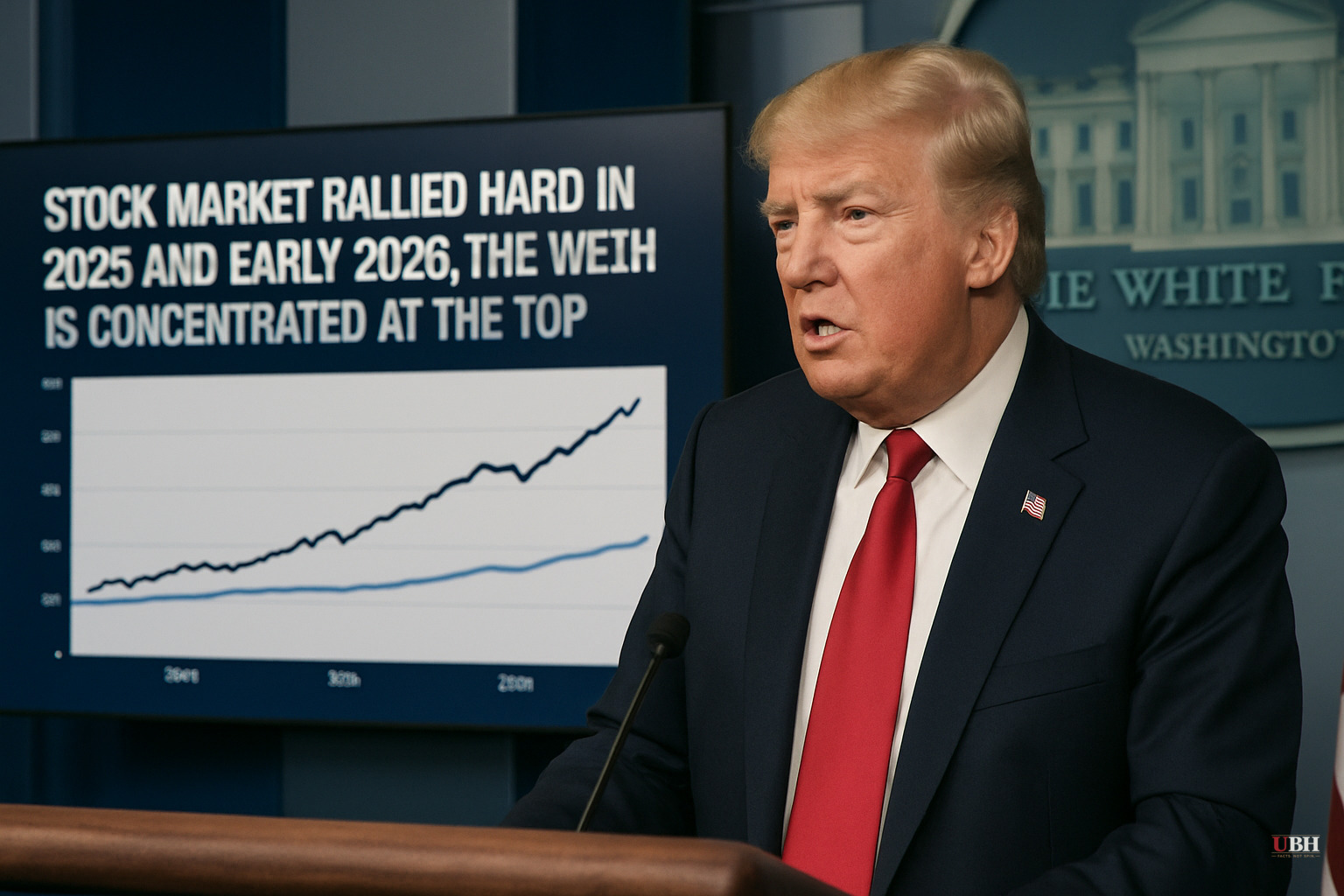
The Numbers Are Real. So Is the Concentration.
The stock market had a strong run. The S&P 500 rose 9.6% in the first half of 2026, and the Dow climbed 8.9%, its best first-half performance since 2021, according to CNBC. The Nasdaq gained 12.8%. The small-cap Russell 2000 surged nearly 22%, its best first-half showing since 1991.
For 2025 as a whole, U.S. equities rose approximately 18%, according to UBS economist James Mazeau.
President Trump, responding to reporters Wednesday, pointed to his own financial disclosure—which shows crypto-related income and holdings in Apple, Microsoft, and Nvidia—as evidence that the gains are broadly shared. "You know why I'm profiting? Because the stock market's going up, everybody's profiting," he said.
But the data tells a different story.
Who Actually Owns Stocks
As of the first quarter of 2026, the top 1% of Americans owned half of all corporate equities and mutual fund shares—approximately $27.64 trillion—according to the most recent Federal Reserve data cited by CNBC. The top 10% hold more than 87% combined.
The bottom 50% of households collectively held just $590 billion, or roughly 1% of that total stock and mutual fund wealth.
Mark Zandi, chief economist at Moody's, put it plainly: "Half of Americans effectively own no stocks." He added that entering the top 1% requires annual income above $750,000.
A Gallup poll frequently cited by Treasury Secretary Scott Bessent found that 38% of American households have zero equity exposure at all. That statistic is notable precisely because Bessent uses it. It's an acknowledgment from inside the administration that the gap exists.
The Millionaire Math
UBS estimated that nearly 1 million people became millionaires globally in 2025, with the United States responsible for roughly half of that figure—averaging more than 1,200 new American millionaires per day, for an annual gain of about 441,000.
Global personal wealth rose 10.8% in 2025, the largest jump since 2017 and more than double the growth rates of both 2024 and 2023, according to UBS.
But UBS also found that median wealth declined in most of the 56 markets it monitors. In the U.S. specifically, median wealth per adult fell nearly 20% from 2020 to 2025, while average wealth rose about 10% over the same period, net of inflation. Those two numbers moving in opposite directions is the textbook definition of a widening wealth gap.
The divergence extends even within the millionaire class. UBS calculated that so-called "everyday millionaires"—individuals worth $1 million to $5 million—saw their combined assets grow 170% since 2000, net of inflation. Their wealthier peers saw 343% growth over the same stretch.
"The higher you go in the wealth bands, the more wealth creation will tend to be linked to either the performance of your business or your investment portfolio, or both," Mazeau told CNBC.
The Fair Counterargument
The strongest pushback to the wealth-gap framing is legitimate. Rising markets don't just help the rich directly. They fund pension systems, 401(k)s, and the endowments that support hospitals, universities, and charities. Broader equity ownership over time does build middle-class wealth. And the problem isn't that markets went up; the problem, if there is one, is that access to those markets is unequal.
That's the argument behind the administration's proposed Trump Accounts, a new investment vehicle that would seed equity holdings for children across all income levels. Altimeter Capital CEO Brad Gerstner, who helped design the program, argued on CNBC's "Halftime Report" on June 12 that the goal is to "get capital into the pockets of every child born so that they can compound in the upside" of major U.S. companies. Consulting firm McKinsey estimated the accounts could generate between $80 billion and more than $900 billion in long-term asset accumulation for lower-wealth households over the next decade, with outcomes depending heavily on participation rates and sustained contributions.
That range is wide enough to be nearly meaningless as a projection, but the underlying logic is sound. Earlier equity exposure compounds into real wealth, consistent with how the top 1% actually built their advantage.
What This Leaves Unresolved
The Trump Accounts proposal addresses a real structural problem. But the program has NOT launched yet as of July 2, 2026. Whether participation rates among lower-income families will be high enough to matter is genuinely unknown. McKinsey's own analysis flags participation and sustained engagement as the key variables. In other words, the program works if people use it, and lower-income households historically have lower rates of engagement with voluntary savings vehicles.
The more immediate open question: as markets have rallied sharply in 2025 and through mid-2026, the Fed's wealth distribution data will lag by at least one to two quarters. The concentration figures as of Q1 2026 may already understate how much further the top end of the distribution has pulled ahead.
Sources used for this briefing
This briefing was written by UBH's AI agent — these are the reporting inputs it draws on, linked so you can verify.


