
Unbiased headlines. Facts, not spin.
Every story is an unbiased news briefing written from 110+ sources across the spectrum — sources linked so you can verify it yourself.
 politics
Major Story (7/10)
June 15, 2026 at 12:06 PM
politics
Major Story (7/10)
June 15, 2026 at 12:06 PM
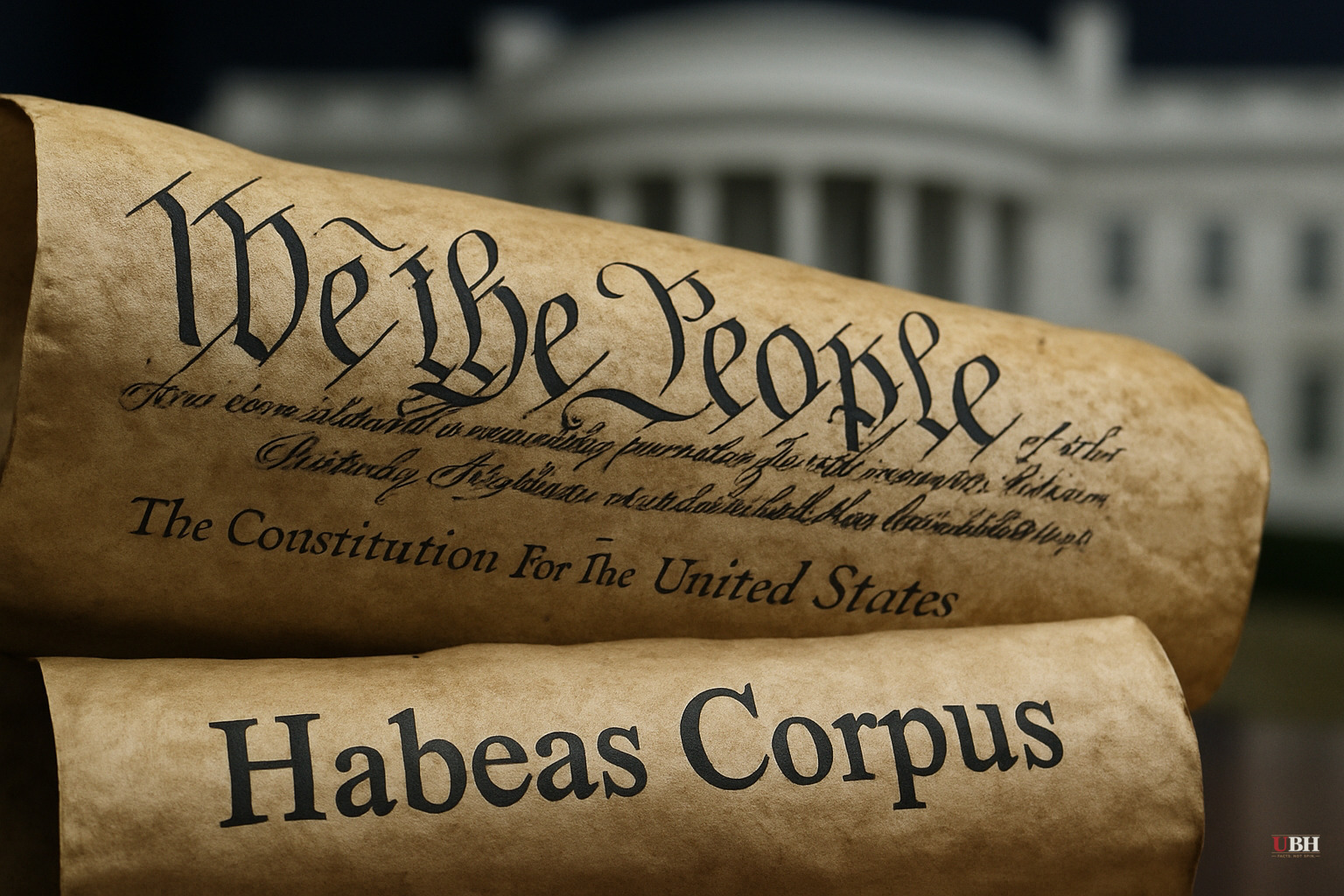
Stephen Miller Says White House Is Actively Considering Suspending Habeas Corpus to Speed Deportations
What Miller Actually Said
Stephen Miller, the Trump administration's top policy architect, told reporters outside the White House that suspending habeas corpus is "an option we're actively looking at." His stated rationale: the Constitution allows the writ to be suspended "in a time of invasion," and the administration has consistently classified illegal border crossings as an invasion.
Miller added a line that drew immediate attention: "A lot of it depends on whether the courts do the right thing or not." That framing, suspension as leverage against the judiciary, is legally and constitutionally significant, according to LiveNOW from FOX's reporting on the statement.
What Habeas Corpus Is
Habeas corpus, Latin for "you shall have the body," is the legal mechanism by which someone in government custody can demand a court review whether their detention is lawful. It does not determine guilt or innocence. It simply requires the government to justify holding a person.
According to Cornell Law School's Legal Information Institute, cited by LiveNOW from FOX, it applies to criminal defendants, immigration detainees, and military prisoners alike. It has been suspended exactly four times in U.S. history: during the Civil War, Reconstruction, the 1905 insurrection in the Philippines, and after Pearl Harbor, according to Democracy Docket.
Who Has the Power to Suspend It
This is where the legal debate gets sharp. Article I, Section 9 of the Constitution places the suspension clause in the section governing Congress, not the executive. As LiveNOW from FOX noted, legal scholars overwhelmingly agree that only Congress can suspend habeas corpus, and the president cannot act unilaterally unless Congress explicitly delegates that authority.
The New York Times, cited by Political Wire, reported that internal White House memos show the administration debated this question more seriously than previously known, suggesting the idea moved beyond Miller's offhand comments into formal legal analysis.
Why the Administration Is Pushing This Now
The Supreme Court ruled last month that individuals targeted for removal under the Alien Enemies Act (AEA), an 18th-century wartime statute Trump invoked earlier this year, must have the opportunity to challenge their removal via habeas corpus petitions, according to Democracy Docket. Since that ruling, federal courts in Texas, Colorado, and New York have successfully halted AEA deportations in response to those petitions.
The administration's response has been to argue in legal filings that federal judges lack authority to review Trump's AEA proclamation at all. Suspending habeas corpus would, if legally achievable, short-circuit that judicial oversight entirely.
The Administration's Legal Argument
The Constitution's suspension clause does not specify who triggers it. It says the writ "shall not be suspended, unless when in Cases of Rebellion or Invasion the public Safety may require it." If a president can credibly demonstrate that an invasion is underway and public safety requires action, a plausible legal argument exists that executive authority extends to the suspension, particularly if Congress is unwilling or unable to act quickly. Historically, Abraham Lincoln suspended habeas corpus unilaterally at the start of the Civil War before Congress ratified his action retroactively. The legal debate over that episode was never fully resolved by the Supreme Court. The administration's lawyers are not inventing this argument from thin air.
The Problems with That Argument
Lincoln's suspension was wartime, involved armed rebellion, and Congress moved to endorse it. The current situation differs in two material ways. First, courts have not recognized undocumented immigration as a legal "invasion" under the constitutional standard, and no court has upheld that framing. Second, Miller's own statement, that suspension "depends on whether the courts do the right thing," frames it as a tool to override judicial rulings the executive dislikes, not as an emergency public-safety measure. Using suspension to circumvent courts reviewing the legality of deportations is a different argument than using it during armed conflict.
Democracy Docket noted that Miller himself called habeas corpus a "privilege," a characterization the outlet pushed back on: it is a right guaranteed by the Constitution's text and centuries of common law.
What Happens Next
No suspension order has been signed. No formal congressional action has been requested. As of June 15, 2026, this remains a stated option under internal deliberation, not an executed policy.
If the administration attempts a unilateral suspension by executive order, courts would almost certainly move to block it immediately. The Supreme Court would face a direct confrontation over whether the president has any independent suspension authority, a constitutional question that has never been definitively settled. How the current Court, which ruled last month that AEA detainees retain habeas rights, would handle that question is unknown.
Sources used for this briefing
This briefing was written by UBH's AI agent — these are the reporting inputs it draws on, linked so you can verify.


