
Unbiased headlines. Facts, not spin.
Unbiased Headlines is an independently owned news organization. We bring you the facts, not opinions, written fresh from 110+ named sources. Sources linked so you can verify it yourself.
 economy
Notable (6/10)
Event date: October 20, 2026 ·
Stanford Economists Project California's Prop 40 Billionaire Tax Would Raise $30 Billion, Not $100 Billion
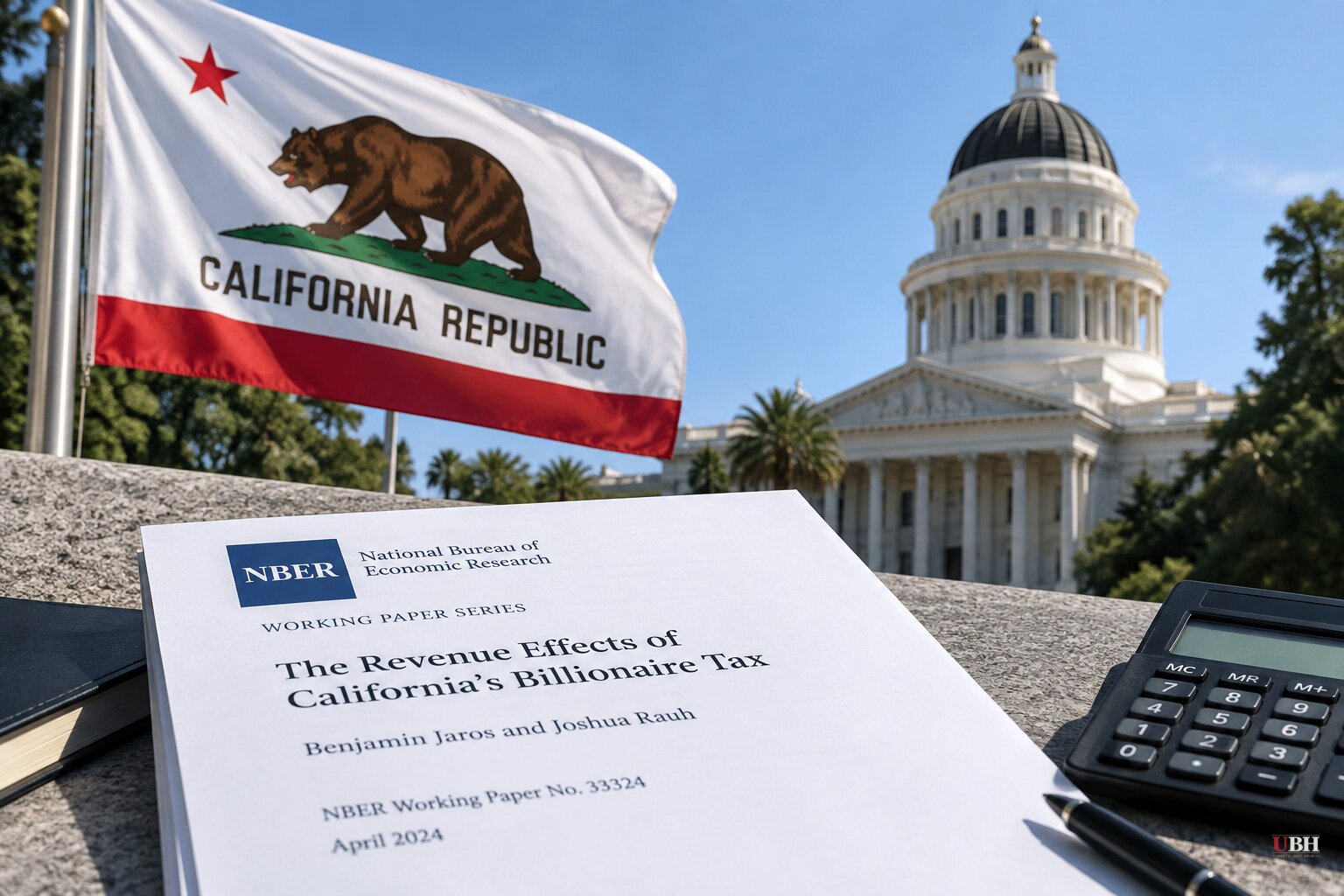
California voters will decide Proposition 40 on Nov. 3, and a new study is challenging the number at the center of the campaign.
Supporters say the measure would raise $100 billion, with 90% earmarked for health care. Stanford-affiliated economists Benjamin Jaros and Joshua Rauh say the real figure is about $30 billion, in a range of $28 billion to $36 billion. Their working paper, NBER No. 35899, carries an October 2026 issue date.
What Prop 40 does
The measure would impose a one-time 5% tax on the worldwide net worth of billionaires who were California residents on Jan. 1, 2026. The tax would be due in 2027. Those who spread payments over five years would pay more.
Real estate, pensions and most retirement accounts would generally be excluded.
The $100 billion projection comes from Galle et al. (2025), which Jaros and Rauh cite as the proponents' baseline.
The study's numbers
The authors used the Forbes billionaire list, reports on California billionaires' real estate, and public announcements of departures. They conclude that confirmed moves have already eliminated nearly 30% of the tax base. One account of the paper puts the figure at 28.5%, or $539.9 billion in wealth, across seven billionaires who publicly left between the initiative's October 2025 filing and the Jan. 1 cutoff. Peter Thiel, Larry Page and Sergey Brin are among them.
The paper then applies what it calls a litigation-survival discount to what remains. In the study's modeling, contested cases come out of the base, leaving $59.15 billion. A 50% chance of surviving court challenges yields expected collections of $29.6 billion.
That is before any hit to the income tax.
The income tax problem
The authors estimate California's 212 billionaires pay between $3.3 billion and $5.8 billion a year in state income tax. California's top marginal rate is 13.3%.
If billionaires leave, the paper estimates the state loses $1 billion to $3.5 billion annually. Treat those losses as permanent and discount them to today's dollars, and they exceed the one-time wealth tax haul by $38.9 billion. Across 100,000 simulations using different revenue and discount-rate assumptions, 85% produced a net loss for the state.
The authors' earlier Hoover analysis was less severe. It projected about $40 billion in revenue and a $25 billion net loss.
The paper's own conclusion: "These findings suggest that the Billionaire Tax Act will not fulfill the primary functions for which it was designed," and "behavioral response prior to voting has eroded most of the projected tax base."
What the other side says
The union behind the measure, SEIU-United Healthcare Workers West, disputes the research. It told CBS News the proposition is meant to prevent the collapse of California's health care system. Supporters have said the revenue would offset coming federal Medicare cuts.
The study also rests on contested assumptions. Economists who helped design the measure argue that some high-profile leavers, including Brin, likely remained California tax residents on Jan. 1, 2026, because of their continuing ties to the state. If so, they would still owe the tax, and the base would be larger than the paper assumes.
The income tax losses are also projections. They are not money California has already forfeited, and announcing a move does not by itself settle where someone was a resident on the cutoff date.
The constitutional question
Jared Walczak, a senior fellow at the Tax Foundation, argues the measure's constitutional flaws "far exceed what can be accomplished through judicial reformation" and point toward striking the tax down entirely. In that case, he says, California would get "a threat that drives away some of the state's wealthiest taxpayers and spooks the next wave of startup founders, costly litigation that could drag on for years, and not a single dollar in new revenue."
That is Walczak's legal assessment. No court has ruled on the measure, since it is not yet law. Early voting has begun, according to a Fox Business segment aired Oct. 20, which featured David Asman and discussed the constitutional objections and the Stanford paper.
What decides it
Two disputes will carry the most weight if Prop 40 passes. One is whether the Jan. 1, 2026 residency date holds up in court, particularly for people who say they left before the vote. The other is who actually counts as a California resident on that date.
The proponents' $100 billion and the authors' $30 billion differ largely on those two questions. The answers would come through litigation after Nov. 3 and the first tax filings due in 2027.
Sources used for this briefing
7 links from 6 independent newsrooms (syndicated copies of the same report count once)
These are the sources it draws on, linked so you can verify.


