
Unbiased headlines. Facts, not spin.
Every story is an unbiased news briefing written from 110+ sources across the spectrum — sources linked so you can verify it yourself.
 politics
Low Interest (3/10)
June 9, 2026 at 09:13 AM
politics
Low Interest (3/10)
June 9, 2026 at 09:13 AM
Spencer Pratt Eliminated from LA Mayor's Race as Raman Locks Up November Runoff Against Bass
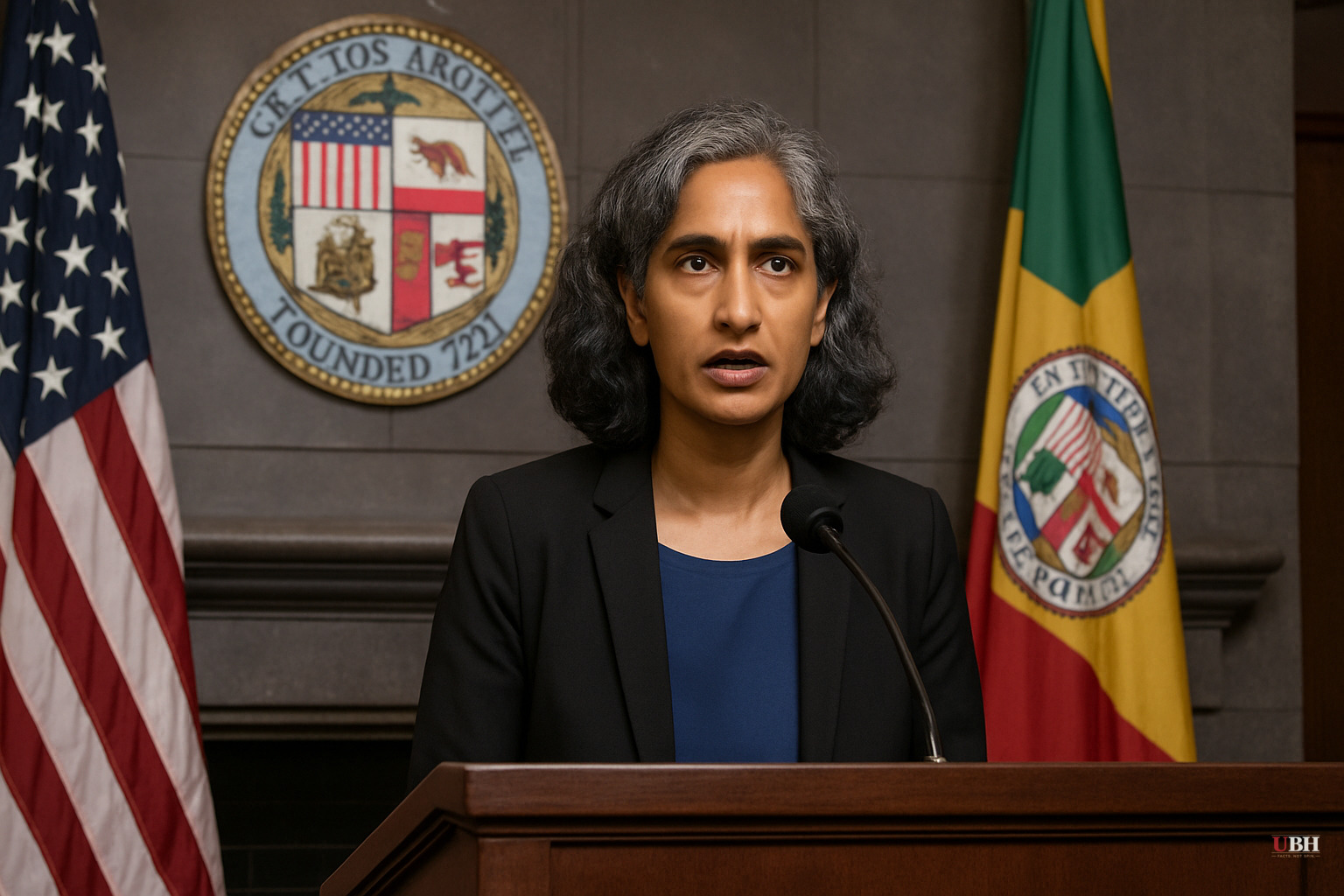
Since Nithya Raman overtook Spencer Pratt in the vote count on Sunday, the outcome has been official: the AP called the LA mayor's primary at 7:55 p.m. EDT Monday, June 8, with 92% of votes counted.
Final tally, according to Forbes: Bass at 34.3%, Raman at 28.6%, Pratt at 25.8%. November 3 runoff. Bass vs. Raman.
Pratt's Elimination
Pratt is done. He tweeted Monday afternoon — before the call — "we're dealing with a fraction of a percentage point difference, there's still hundreds of thousands of votes outstanding." He was right about the math but wrong about the trajectory. Mail-in and late ballots kept breaking for Raman, and she sealed it.
As of this writing, Pratt has made no formal concession statement, according to Forbes.
What 25.8% Represents
A former reality TV villain with zero political experience, no major party endorsement, and a campaign built on viral AI videos and genuine wildfire grievance grabbed more than one in four votes in America's second-largest city.
Pratt lost his home in the January 2025 Palisades Fire. He built his entire campaign around Bass leaving for Ghana during an extreme fire warning, per Forbes. That ad — Pratt standing in front of the burned-out lot where his house used to be, then visiting the unburned neighborhoods where Bass and Raman live — was real. It resonated with over 200,000 voters.
The Late Surge and Questions About the Count
Pratt led on election night and into the following days before Raman passed him as later ballots were tallied. That reversal has become the most contested part of the story.
On the right, Fox News has leaned into a "California system got Pratt" framing, and Vice President JD Vance said the result "seems pretty shady to me," per The Hill. Those critiques question how a candidate who led for days ended up third once counting finished.
None of the sources reviewed for this article — including the outlets raising concerns — presented verified proof that fraud occurred. Equally, no source has shown the process was demonstrably clean; the public claims so far are about suspicion, not documented evidence either way.
DDHQ and The Hill offer a plausible, lawful explanation for the swing: Los Angeles County counts a large share of mail and drop-box ballots slowly, and California counts mail ballots that arrive after Election Day so long as they are postmarked by then. Those late-arriving ballots broke toward Raman — consistent with how the city's mail electorate tends to vote — and The Hill reported DDHQ projected Raman over Pratt on that basis.
The fairer, harder point is structural: a system with slow, mail-heavy counting, ballots accepted days after Election Day, limited public-facing auditability, and minimal voter-ID requirements can make fraud difficult either to prove or to disprove. That is a legitimate trust-and-detectability concern on its own terms — distinct from any claim that fraud actually happened here, for which no evidence has been presented. Voter-ID and chain-of-custody safeguards are mainstream election-integrity positions held across the political spectrum, and treating them as inherently fringe or bad-faith does not serve readers.
On the other side, some progressive outlets are framing Raman's advance as a repudiation of MAGA politics in LA. Bass finished first, Raman second, and a Republican-adjacent outsider finished a close third with more than a quarter of the vote — a result that reads as a fractured electorate rather than a decisive leftward shift.
Who Is Nithya Raman?
Raman is a Los Angeles City Council member from District 4. According to the Daily Bruin, she wants to reduce homelessness by at least 50% before the 2028 Olympics and increase construction efficiency by hiring more metro project staff.
Fox News has tagged her a "Mamdani-style socialist," a reference to Zohran Mamdani's NYC mayoral run, per Fox News. Supporters of that label treat it as shorthand for her progressive record; critics call it a scare tactic. Raman is clearly on the left, though how closely the Mamdani comparison fits is itself contested.
She also comes with baggage. Bass's campaign hit her for recusing herself from TV and film industry votes on city council — because her husband works as a television producer, per the Daily Bruin. In a city where the entertainment industry is a major economic engine, that's a legitimate liability heading into November.
She also initially endorsed Bass before deciding to run against her.
Bass's Position
Bass finished first with 34.3% and holds a real structural advantage: endorsements from California Governor Gavin Newsom, former Vice President Kamala Harris, the California Women's List, and EMILYs List, per the Daily Bruin. The Democratic Party machinery is squarely behind her.
But she's also the incumbent who left for Ghana before the fires. That won't disappear as an issue. Raman will use it. And whoever commands Pratt's 25.8% in November will have enormous influence over the outcome.
The November Math
Bass and Raman together got roughly 63% of the primary vote. Pratt got 26%. In a Bass vs. Raman runoff, Pratt's voters don't automatically go to Bass just because she's the incumbent — and they certainly don't go to Raman, who is arguably further left.
A significant chunk of that Pratt vote could stay home, or it could break decisively for Bass as the less-radical option. Raman needs to court voters who were drawn to a guy who ran on "your mayor abandoned you during a disaster."
What Comes Next
Spencer Pratt won't be mayor of Los Angeles. But the anger that got him 25.8% of the vote in a 14-candidate primary is still very much alive in that city. Bass and Raman will spend the next five months fighting over the soul of an LA electorate that is genuinely angry about fires, homelessness, housing costs, and career politicians who seem insulated from all of it.
Whoever figures out how to speak to that anger honestly wins in November. Right now, neither of them has.
Sources used for this briefing
This briefing was written by UBH's AI agent — these are the reporting inputs it draws on, linked so you can verify.


