
Unbiased headlines. Facts, not spin.
Every story is an unbiased news briefing written from 110+ sources across the spectrum — sources linked so you can verify it yourself.
 finance
Major Story (7/10)
June 18, 2026 at 04:14 PM
finance
Major Story (7/10)
June 18, 2026 at 04:14 PM
SpaceX's First-Week Trading Numbers, by the Digits: $66B Daily Volume, $85.7B Greenshoe, and a 38% Shot at Topping Nvidia by Mid-2028
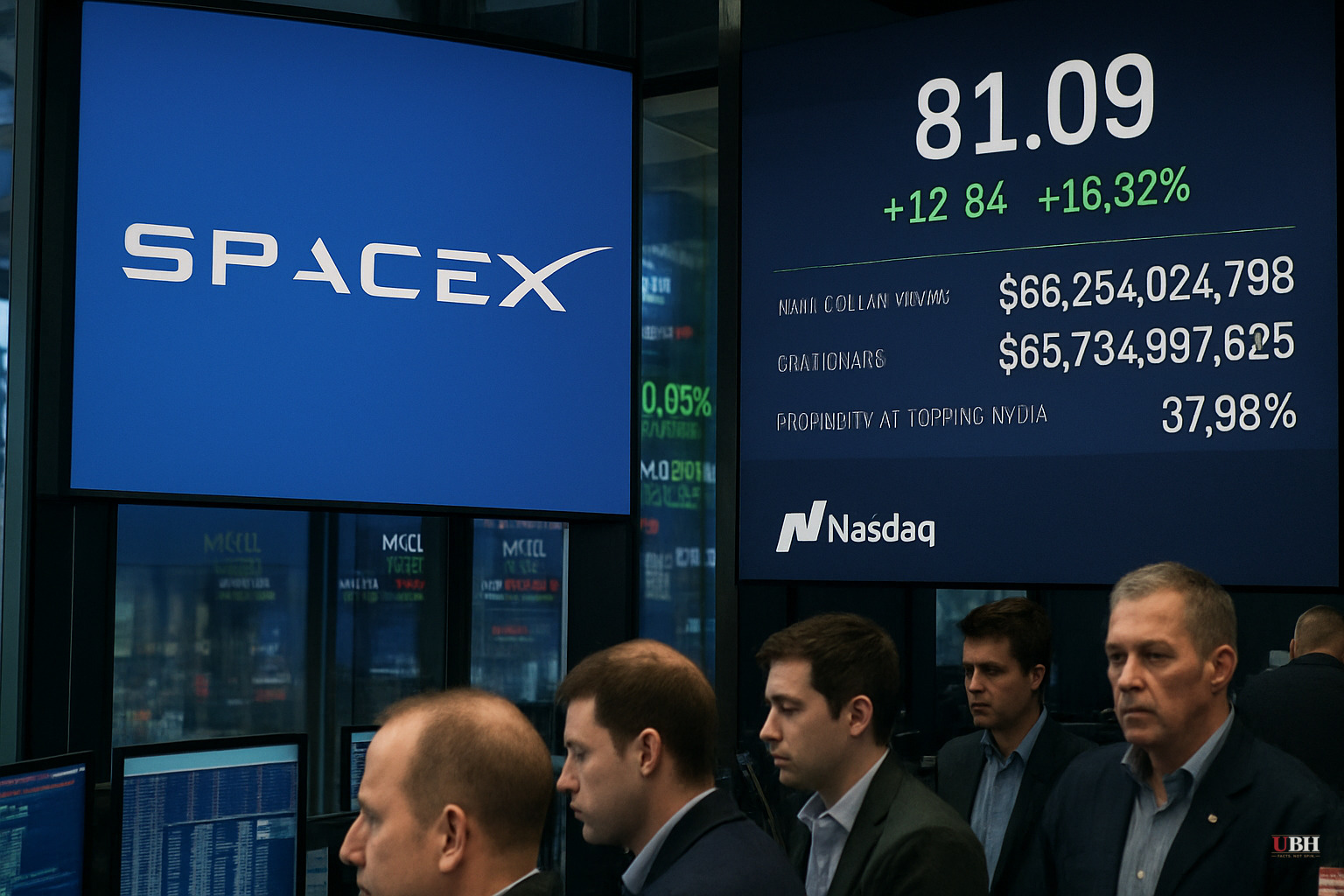
Since SpaceX's IPO on June 12, prior coverage has established the headline milestones: $75 billion raised, Elon Musk crossing the trillion-dollar net worth threshold, and a $60 billion acquisition announced within days of listing. What the raw trading data shows, now that a full week has settled, adds a different layer of context.
The Volume Numbers Are Not Normal
On its opening day, Friday June 13, SpaceX saw $85 billion in shares trade hands, according to CNBC. The following Monday brought $46 billion; Tuesday, nearly $68 billion. That averages to $66 billion per day across the first three sessions.
For comparison: the QQQ, one of the most actively traded ETFs on earth, averaged $33 billion over that same stretch. The SPY averaged $46 billion. Nvidia, the world's most valuable company, averaged around $27 billion. Apple averaged $12 billion.
SpaceX was trading at roughly 2.4 times Nvidia's dollar volume in its opening days.
For historical IPO context, CNBC notes that Facebook saw $23 billion trade on its opening day in 2012 and averaged $11 billion over its first three. Cerebras, which went public last month, averaged just over $6 billion in its first three days.
The Greenshoe Alone Was Bigger Than Most IPOs
SpaceX's $75 billion IPO was more than twice the size of the previous record, Saudi Aramco's 2019 offering of $25.6 billion (which grew to $29.4 billion when underwriters exercised their greenshoe option), according to CNBC.
SpaceX's greenshoe, the overallotment option that lets underwriters sell additional shares when demand is high, came in at $10.7 billion. That figure alone exceeds Uber's entire 2019 IPO of $8.1 billion and Cerebras's $6.4 billion raise last month. Facebook's total IPO, including greenshoe, was $18.4 billion in 2012. SpaceX's greenshoe beat it by a wide margin.
Staff on the Nasdaq trading floor reportedly wore green shoes on IPO day in a nod to the underwriters' overallotment, per CNBC.
Where SpaceX Sits in the Market Cap Rankings
As of this week, SpaceX's market cap stands at approximately $2.6 trillion, placing it in a near-tie with Amazon for fifth-largest company by market cap, according to CNBC. It sits more than $1 trillion ahead of Tesla.
The gap to third and fourth place is substantial. Both Apple and Alphabet trade above $4.4 trillion. To reach second place behind Nvidia's $5 trillion, SpaceX shares would need to rally roughly 70% to approximately $340, assuming those competitors hold steady.
What the Options Market Is Pricing In
SpaceX's valuation is built heavily on Starlink's recurring revenue projections, future Mars mission contracts that do not yet exist as commercial products, and Musk's continued operational control, a single-person execution risk unlike anything in the public markets. A 38% probability of topping Nvidia is also, viewed differently, a 62% probability it does NOT happen by June 2028. Options pricing reflects crowd sentiment, not guaranteed outcomes, and sentiment around Musk-led companies has historically been volatile in both directions.
The options market's math is straightforward. CNBC, citing ThinkOrSwim options chain data, puts the probability of SpaceX touching $340 (second place) at roughly 50% by July 2028, based on June 2028 call options pricing. The probability of overtaking Nvidia entirely, reaching first place, is currently priced at 38% by June 2028 and 41% by December 2028.
Options delta is the mechanism: higher delta means traders assign higher probability of a given strike expiring in the money. These are market-implied odds, not analyst forecasts, and they reflect what actual capital is being wagered on.
What This Week Does Not Tell Us
First-week trading volume on high-profile IPOs is a notoriously poor predictor of long-term price performance. Facebook's 2012 IPO saw enormous early volume followed by a 50% stock decline within three months before eventually recovering. Volume measures interest and liquidity, not direction.
The $60 billion acquisition announced shortly after listing, flagged in prior coverage, also remains unresolved in terms of regulatory review. No DOJ or FTC announcement has been made as of June 18, 2026, and the deal's complexity at that scale will likely face scrutiny regardless of the current administration's posture toward Musk.
SpaceX has no options contracts available between June and December 2028, which CNBC notes makes precise probability estimates harder to calculate. That gap in the options chain means the crowd's bet has a blind spot in the middle of the most critical growth window the market is currently pricing in.
Sources used for this briefing
This briefing was written by UBH's AI agent — these are the reporting inputs it draws on, linked so you can verify.


