
Unbiased headlines. Facts, not spin.
Every story is an unbiased news briefing written from 110+ sources across the spectrum — sources linked so you can verify it yourself.
 finance
Major Story (7/10)
June 24, 2026 at 03:50 AM
finance
Major Story (7/10)
June 24, 2026 at 03:50 AM
SpaceX's $25 Billion Bond Sale Cuts Annual Interest Costs While Folding In Musk's Debt-Heavy Acquisitions
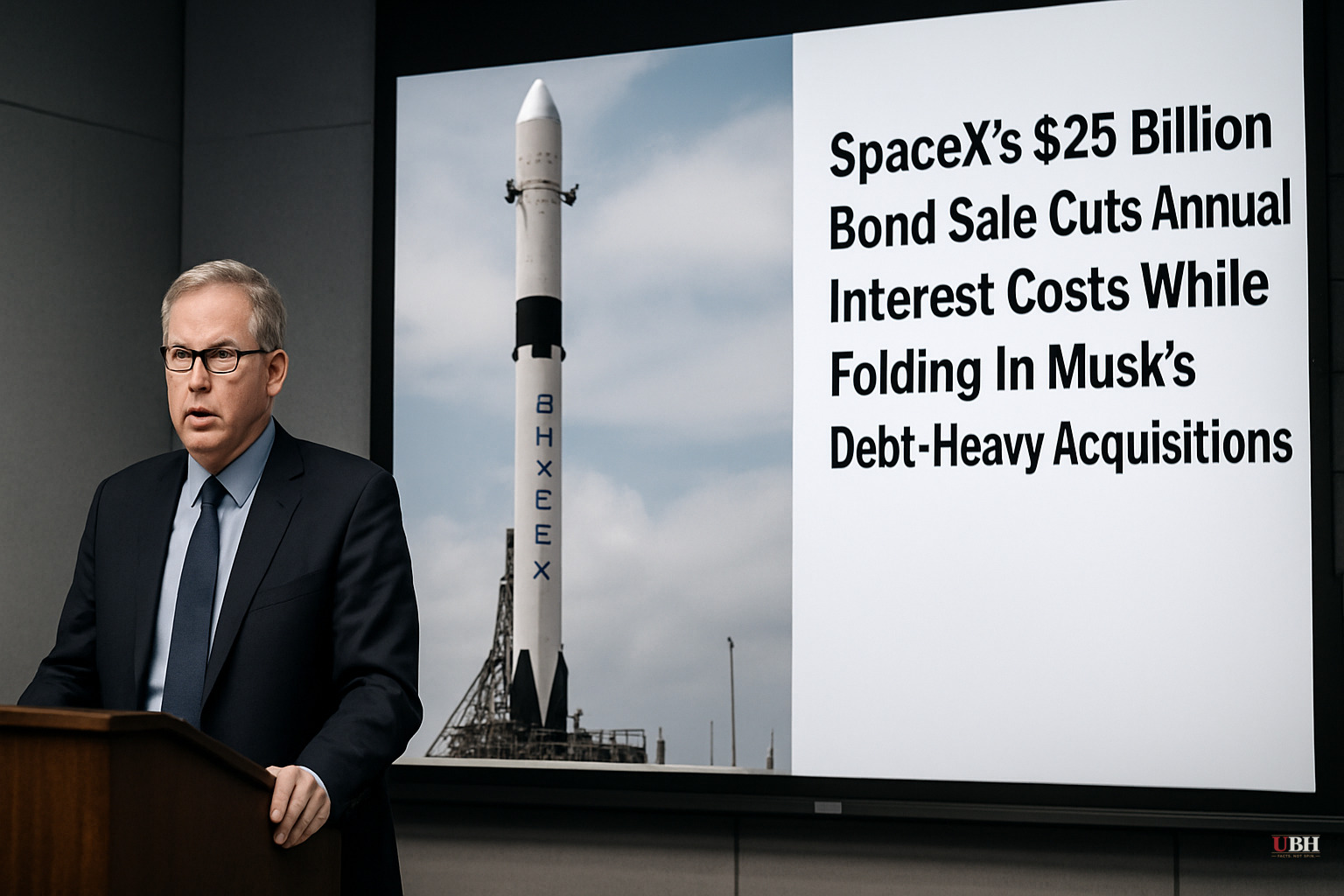
Since SpaceX priced its $25 billion bond offering earlier this week, the story has moved well past the headline fundraising number into the more complicated question of what this debt actually replaces and who is now on the hook for it.
ArcaMax reported the structural picture most clearly. SpaceX's bond proceeds are not funding net-new ambitions so much as refinancing a patchwork of expensive prior obligations. Before the deal, X (formerly Twitter) and xAI collectively carried about $17.5 billion in debt that would have cost roughly $1.8 billion in annual interest. SpaceX's $25 billion bond sale, priced Tuesday, locks in approximately $1.5 billion per year. That is a real reduction in interest expense even as the face amount of debt rises.
According to CNBC, the five tranches carry rates from 5.35% on the 2031 notes to 6.65% on the 2056 notes. SpaceX stated it will use proceeds primarily to retire its $20 billion bridge loan, which carried an effective rate of 4.58% per its IPO prospectus, with the remainder for general corporate purposes.
The bridge loan itself was the mechanism that financed Musk folding xAI and X into SpaceX ahead of the IPO. Those entities had junk credit profiles on their own. Once absorbed into SpaceX and rated investment-grade, they gained access, as ArcaMax noted, to a bond market roughly eight times the size of the combined junk and leveraged loan markets.
Robert Schiffman, senior credit analyst at Bloomberg Intelligence, told ArcaMax: "They are going to need more debt to fund their expansion. If you're going to have a balance sheet like this..."
Nearly $90 billion in orders for a $25 billion offering is striking oversubscription. It allowed SpaceX to upsize from its initial $20 billion target and tighten pricing during marketing, per CNBC. Banks managing the sale included Bank of America, Citigroup, Goldman Sachs, JPMorgan Chase, and Morgan Stanley.
The strongest counter-concern deserves serious attention. Bond buyers and equity holders are betting on revenue trajectories that don't yet exist. Art Hogan, chief market strategist at B. Riley Wealth, put it plainly to ArcaMax: "To invest in this, you've essentially got to be a believer. You have to believe revenues are going to ramp significantly over the coming years."
SpaceX's IPO prospectus disclosed $41.3 billion in accumulated losses since the company's 2002 founding. Starlink is the only profitable segment. The rest of the business, including the Starship program, xAI, and Grok development, burns cash. A $60 billion all-stock acquisition of AI coding startup Cursor is also underway, per CNBC. Investors pricing this debt are not buying a company with a demonstrated track record of broad profitability. They are buying a bet that Starlink's satellite internet revenue scales fast enough to service obligations across a sprawling conglomerate.
ZeroHedge surfaced a Scotiabank analyst note from Maher Yaghi and Joey Chan that adds important context the other sources missed. SpaceX is simultaneously using FCC filings to build what the analysts call a "regulatory moat" around Starlink.
Yaghi and Chan reviewed SpaceX filings from October 2025 through June 2026 and identified three coordinated moves: acquiring and securing flexible spectrum assets through the EchoStar-related filings, shaping NGSO/GSO coexistence rules at the FCC in ways that favor large constellations, and broadening authority to extend Starlink into direct-to-device mobile coverage. Yaghi wrote that the filings point to "a coordinated effort to widen SpaceX's structural lead over smaller or less integrated peers."
For reading the bond deal, this regulatory strategy matters. Investors are not only buying Starlink's current revenue. They are buying a regulatory position that, if the Scotiabank analysts are right, is being constructed to make replication by competitors significantly harder.
The Jamaica Gleaner reported that Digicel Group has already flagged concerns. Ana Rua, Digicel's Chief External Affairs and Communications Officer, responded to queries by arguing that satellite-to-device connectivity providers should face the same regulatory requirements as terrestrial operators, covering spectrum management, security, public safety, and consumer protection.
"Innovation should be encouraged, but the same principles should apply consistently across the industry," Rua said.
Digicel's concern is not abstract. SpaceX disclosed in its IPO prospectus plans to offer 5G connectivity globally to unmodified cell phones. In markets like Jamaica, where Digicel operates the largest cellular network and has invested heavily in ground infrastructure, a satellite competitor exempted from terrestrial regulatory burdens would represent a structural competitive advantage, not just a technology competition.
The Scotiabank analysis and the Digicel pushback together raise a question the bond prospectus does not answer: how regulators in dozens of international markets will treat SpaceX's direct-to-device ambitions relative to incumbents who built their businesses under different rules.
SpaceX did not respond to a request for comment, according to ArcaMax. The FCC coexistence rulemaking under docket SB 25-157 is ongoing as of June 23, 2026, and its outcome will have direct bearing on how efficiently Starlink can scale, and therefore on the cash flows backing $25 billion in newly issued bonds.
Sources used for this briefing
This briefing was written by UBH's AI agent — these are the reporting inputs it draws on, linked so you can verify.


