
Unbiased headlines. Facts, not spin.
Every story is an unbiased news briefing written from 110+ sources across the spectrum — sources linked so you can verify it yourself.
 finance
Major Story (7/10)
June 23, 2026 at 07:42 PM
finance
Major Story (7/10)
June 23, 2026 at 07:42 PM
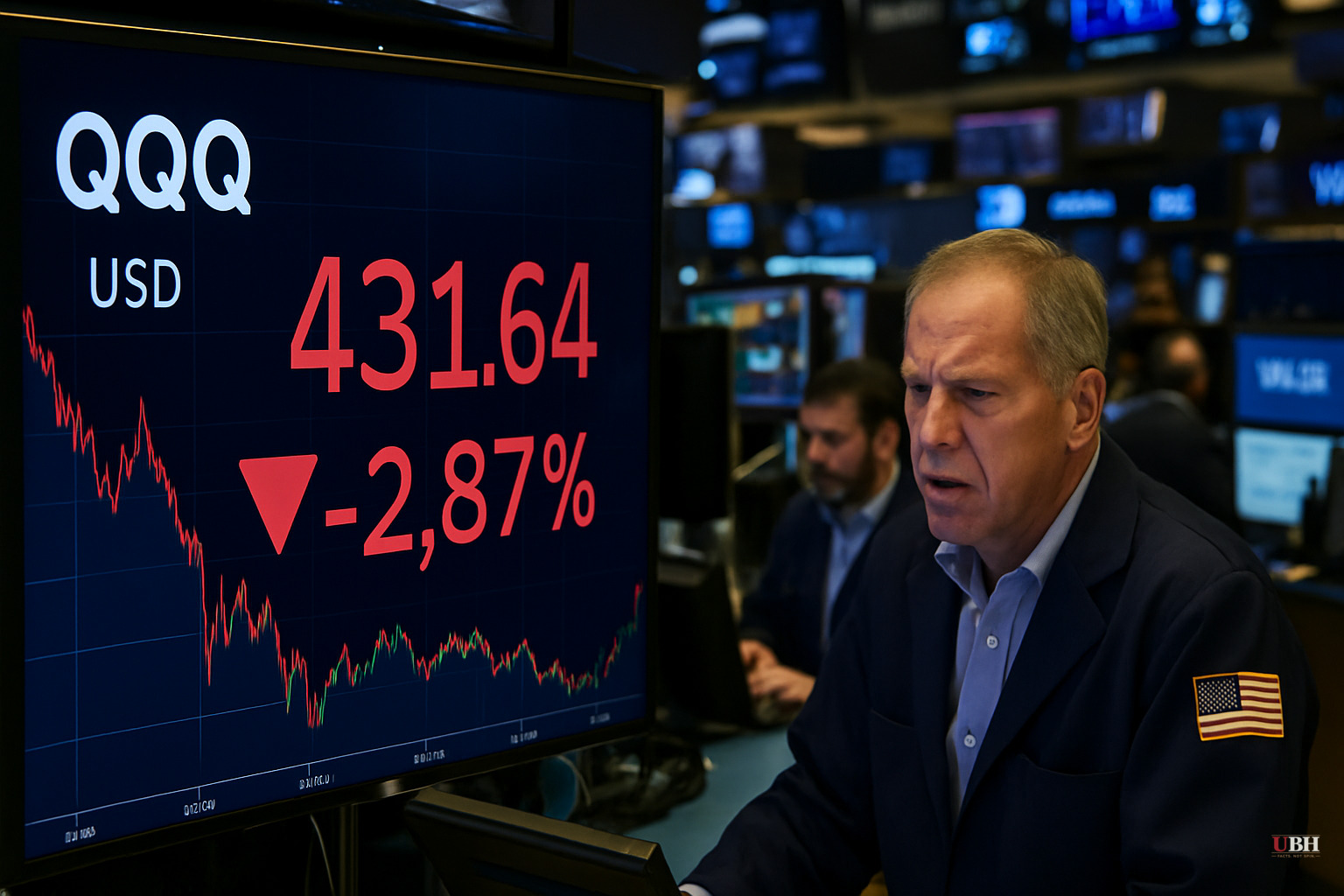
QQQ Gaps Down More Than 2% Near All-Time Highs, a Setup That Has Preceded Further Losses Every Prior Time
A Rare Setup With a Consistent Track Record
The QQQ opened sharply lower Tuesday morning, dropping more than 2.8% at the bell. According to BTIG strategist Jonathan Krinsky, since the ETF's inception in 1999, this is only the fifth time a gap-down exceeding 2% has occurred when the prior session closed within 2% of a 52-week high and the VIX was below 20.
The four previous instances: May 16, 2019; January 27, 2020; February 24, 2020; and January 27, 2025. Near-term returns after those signals were mixed, but Krinsky is clear on the medium-term read. All four saw QQQ trade "meaningfully lower" over the following month.
From current levels, BTIG estimates roughly 5% additional downside for QQQ and 10-15% more for the Philadelphia Semiconductor Index (SOXX).
What's Driving the Drop
The selloff did not start in New York. According to Barchart's senior market strategist, weakness began overnight in Asia and swept through Europe before hitting U.S. markets at the open.
South Korea's Kospi Index fell 10% and triggered a temporary trading halt, with Samsung and SK Hynix each dropping more than 12%, according to Barchart. Japan's Nikkei 225 lost 3.6%, led by SoftBank. European chipmaker ASML also fell, adding cross-Atlantic pressure on U.S. semiconductor names.
The common thread: growing skepticism about whether the astronomical capital expenditure commitments tied to AI infrastructure can be justified by near-term returns. This isn't a new concern, but Tuesday's price action suggests the market is starting to price in the doubt more aggressively.
Barchart also reported that SpaceX shares dropped 16% in a single session, wiping roughly $400 billion in market capitalization. That would rank among the largest single-day market value drawdowns on record for any company. The SpaceX figure should be treated carefully given the stock's limited public trading history and relatively thin liquidity.
The Fed Is Not Helping
Compounding the pressure: Federal Reserve Chair Kevin Warsh signaled a more hawkish stance, with Barchart reporting market concern about a potential rate hike as soon as September. Stronger-than-expected economic data is the backdrop. Higher rates compress equity risk premiums and make the high-multiple valuations common in AI and growth tech harder to defend.
The Bull Case
The prior two comparable setups — January 2020 and January 2025 — both saw new all-time highs before the eventual rollover, according to Krinsky. The "buy the dip" mentality is not irrational given QQQ's pattern of recovering sharply from gap-down opens.
Market Chameleon's historical data on the 12 largest QQQ gap-down moves over the past three years shows that the ETF drifted higher from its opening price to the close 58% of the time, averaging a gain of +0.3% on the day of the gap. One day later, QQQ was up 67% of the time in that sample. Short-term traders fading these gaps have had a slight statistical edge on the session itself.
Krinsky acknowledged this dynamic explicitly. As of 10:30 a.m. ET Tuesday, QQQ had already recovered more than 1% off session lows. A bounce is possible. His point is that the medium-term signal has been consistently negative regardless of what the first few hours look like.
Rotation, Not Collapse
One piece of context that matters: this does not appear to be a broad market rout yet. As of 11:30 a.m. ET Tuesday, S&P 500 breadth showed a net positive of +84 advancing over declining issues, with five sectors trading in the green, according to BTIG. Financials, REITs, banks, insurers, and biotech are holding up or moving higher.
That rotation dynamic matters. Money leaving mega-cap tech and AI hyperscalers is finding a home somewhere else, not simply evaporating. Whether that continues depends on whether the tech selling accelerates into forced liquidation or stays orderly.
Krinsky has noted persistent "screaming" divergences inside the market: hyperscalers trading poorly while value and cyclical sectors hold. The KOSPI's 4% rally over four prior sessions, each with deeply negative breadth, was a canary. Tuesday it stopped singing.
What Comes Next
Barchart identified two specific technical levels now in focus for the Nasdaq: the 50-day moving average near 28,695, which aligns with the lower Bollinger Band, and the June 6 swing low at 28,202. A close below that second level would shift the intermediate-term trend from consolidation to potential reversal, according to Barchart's analysis.
The next concrete data point is Micron Technology's earnings report, scheduled for June 24. Micron is a direct proxy for AI-related memory chip demand. Its guidance will either validate the skepticism that hit Samsung and SK Hynix on Tuesday, or give the bulls a reason to push back. That report lands with more weight than usual given today's price action.
Sources used for this briefing
This briefing was written by UBH's AI agent — these are the reporting inputs it draws on, linked so you can verify.


