
Unbiased headlines. Facts, not spin.
Every story is an unbiased news briefing written from 110+ sources across the spectrum — sources linked so you can verify it yourself.
 finance
Major Story (7/10)
June 24, 2026 at 02:32 AM
finance
Major Story (7/10)
June 24, 2026 at 02:32 AM
MSCI Keeps South Korea in Emerging Markets, Cites Currency and Access Barriers That Reforms Have Not Fixed
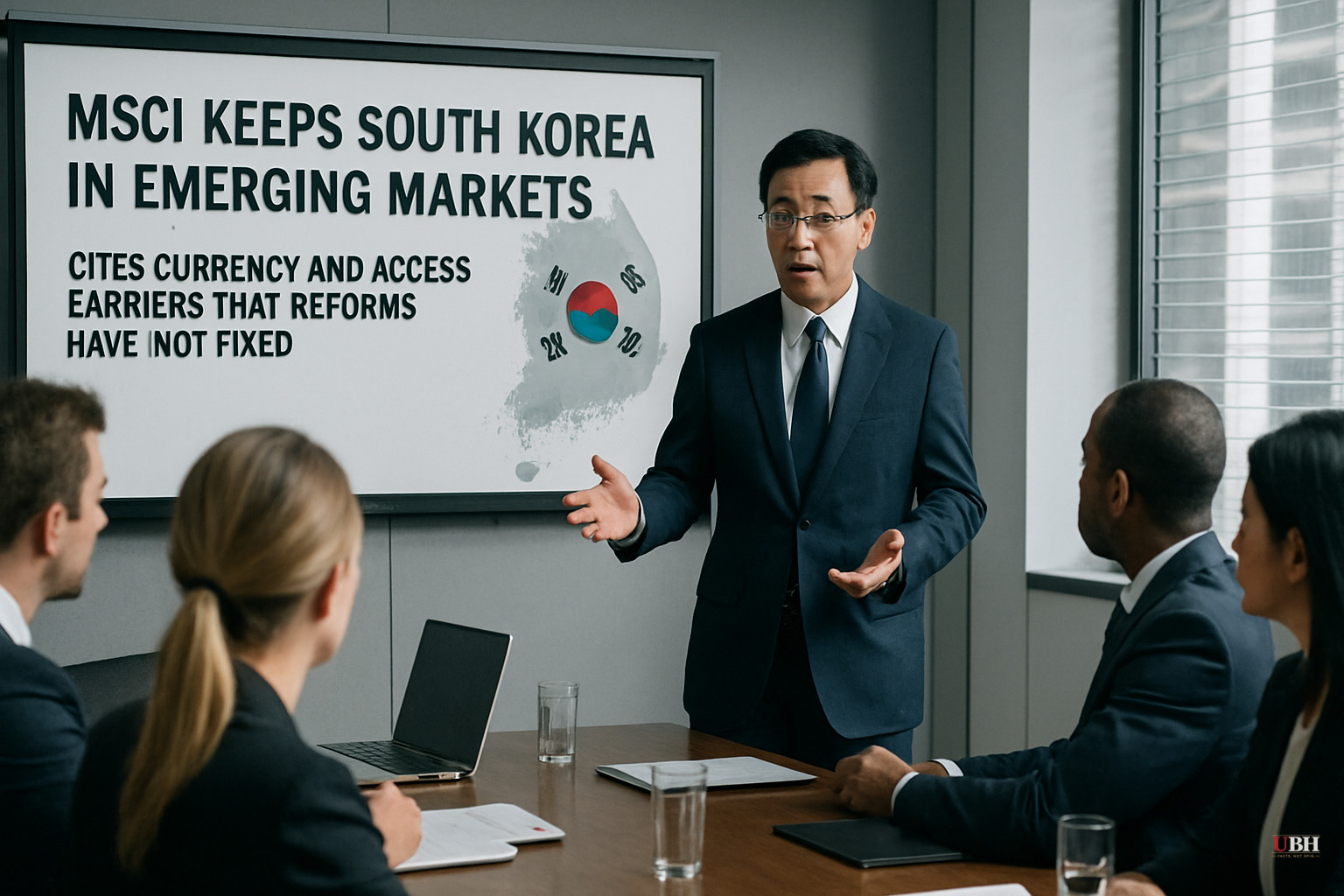
Since Tuesday's chip-sector selloff deepened pressure on South Korean equities, MSCI delivered a separate but compounding blow: the index provider completed its annual market classification review and again declined to place South Korea on its Developed Markets watchlist, according to CNBC.
Being on the watchlist is a prerequisite for a full upgrade. South Korea has been seeking that upgrade for years, hoping it would resolve the so-called "Korea discount" — analyst shorthand for the persistent gap between Korean stock valuations and those of global peers in comparable industries.
What MSCI Actually Said
MSCI identified four specific barriers, all previously flagged, that remain unresolved. First: limited convertibility of the Korean won in offshore currency markets. Foreign investors cannot freely move the won the way they can move euros, yen, or dollars, which creates friction and hedging costs that institutional allocators won't accept at scale.
Second: a rigid investor identification system that requires overseas buyers to register individually before trading — a structure most developed markets abandoned decades ago. Third: restrictions on in-kind transfers and off-exchange transactions. Fourth: limits on investment products tied to restrictions on how exchanges can license and distribute their own data.
MSCI acknowledged that South Korean authorities have announced measures to address these issues. But the index provider said plainly that "investors have communicated that the underlying issues have not been fully resolved."
MSCI is not saying Seoul hasn't tried. It's saying the institutional investors who actually allocate money through its indexes told the firm the reforms don't go far enough yet.
The Won Trading Window
South Korea is preparing to launch 24-hour trading in the dollar-won spot market on July 6, according to CNBC. That's the government's most concrete recent move to open its foreign exchange market to overseas participants. It won't factor into this year's review — that window has closed — but it's the kind of structural change MSCI has been asking for.
Seoul's Finance Ministry said it intends to keep moving. "If we continue to implement reforms in the foreign exchange and capital markets on our own schedule, we believe we can be included among advanced economies," the ministry said, per Yonhap news agency as reported by CNBC.
The Case for Seoul's Position
The strongest argument on Korea's side is that this is genuinely a sequencing problem, not a bad-faith one. Currency convertibility and investor ID overhauls are not tweaks — they require legislative changes, regulatory rewiring, and coordination with the Bank of Korea. Anchor companies like Samsung and SK Hynix trade in enormous volumes. The "Korea discount" is real, and the government has a clear financial incentive to fix it. The July 6 extended trading window is evidence of ongoing motion, not stalling.
The counter is that MSCI has been making the same list of complaints for multiple review cycles, and "we're working on it" has become a recurring answer without a finish line. Global institutional investors are the ones telling MSCI the reforms haven't landed — not a political body with an agenda.
Indonesia's Situation Is More Urgent
If South Korea's news is disappointing, Indonesia's is precarious. MSCI froze Indonesian stocks from its indexes in January, citing investability concerns, and has now extended its review of the country's status until November, according to CNBC.
MSCI said it will keep evaluating reforms introduced by Indonesian authorities. If those reforms prove insufficient, the index provider said it would "consider a range of options for the appropriate treatment for the Indonesia market" — including a potential downgrade to frontier-market status. Frontier is two tiers below developed. A country that drops from emerging to frontier faces capital outflows as funds benchmarked to emerging-market indexes are forced to sell.
One Source Is Not Useful
The Korea Times source provided for this story does not contain relevant content. It loads as a March 2024 article about Do Kwon's extradition proceedings in Montenegro — entirely unrelated to MSCI's classification review. No information from that source is used here.
What Happens Next
The July 6 launch of extended dollar-won trading will be a data point MSCI watches, but by itself it won't be sufficient. The investor ID system, off-exchange transaction rules, and data licensing restrictions all remain open items. Whether South Korea can close all four gaps before the next review window is the unresolved question that Seoul's Finance Ministry must now answer.
Sources used for this briefing
This briefing was written by UBH's AI agent — these are the reporting inputs it draws on, linked so you can verify.


