
Unbiased headlines. Facts, not spin.
Every story is an unbiased news briefing written from 110+ sources across the spectrum — sources linked so you can verify it yourself.
 finance
Major Story (8/10)
June 23, 2026 at 06:04 AM
finance
Major Story (8/10)
June 23, 2026 at 06:04 AM
SpaceX Stock Shed $600 Billion in Market Cap in a Single Day After Record Retail IPO Buying
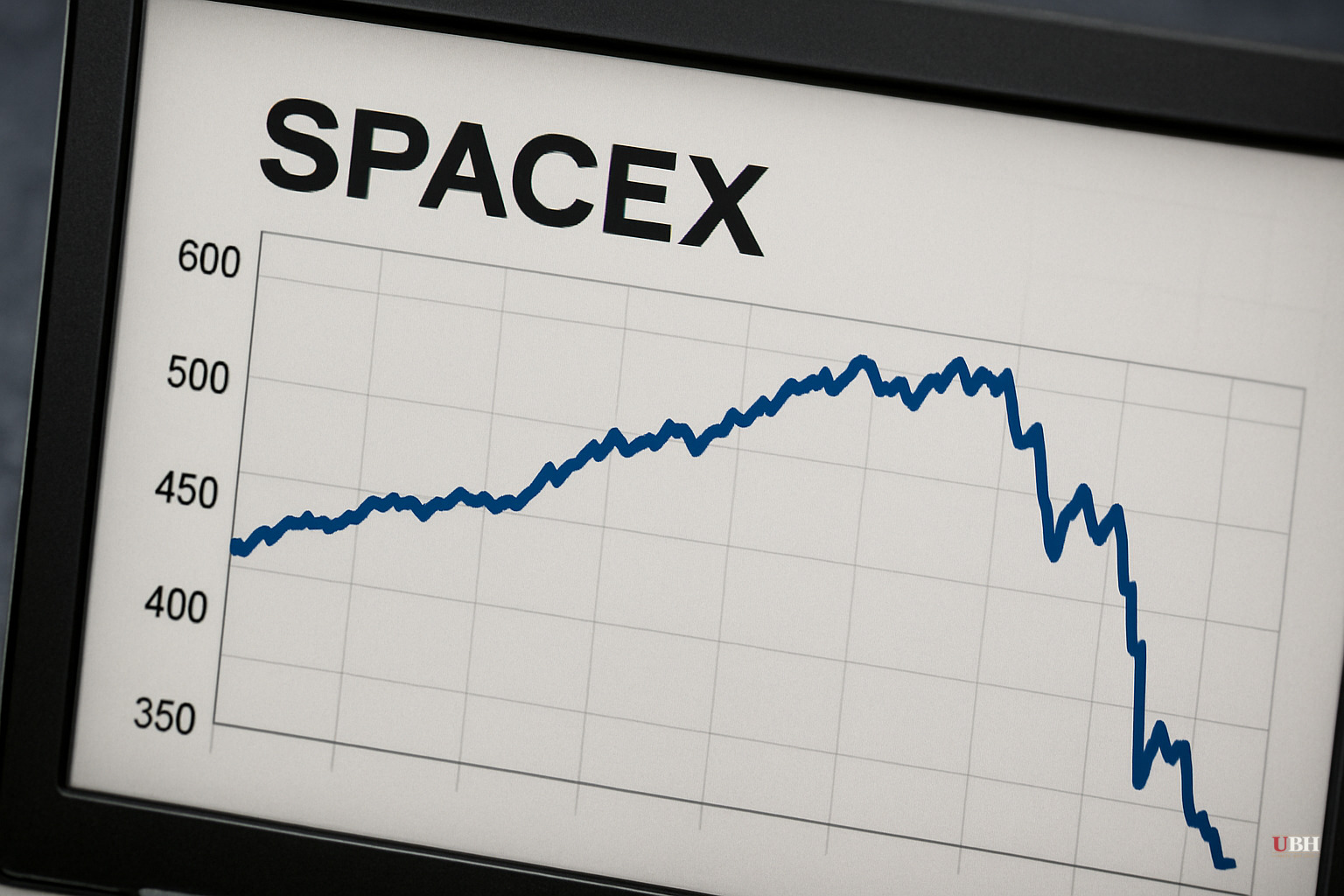
Since SpaceX began trading on June 12, the stock has completed one of the fastest round-trips in large-cap history: record retail inflows followed by a single-day wipeout of $600 billion in market capitalization.
What the IPO numbers actually looked like
SpaceX priced at $135 and opened at $150 on its first day, according to ZeroHedge. Within two trading days, options traders were targeting $380 calls expiring within days, a classic setup for a gamma squeeze attempt.
Retail investors bought a net $405 million of SPCX during its first five trading sessions, according to Vanda Track. That figure, Vanda noted, was "comfortably the strongest retail IPO debut in recent history." For context: retail bought more SPCX in one week than they bought across all other Mag 7 stocks combined over the same period.
Canaccord described what it called a "new level of frenzy" in a note published Monday. Their analysts observed that SpaceX's market cap, within its first week, added the equivalent of roughly half the value of Meta. The stock entered the top six companies by market cap globally. Canaccord also flagged something worth keeping in mind: SpaceX's market cap surpassed Tesla's, despite SpaceX generating only about 20% of Tesla's revenue base.
The revenue reality
SpaceX's 2025 revenues break down as follows, per Canaccord: Starlink connectivity contributed $11.39 billion, launch services generated $4.1 billion, and AI compute came in at $3.2 billion. The company is primarily a connectivity business, not a rocket company, by revenue.
That revenue base is real, but it was being priced at a multiple that assumed years of hyper-growth had already arrived. When a stock's market cap blows past its far-larger sibling company on a fraction of the revenue, that premium is borrowing from the future.
One-day loss of $600 billion
Then came the collapse. After peaking on June 16 — the day SPCX hit a record $225 and briefly topped Microsoft in market cap — daily retail flows collapsed and the stock slumped for three straight days. The culmination was a single-session plunge of 16.4%, shedding a record $600 billion in market value, according to ZeroHedge. Following a 5% drop on Wednesday and a 3.5% slide on Thursday, the stock was left just barely above its opening trading price of $150 from two weeks prior. The stock also tagged that $150 post-IPO opening price after hours.
To put the number in perspective: $600 billion is larger than the entire market cap of most Fortune 500 companies.
What drove the collapse
ZeroHedge reported that the plunge coincided with SpaceX rushing to sell over $20 billion in investment-grade bonds — its first such offering — to refinance an existing bridge loan before the bond market window closed. Meanwhile, the market was absorbing the reality that 95% of SPCX float remains locked up, with significant unlocks on the horizon: a 20% insider share unlock is expected after SpaceX's earnings announcement in early to mid-August, a 10% unlock if the stock trades 30% above the IPO price, and additional 7% unlocks scheduled as well, according to 22V Research strategist Jeff Jacobson.
The strongest counter-argument
Fair-minded SpaceX bulls would say this framing misses the point. Vanda Track itself noted that as the first week progressed, retail buying increasingly "resembles a retail investor that is building long-term positions rather than chasing a short-term meme stock." Starlink is a real, cash-generating business with monopoly-adjacent positioning in low-Earth orbit broadband. The AI compute segment is early but growing. Dismissing SpaceX's long-term value because its first week was chaotic is as sloppy as bidding $380 calls on day two.
A $600 billion single-day decline, however, is not a sentiment correction. It is a structural pricing problem. The stock was valued as though every optimistic scenario had already materialized, and markets eventually price things.
Gamma squeeze mechanics and what they signal
The $380 call buying in the first two days was not a value investment. It was a bet that enough coordinated buying could force market makers to hedge by purchasing shares, driving prices higher in a self-reinforcing loop. That strategy sometimes works, briefly. It does not create durable value. When the squeeze attempt fizzles, the unwinding accelerates on the way down.
This is the pattern ZeroHedge was tracking when it posted about the options activity on June 16. The retail frenzy that Canaccord and Vanda Track documented turned into the fuel for a faster-than-normal correction.
What remains unresolved
Canaccord warned that while tech can likely keep its momentum in the short term, "a new, more dangerous layer of air is now underneath these stocks." With 95% of the float still locked up and major unlock triggers approaching, the question of where SPCX finds a durable floor remains open. Whether the company's genuine revenue base — dominated by Starlink connectivity — is enough to rebuild a credible valuation thesis at current prices is what investors will be working through in the weeks ahead.
Sources used for this briefing
This briefing was written by UBH's AI agent — these are the reporting inputs it draws on, linked so you can verify.


