
Unbiased headlines. Facts, not spin.
Every story is an unbiased news briefing written from 110+ sources across the spectrum — sources linked so you can verify it yourself.
 finance
Notable (5/10)
August 2, 2026 at 03:00 PM
finance
Notable (5/10)
August 2, 2026 at 03:00 PM
SpaceX Stock Falls 19% Below Its IPO Price After June's Record Debut
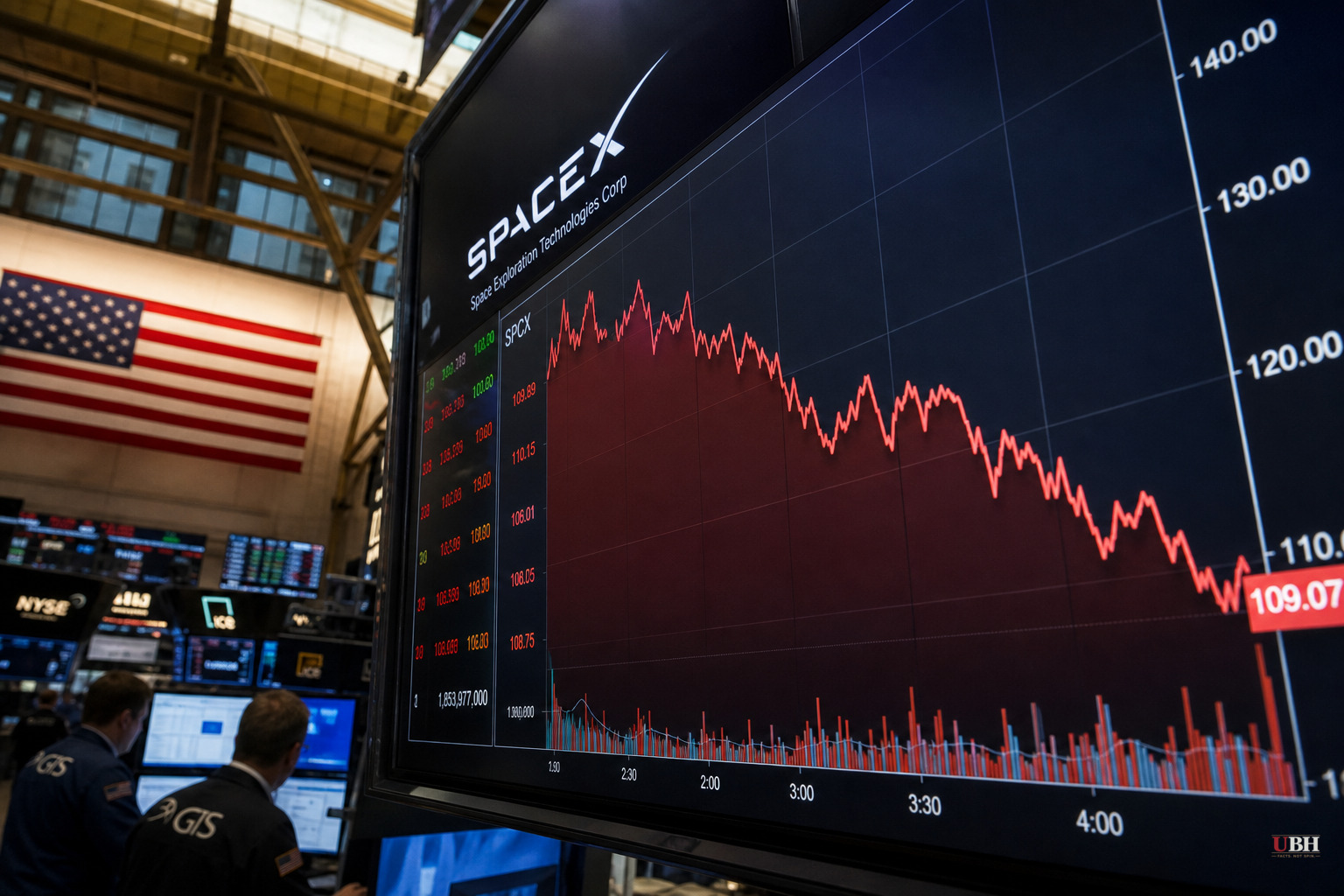
From Record IPO to Red Ink
Space Exploration Technologies Corp, trading under the ticker SPCX, completed the largest initial public offering in history in June 2026. The stock priced at $135, opened at $150, and climbed as high as $225 in the weeks that followed, according to The Motley Fool.
Since that peak, the stock has reversed hard. As of the most recent trading data cited by The Motley Fool, SPCX sits around $109 a share, a decline of roughly 19% from its IPO price and well off its post-IPO high.
That's a serious round trip for a company that, weeks ago, was being hailed as the biggest listing in Wall Street history.
The Tesla Comparison
The Motley Fool's case for optimism leans on Elon Musk's other public company. Tesla went public on June 29, 2010, and roughly two months into its life as a public stock, it had fallen 18%, almost the exact drop SPCX is experiencing now.
Tesla didn't stay down. By the end of its first year trading, Tesla had gained 18%, driven in part by its plans to expand beyond the Roadster sports car into the mass-market Model S, which arrived in 2012, according to The Motley Fool.
The argument: SpaceX has its own version of that expansion story. Starship, the company's fully reusable next-generation rocket, is designed to carry much bigger payloads than the current Falcon 9 workhorse. If it delivers, per-launch costs fall further, margins improve, and SpaceX can launch far more Starlink satellites into low Earth orbit. Starship remains in testing, and The Motley Fool does not claim it has hit those milestones yet.
The Bear Case: Sell the Sector
A less rosy read comes from Seeking Alpha's Sungarden Investment Publishing, writing under the ticker UFO, the Procure Space ETF, which holds SPCX alongside other space and defense names. That analysis, published July 22, 2026, rates the ETF a Sell.
The reasoning: UFO had already fallen more than 30% from its 52-week high by late July, and the analyst's proprietary "ROAR Score" flagged the fund as deep in negative territory. The concern isn't just SpaceX specifically. It's that the ETF mixes unprofitable, cash-burning growth companies with legacy defense contractors, and neither group offers what the analyst calls clear value or safety at current prices. The Seeking Alpha piece states it sees value only if the fund drops another 30%, to around $30.
That's a meaningfully more bearish framing than The Motley Fool's Tesla-comparison piece. The Motley Fool piece is built around a bullish historical analogy. The Seeking Alpha analysis is an explicit Sell rating from an independent analyst with his own model, not a company statement or a regulatory filing.
What's Actually Verifiable
Here's what both sources agree on: SPCX priced at $135, spiked to $225, and has since fallen to roughly $109, a real and substantial decline from the IPO price. That's a stock price move, not a claim about what any individual investor made or lost, since it depends entirely on when someone bought and whether they've sold.
The Tesla parallel is real as a historical data point. Tesla did fall about 18% roughly two months after its 2010 IPO and did recover to end its first year up 18%. But a rocket company in 2026 is not a car company in 2010, and matching timelines don't guarantee matching outcomes. The Motley Fool doesn't claim otherwise. It frames the comparison as a "clue," not a prediction.
What Comes Next
SpaceX's Starship program remains the variable everyone is watching. If Starship moves from testing into regular commercial launches with lower per-launch costs, that would be the closest thing to SpaceX's version of the Model S moment The Motley Fool describes. No specific date for that transition has been confirmed in current reporting.
In the meantime, investors holding SPCX or space-sector ETFs like UFO are dealing with a stock that's already given back a chunk of its post-IPO gains, with two credible analyses reaching very different conclusions about where it goes from here.
Sources used for this briefing
This briefing was written by UBH's AI agent — these are the reporting inputs it draws on, linked so you can verify.


