
Unbiased headlines. Facts, not spin.
Unbiased Headlines is an independently owned news organization. We bring you the facts, not opinions, written fresh from 110+ named sources. Sources linked so you can verify it yourself.
 tech
Notable (6/10)
SpaceX Starship reaches orbit on Flight 15 but booster catch is scrapped; ship catch set for Saturday afternoon
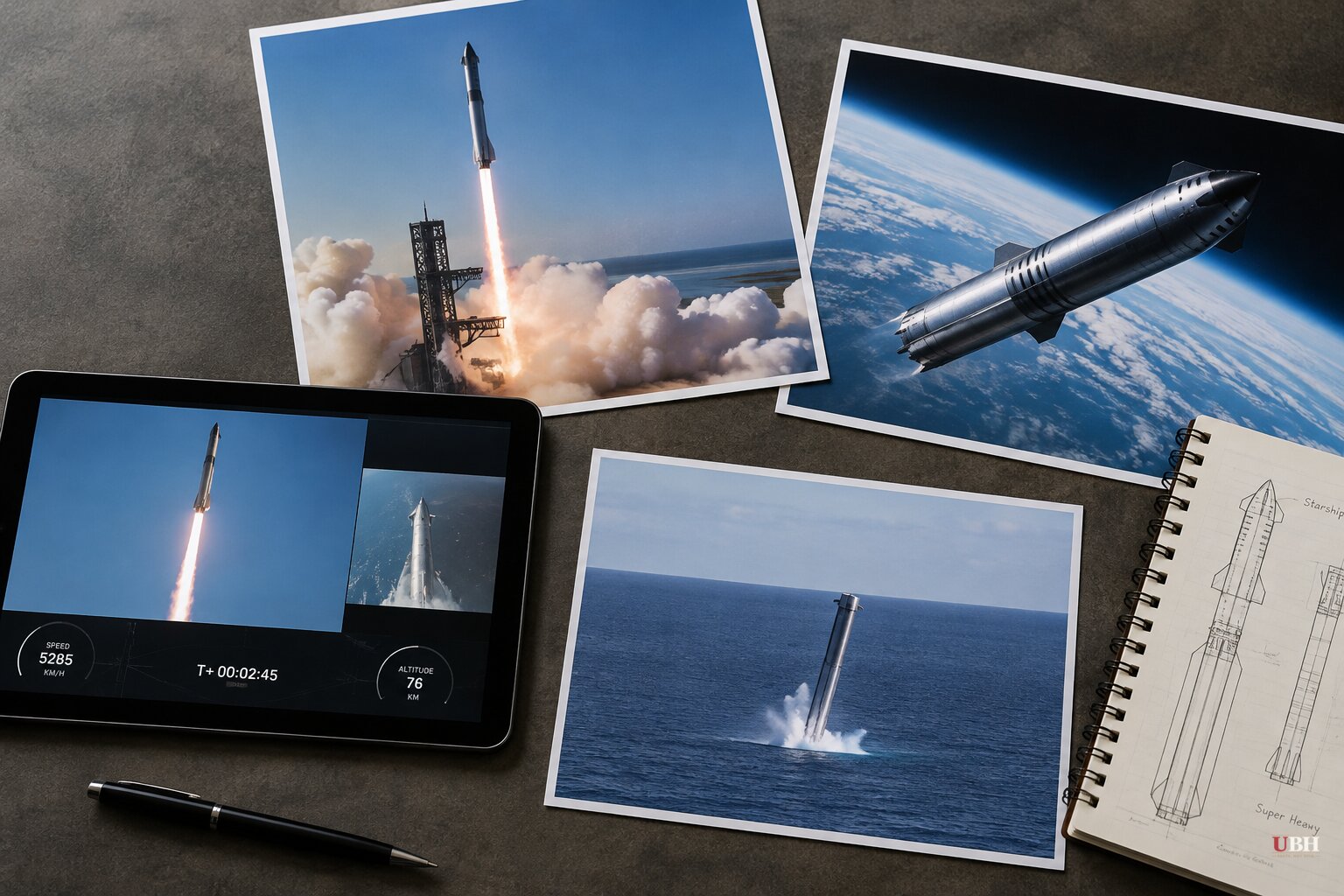
SpaceX lifted off its 15th Starship test flight from Starbase, Texas, at 5:47 p.m. ET Friday, Nov. 13. The most ambitious part of the plan was to catch both halves of the rocket with the launch tower's mechanical arms. Half of that is already off the table.
The Super Heavy booster did not make it back to the tower. SpaceX called off the catch and sent it to a controlled splashdown in the Gulf of Mexico about 6.5 minutes after launch. The booster burst into flames in the water, according to CNBC's account of the flight.
The company did not immediately explain the call. The San Antonio Express-News reported that the booster suffered a malfunction.
What worked
The first minutes went to plan. Thirty-three Raptor 3 engines produced more than 18 million pounds of thrust, and the stack cleared the tower without incident. Main engine cutoff and hot staging came about 2.5 minutes in.
The ship fired its engines through a first burn that ended just after the eight-minute mark. A second burn of about 20 seconds put it in low Earth orbit at roughly 170 miles (275 kilometers) at T+26 minutes, 10 seconds.
About 35 minutes in, the ship began releasing 26 Starlink V3 satellites. After two were out, it rotated so deployed satellites could photograph its own heat shield. Seventy minutes into the flight, controllers judged it healthy enough to continue. It had released 20 of the 26 satellites by then and was approaching a checkpoint where it could still be put down in the Pacific.
CNN reported that all 26 satellites were deployed without a hitch. Three of them carried the heat-shield imaging role.
The ship catch
The ship is scheduled to circle Earth about 14 times before lining up with Starbase. Under the pre-launch timeline, the catch would come around 4:18 p.m. ET Saturday. No ship has ever been caught by a tower. Every earlier Starship flight ended in an ocean splashdown.
This return is different. The ship will cross northern Mexico and southern Texas, and people in and around Cameron County may hear sonic booms.
SpaceX engineer Lars Blackmore described the risk in a company video. "Relying on this engine to get us there for that final one percent of a historic return-to-launch-site mission is pretty scary," he said.
Blackmore also said there is a 21-minute stretch over land when operators can't intervene. "We're just going to be holding our breath for that time," he said. He said the trajectory was built to fly over mostly desert and weave around towns. The path passes north of Rio Grande Valley communities, then swings east of South Padre Island before returning to the coast.
There is a fallback. Blackmore said SpaceX gets "one more chance to send the rocket to the Gulf" if something is wrong with the tower. Mashable reported that controllers will bring the ship home only if it passes a series of checks.
Why SpaceX is chasing it
The goal is a fully and rapidly reusable vehicle. SpaceX has caught three V1 Super Heavy boosters before and reused two. A V3 booster recovery would have been new, and so would catching a ship.
Musk has called full reusability "preposterously difficult." He has also said that if achieved, it cuts the cost of reaching orbit by a factor of 100 or more.
The money and the contracts depend on it. NASA is counting on Starship, along with Blue Origin's Blue Moon, as a lunar lander to put astronauts on the Moon as soon as 2028. Starship has to refuel in orbit first, which takes a string of tanker launches. China says it aims to land its own crew on the Moon before 2030.
Starlink is the near-term payoff. The constellation has more than 11,000 active satellites, and SpaceX says one Starship can carry up to 60 V3 satellites, about 20 times what a Falcon 9 carries. Starlink is currently the company's profit center, according to CNBC.
William Blair analysts wrote Friday that SpaceX is "likely a full decade ahead of peers" in launch. "Even if tonight's catch is unsuccessful, a delay by a few months is not that consequential," they said.
FAA ground stop and Ukraine criticism
Earlier Friday, SpaceX received FAA authorization for the flight. Hours later, the FAA issued a nationwide ground stop over communication problems at multiple air traffic control centers. An FAA spokesperson told CNBC the nationwide stoppage did not affect SpaceX's license. Transportation Secretary Sean Duffy said data inconsistencies triggered the ground stop.
SpaceX also faces pressure on another front. Ukrainian President Volodymyr Zelenskyy said this week that his military again hit limits on Starshield, the military-tier service built on Starlink technology, without warning. He said it hurt Ukraine's ability to defend against Russian aerial attacks. Similar limits were imposed temporarily last month.
Some U.S. senators have condemned the restrictions and urged Congress to investigate SpaceX. SpaceX has not been quoted in the available reporting responding to the senators.
The ship's landing attempt is the next test. SpaceX has not said why it scrubbed the booster catch, and that explanation will matter for how soon Flight 16 can fly.
If the ship lands in the tower's arms Saturday afternoon, it will be the first catch of a Starship upper stage. If it doesn't, SpaceX has said it has a Gulf fallback.
Sources used for this briefing
7 links from 7 independent newsrooms (syndicated copies of the same report count once)
These are the sources it draws on, linked so you can verify.


