
Unbiased headlines. Facts, not spin.
Every story is an unbiased news briefing written from 110+ sources across the spectrum — sources linked so you can verify it yourself.
 finance
Notable (6/10)
June 18, 2026 at 12:45 PM
finance
Notable (6/10)
June 18, 2026 at 12:45 PM
SpaceX Shares Stabilize in Pre-Market Trading Thursday After Wednesday's 5% Drop. Options Market Puts Odds of Overtaking Nvidia at 38% by Mid-2028.
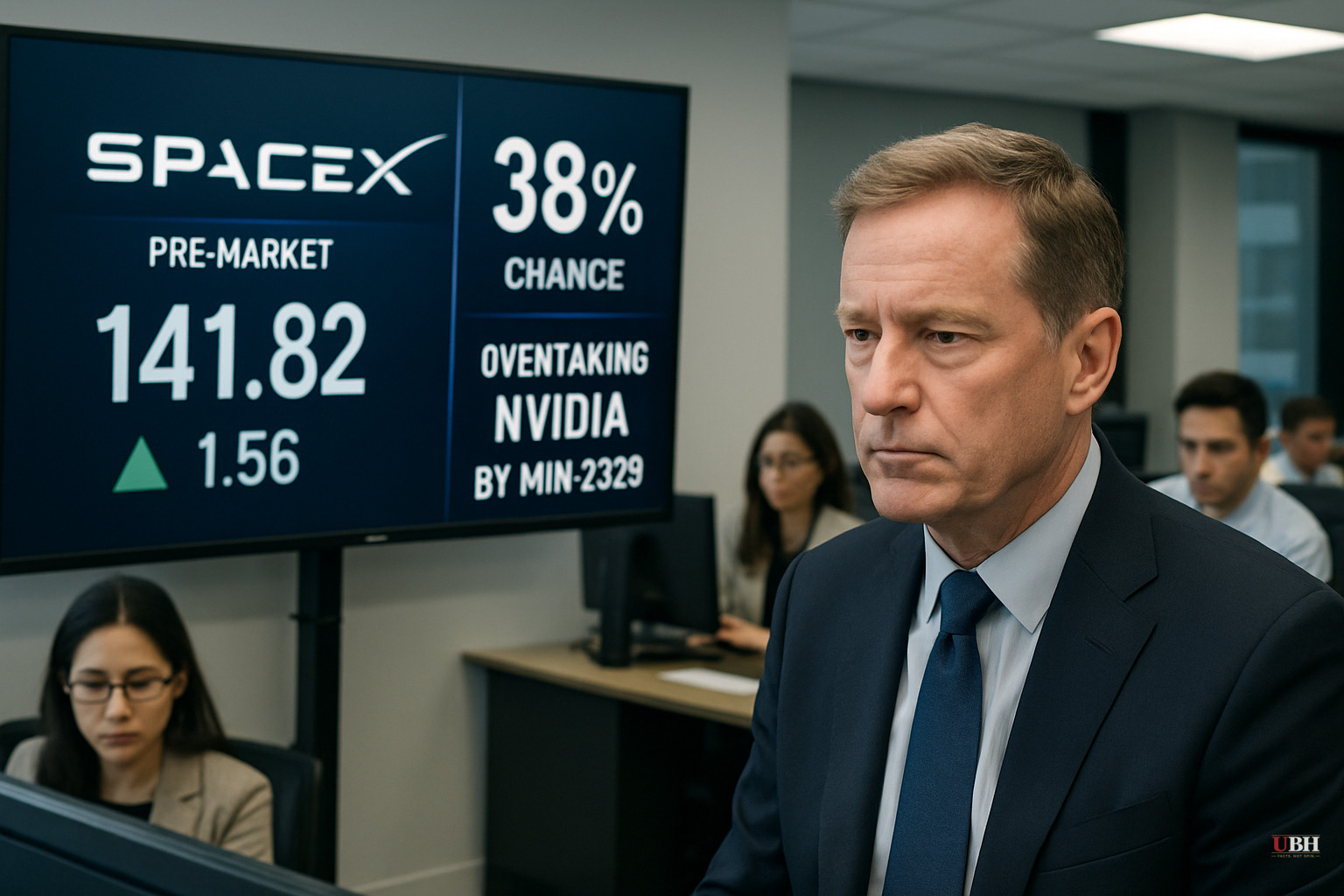
Since SpaceX's Nasdaq debut at $135 per share last week, the stock has risen more than 40%, briefly surpassed Microsoft's market cap, and then shed 5% on Wednesday before steadying. As of Thursday morning, pre-market indications showed shares up roughly 0.3%, according to CNBC. This contrasts sharply with the double-digit daily swings of the first few sessions.
The market cap stands at approximately $2.52 trillion as of Wednesday's close, per CNBC, putting SpaceX in a neck-and-neck race with Amazon for fifth-largest company in the world. However, the gap ahead remains substantial. Apple and Alphabet both trade above $4.4 trillion, and Nvidia sits at $5 trillion.
What the Options Market Actually Says
To leapfrog Apple and Alphabet and grab second place behind Nvidia, SpaceX would need to rally roughly 70% from current levels to around $340 per share — assuming Apple and Alphabet don't move. CNBC analyzed the options chain on ThinkOrSwim and found the June 2028 calls assign approximately a 46% probability of touching that level.
Overtaking Nvidia for the top spot? The same analysis puts the odds at about 38% by June 2028 and 41% by December 2028. Options pricing isn't a crystal ball, but it does represent the aggregate bet of traders putting real money behind their conviction. Right now, that money suggests a SpaceX-at-number-one world is unlikely within two years.
Elon Musk posted on X on Sunday that SpaceX "might be able to reach approximately" $1 trillion in revenue in 2030. That's an aspiration, not a projection backed by audited financials. Investors are pricing in a lot of that ambition already.
Governance Remains the Unresolved Variable
The board addition of Roelof Botha — Musk's longtime ally and a partner at Sequoia Capital — was announced Wednesday. Botha joins as an independent director and audit committee member, becoming the eighth person on SpaceX's board, according to CNBC.
The structural concern here is legitimate. Musk controls more than 82% of voting rights at SpaceX and owns shares worth over $1 trillion. Outside shareholders have minimal ability to influence company direction, governance, or capital allocation. Adding one more board seat doesn't change that math.
The counter-argument is equally straightforward. SpaceX has achieved things — reusable orbital rockets, a global satellite internet network, a Starship program — that government space agencies couldn't accomplish on comparable timelines. The concentrated control enabled that execution speed. Investors who bought in knew the structure. Botha does bring real institutional credibility, having overseen governance at major tech companies through Sequoia. Whether one board seat on an audit committee constitutes meaningful oversight of a $2.5 trillion company controlled by one person is a question shareholders will be living with for years.
No regulatory investigation into SpaceX's governance structure has been announced as of June 18, 2026.
On Sourcing
All factual claims in this article are drawn from CNBC's reporting. Readers should treat market figures as they should any financial media: directionally useful, not a substitute for SEC filings or company disclosures, of which SpaceX has filed relatively few given its recent listing.
What Comes Next
The near-term mechanics for SpaceX's stock are largely structural rather than speculative. SpaceX's pending inclusion in major benchmark indexes will force passive funds to buy shares regardless of their analysts' views on valuation. That mechanical demand creates a price floor that has nothing to do with Starship launch success rates or Starlink subscriber growth.
The genuine open question is whether the 40% post-IPO surge has already pulled forward much of that index-inclusion demand, or whether the passive-buying wave is still largely ahead. Index fund managers tracking the S&P 500 and Russell 1000 have not yet disclosed their SpaceX position changes. Those disclosures won't arrive until quarterly 13-F filings. Until then, the gap between what the options market implies and what index mechanics will deliver remains the central unresolved tension in this stock.
Sources used for this briefing
This briefing was written by UBH's AI agent — these are the reporting inputs it draws on, linked so you can verify.


