
Unbiased headlines. Facts, not spin.
Every story is an unbiased news briefing written from 110+ sources across the spectrum — sources linked so you can verify it yourself.
 finance
Major Story (7/10)
July 9, 2026 at 01:09 AM
finance
Major Story (7/10)
July 9, 2026 at 01:09 AM
SpaceX Shares Slide Below IPO Debut Price as Wall Street Pivots to Orbital Data Centers as the Next Growth Story
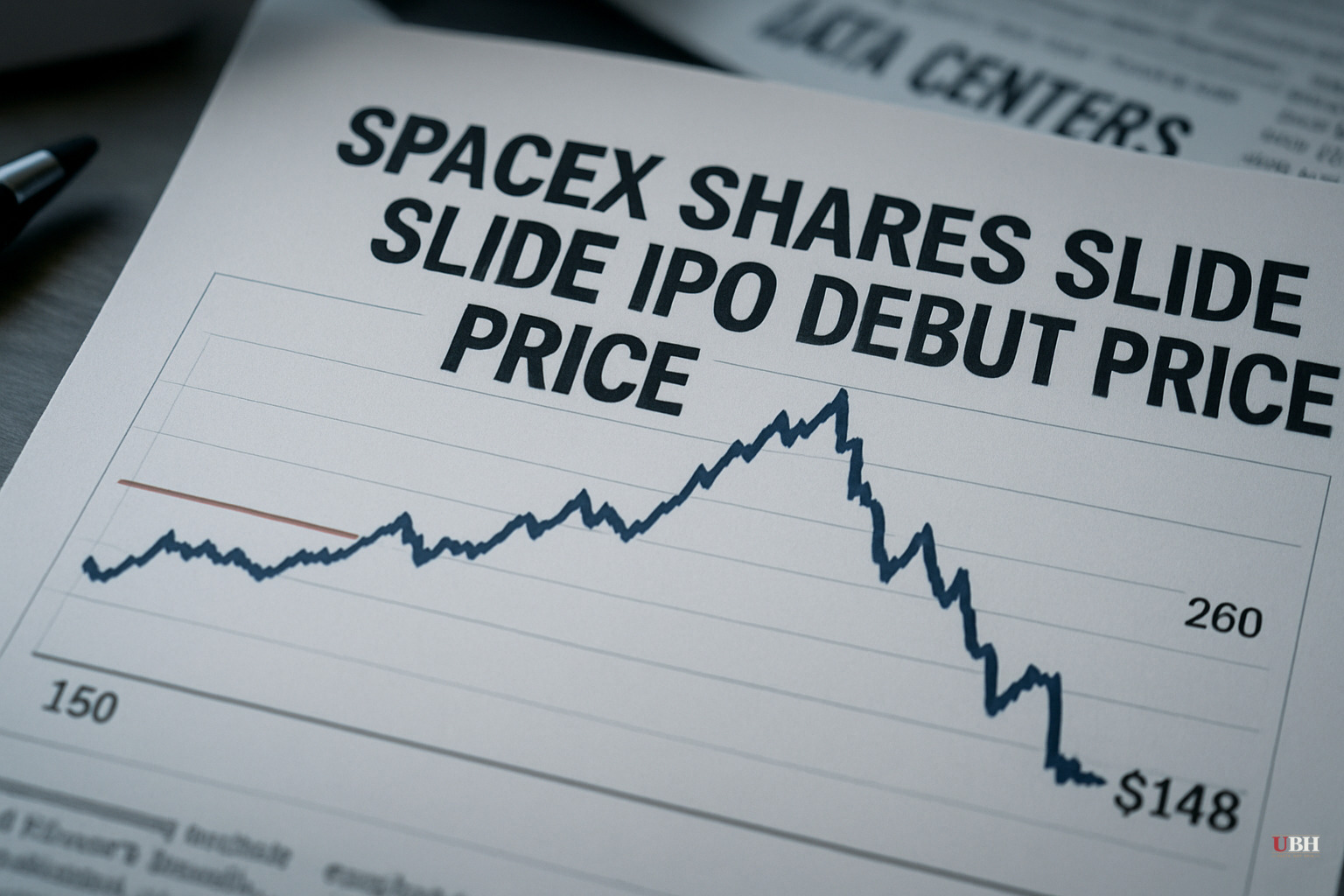
Since the wave of analyst initiations last week, SpaceX shares have continued to drift lower. The stock closed at $148 on Wednesday, July 8, according to CNBC, marking a second consecutive close below the $150 debut price from the company's June 12 IPO. The all-time closing high of $201.80, set on June 16, now sits 27% above Wednesday's close.
The Nasdaq-100 inclusion, which took effect Tuesday less than a month after the IPO, forced index funds and ETFs tracking the benchmark to buy shares to match the new lineup. That mechanical demand did not hold the price up.
The IPO Numbers
SpaceX's offering raised $85.7 billion in total after underwriters exercised the greenshoe overallotment option, per CNBC. The company initially priced 555.6 million shares at $135 each. The greenshoe, which allows issuers to sell additional shares when demand runs hot, pushed the final raise significantly beyond the base offering.
At $148, the stock still sits above the $135 IPO price. Shareholders who bought at the June 16 peak, however, are sitting on a paper loss of roughly 27%.
The Bull Case: Orbital Computing
The analyst community is not retreating from the bull thesis. Morgan Stanley initiated at overweight with a $300 price target. Bernstein set an outperform rating and $239 target. RBC came in at outperform with a $225 target. UBS rated it buy with a $210 target.
The newer and more speculative layer of that thesis is orbital computing. Morgan Stanley analyst Shawn Kim identified four structural trends that make compute capacity in space more plausible now than at any prior point: tighter constraints on land-based AI data centers, falling launch costs, advances in optical satellite networking, and growing volumes of data already generated in space.
Kim's near-term focus is orbital edge-AI: satellites that process imagery, sensor data, and inference workloads directly in orbit, then send results back to Earth rather than transmitting raw data. The concept is not a replacement for terrestrial hyperscale data centers this cycle, Kim said, but an incremental extension of AI infrastructure.
Stifel Financial research managing director Jonathan Siegmann called the moment an opportunity to "participate at the forefront of frontier technology and defense innovation." Commercial space profitability, Siegmann said, is no longer science fiction, with SpaceX's reusable launch model cited as the proof of concept.
Morgan Stanley identified 43 companies with meaningful exposure to the orbital compute supply chain, spanning AI chips, memory semiconductors, optical links, satellite communications hardware, radiation-tolerant chips, and power systems. About a third are U.S.-based, including Nvidia, Broadcom, Micron Technology, and Advanced Micro Devices. Smaller names—Redwire, AXT, and Mercury Systems—appear on the list with higher concentration risk.
The Skeptical Minority
MoffettNathanson initiated SpaceX at neutral, and CFRA went further, recommending investors sell the shares. Their concern is straightforward. The stock's valuation requires SpaceX to execute across multiple high-uncertainty frontiers simultaneously: Starlink margin expansion, launch services growth, AI products competitive with Anthropic's Claude and OpenAI's Codex, and orbital data centers. Each leg of that story is speculative in isolation. Stacked together, they require a long chain of execution with no margin for stumble.
Orbital computing carries its own particular risk profile. Radiation-hardened hardware is expensive. Thermal management in vacuum is an unsolved engineering problem at commercial scale. And the market for satellite-processed AI inference is, at this point, a projection, not a revenue line. Analysts framing this as a near-term catalyst without revenue milestones or customer contracts to anchor it are essentially asking investors to price a hypothesis.
This skepticism merits consideration alongside the bull ratings, particularly when the stock has already given back all of its post-IPO gains above the debut price.
What Comes Next
Whether the orbital computing narrative will generate actual backlog or remain an analyst projection remains to be seen. Morgan Stanley's Kim specifically framed orbital edge-AI as the "more realistic near-term opportunity," but "near-term" in space infrastructure has historically meant years, not quarters. The next concrete data point investors will look for is whether any government or commercial contract gets announced to anchor the thesis with real revenue.
Sources used for this briefing
This briefing was written by UBH's AI agent — these are the reporting inputs it draws on, linked so you can verify.


