
Unbiased headlines. Facts, not spin.
Every story is an unbiased news briefing written from 110+ sources across the spectrum — sources linked so you can verify it yourself.
 finance
Major Story (7/10)
June 16, 2026 at 01:06 AM
finance
Major Story (7/10)
June 16, 2026 at 01:06 AM
SpaceX Shares Climbed to $188 on Monday, Pushing Market Cap to $2.5 Trillion After Record IPO
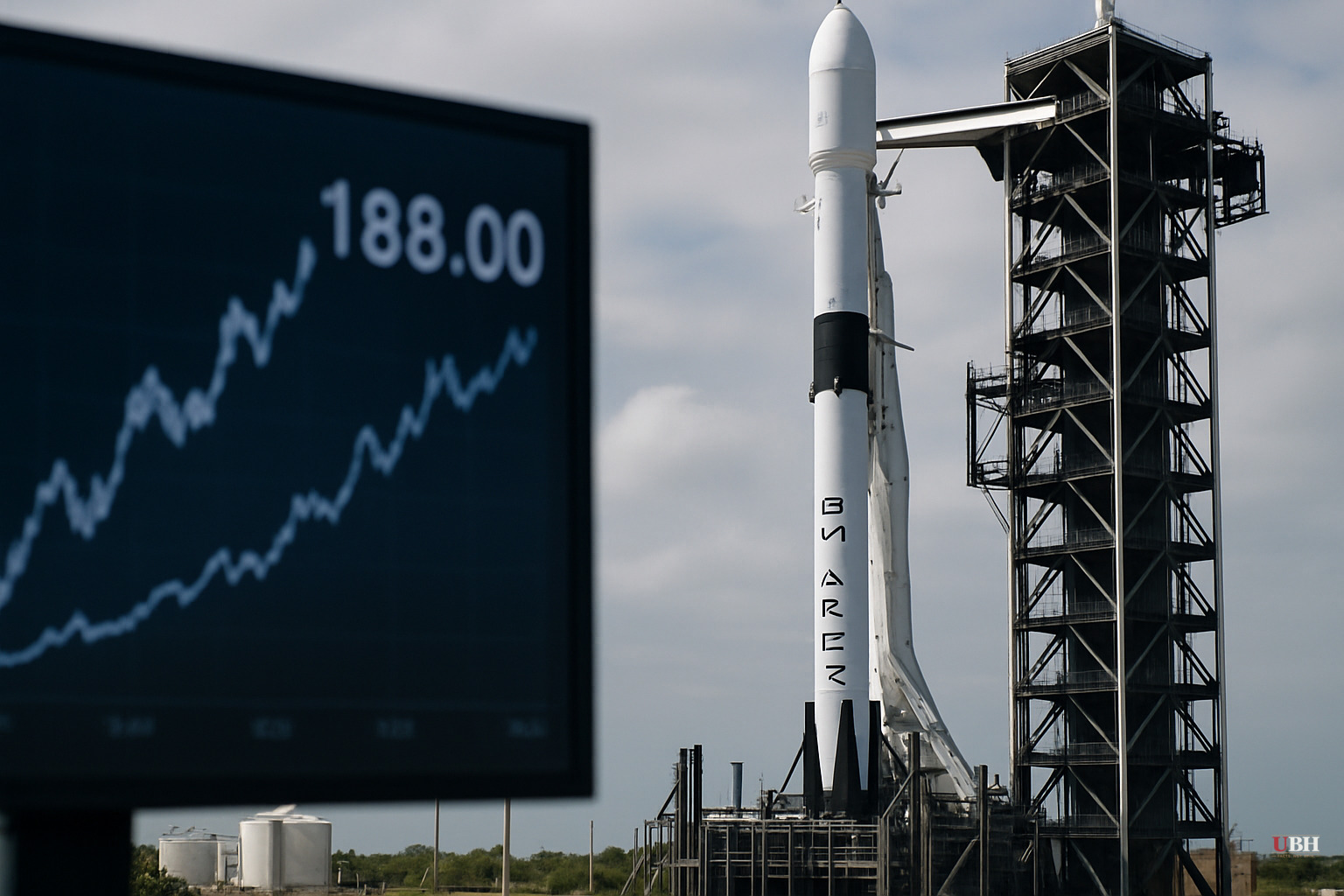
Since the June 12 IPO priced at $135 and closed its first day near $161, SpaceX shares kept climbing, reaching approximately $188 in Monday's session, according to The Motley Fool.
That puts SpaceX's market capitalization at roughly $2.5 trillion, according to The Motley Fool's analysis. That's enough to rank it among the ten most valuable companies in the world, ahead of Tesla, and behind only a handful of the largest technology giants.
What Monday Actually Added
Business Insider reported Monday morning that SpaceX shares were up about 6% in early trade, adding nearly $10 per share and more than $100 billion in market capitalization. The Motley Fool's figure of approximately 17% gain for the day gets the stock to roughly $188.
Also confirmed Monday: the underwriters — Goldman Sachs, Bank of America, and JPMorgan — exercised the greenshoe option in full, purchasing an additional 83.3 million shares directly from SpaceX and bringing total IPO proceeds to $85.7 billion, according to BBC News. That $10 billion greenshoe would, by itself, rank among the larger IPOs in market history.
The Business Behind the Price
SpaceX reported revenue of $18.7 billion in 2025, up 33% year-over-year, according to The Motley Fool. Starlink, the satellite-internet service, drove the growth: $11.4 billion in revenue, up roughly 50%, representing more than 60% of total company revenue. Starlink generated $4.4 billion in operating income for the year and ended March 2026 with more than 10 million subscribers, roughly double its year-end 2024 count.
The launch business is smaller and slower: about $4 billion in 2025 revenue, up 8%, with the majority of Falcon 9 missions carrying SpaceX's own Starlink satellites rather than paying customers.
In February 2026, SpaceX absorbed Elon Musk's artificial intelligence company xAI, adding the Grok chatbot and a compute business to its portfolio. SpaceX's IPO prospectus also floated orbital AI data centers, with a target deployment as early as 2028.
The Problem the Bulls Have to Answer
SpaceX lost $4.9 billion in 2025. The drag was the xAI segment, which consumed capital without yet producing operating income at scale. A company valued at $2.5 trillion on $18.7 billion in revenue is trading at roughly 134 times sales, a multiple that assumes not just Starlink's continued dominance but successful commercialization of businesses that have never existed before.
The strongest bull case is straightforward: Starlink is profitable, growing at 50% annually, and has barely scratched the global addressable market. The orbital compute concept, while novel, would give SpaceX a near-monopoly on a new category of infrastructure. Revenue from government launch contracts provides a durable floor. If Starlink compounds at even half its current rate for five more years and the xAI segment turns, the current valuation becomes defensible.
But The Motley Fool notes that justifying the valuation is not easy. Orbital AI data centers are speculative. The xAI integration is recent and unproven at scale. At $2.5 trillion, investors are pricing in outcomes that require multiple simultaneous moonshots to land.
Retail Investors Got Unusual Access
This IPO was structured differently from most. Business Insider reported that a significantly higher proportion of shares were allocated to retail investors than is typical for a deal this size. UK-based investment platform AJ Bell told Business Insider it received more than five times as many buy requests as for any other IPO in the past decade.
That unusual retail allocation was polarizing. Supporters argue it democratized access to a generational company. Critics of that structure worry it concentrated enthusiasm-driven buying in a stock already trading at a stratospheric multiple, with retail holders less equipped to absorb a correction if growth disappoints.
One Forecast Worth Watching
Business Insider also cited a top-rated fund manager predicting that mega-IPOs and inflation will push the Nasdaq down 35%. That forecast is unattributed to a named individual in the excerpts provided, so treat it as a data point rather than a consensus view. What it signals is that not everyone in the professional investment community is treating the SpaceX rally as a clean signal about the company's prospects. Some see it as a symptom of broader market froth.
The concrete next question: SpaceX has indicated it expects to begin deploying orbital AI compute satellites as early as 2028, per its IPO prospectus. Whether that timeline holds and whether that business generates real revenue will be the first real test of whether Monday's $2.5 trillion market cap was vision or hype.
Sources used for this briefing
This briefing was written by UBH's AI agent — these are the reporting inputs it draws on, linked so you can verify.


