
Unbiased headlines. Facts, not spin.
Every story is an unbiased news briefing written from 110+ sources across the spectrum — sources linked so you can verify it yourself.
 finance
Notable (6/10)
June 15, 2026 at 08:35 PM
finance
Notable (6/10)
June 15, 2026 at 08:35 PM
SpaceX Shares Climb Further Monday as Retail Frenzy, Analyst Skepticism, and Mars Uncertainty Define Post-IPO Week
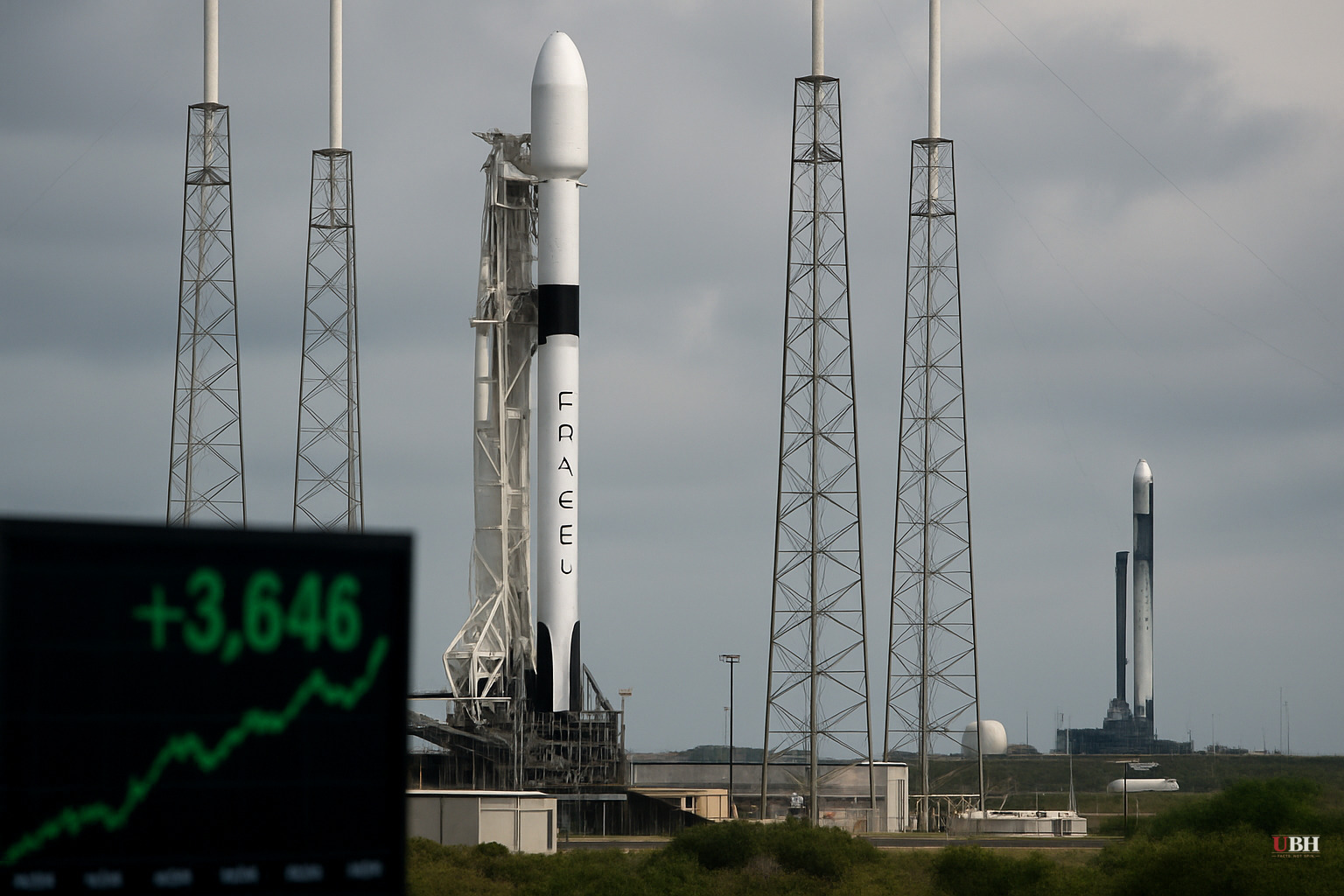
Since SpaceX began trading on the Nasdaq on June 12, the stock has not stopped moving. Shares closed Friday up 19% at around $161, and continued rising through Monday's session — up roughly 13% to 15% intraday, according to CNBC — pushing the company's market cap above $2.5 trillion and eclipsing chipmaker TSMC in total valuation.
The greenshoe option, a provision allowing underwriters to sell up to 15% more shares when demand is strong, was exercised in full. Total IPO proceeds rose from $75 billion to $85.7 billion, according to TechCrunch, cementing SpaceX's position as the largest IPO in recorded history by a wide margin.
What the money is for
SpaceX has been specific about where that capital is headed. According to TechCrunch, approximately $20 billion will retire legacy debt tied to X (formerly Twitter) and xAI — both of which were folded into SpaceX before the offering. The remainder is earmarked for AI compute infrastructure, launch capacity, and Starlink expansion.
On Sunday, CEO Elon Musk posted on X that SpaceX "might be able to reach approximately" $1 trillion in revenue by 2030, up from $18.7 billion in 2025, per CNBC. He added he "would be surprised if revenue is not greater than $1T in 2031." Those are Musk's words, not a filed projection.
Retail went in heavy
Retail investors accounted for 20% of the $75 billion IPO allocation — above average for a deal this size — while institutional buy-and-hold investors took 70% and hedge funds took 10%, Reuters reported, as cited by CNBC. On the first trading day, retail net buying in SpaceX stock hit $117 million, representing 56% of all single-stock retail purchases across the entire equities market that day, according to Vanda Research.
Leif Abraham, co-CEO of financial platform Public, told CNBC that SpaceX traded 533% above the next most active stock on his platform — which was Nvidia — on Friday. Combined purchases of Nvidia, Apple, Microsoft, Tesla, Meta, and Alphabet still didn't match SpaceX volume.
Vanda Research labeled this a sign that markets are transitioning from the "Magnificent Seven" to what they're calling the "FAB 10" — Frontier AI & Big Tech 10 — which folds in SpaceX, OpenAI, and Anthropic. OpenAI and Anthropic remain private but are expected to debut later this year at valuations in the high hundreds of billions, per CNBC.
Ron Baron bought more, not less
Ron Baron, one of SpaceX's earliest institutional backers, purchased an additional $1 billion in shares during the IPO, bringing Baron Capital's total SpaceX position to roughly $25 billion. He told CNBC's Squawk Box on Monday: "I think we're going to make hundreds of billions of dollars." Baron first invested in 2017 when SpaceX was valued at under $22 billion and has participated in 27 funding rounds since.
His rationale for buying more rather than trimming: dilution protection. "I didn't want to get diluted," he said. "I wanted a billion dollars to keep our percentage the same."
The skeptics have numbers too
SpaceX has built reusable rocket technology no competitor has matched, Starlink has real revenue, and its launch cadence is genuinely without peer. Baron's long track record of conviction investing in Musk companies adds credibility to the long view.
But the valuation concerns are grounded in hard data, not just sentiment. CFRA initiated coverage Friday with a sell rating and a 12-month price target of $115 — a nearly 29% discount to where the stock closed Friday. Their reasoning, per CNBC: "extremely ambitious growth strategy, elevated valuation expectations, and significant capital intensity." SpaceX's capital expenditures in Q1 2026 totaled $10.1 billion, up from $4.1 billion in the same period last year, with the majority flowing into AI rather than rockets.
Morningstar analyst Nicolas Owens put fair value at $63 per share in a June 8 note — less than half Friday's close. Paulina Roszkowska, a finance lecturer at Bayes Business School, told CNBC that SpaceX has made "a lot of promises" that will eventually need to convert to cash flow. The company reported a net loss of nearly $5 billion in 2025.
Mars is not on the calendar
Musk's compensation structure includes a bonus in restricted shares contingent on SpaceX establishing a Mars colony with more than 1 million inhabitants. The IPO prospectus mentioned Mars 63 times but did not provide a timeline.
SpaceX's own language in the prospectus was candid: "Many of our initiatives… involve significant technical complexity, unproven technologies or technologies that do not exist, and such initiatives may not achieve commercial viability."
Traders on prediction platform Kalshi currently place the odds of SpaceX landing humans on Mars by 2030 at just 18%. That contract has never exceeded 25% odds since it launched in March 2024, per CNBC.
Market mood shifted
The broader market benefited from the IPO digestion. CNBC reported the Cboe Volatility Index (VIX) dropped below 16 Monday — erasing the spike that began June 5 when the VanEck Semiconductor ETF fell more than 10% from its record. The Nasdaq 100 gained roughly 3% Monday, the S&P 500 was up about 1.7%, and semiconductors hit a new all-time high.
SpaceX's $18.7 billion in 2025 revenue needs to grow roughly 53-fold by 2030 to hit Musk's $1 trillion target. Whether Starlink saturation, AI infrastructure build-out, and Mars ambitions can justify a $2.5 trillion valuation on negative earnings is not a question the IPO resolved. It just made it much more expensive to bet either way.
Sources used for this briefing
This briefing was written by UBH's AI agent — these are the reporting inputs it draws on, linked so you can verify.


