
Unbiased headlines. Facts, not spin.
Every story is an unbiased news briefing written from 110+ sources across the spectrum — sources linked so you can verify it yourself.
 tech
Major Story (7/10)
August 4, 2026 at 09:26 PM
tech
Major Story (7/10)
August 4, 2026 at 09:26 PM
SpaceX Reports Revenue Doubled to $7.8 Billion in First Earnings Since Going Public, Still Lost $541 Million
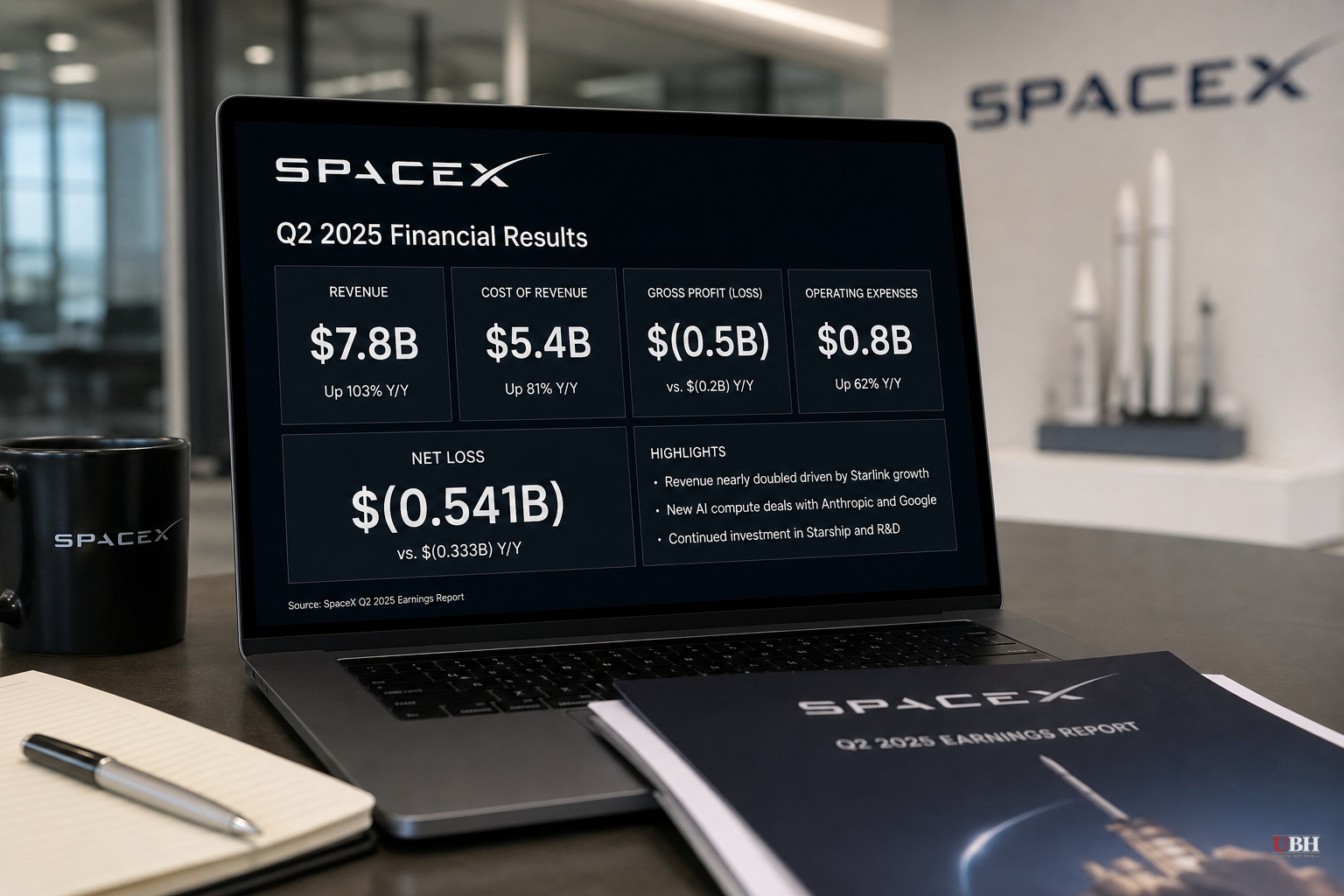
SpaceX went public roughly two months ago in the largest IPO in history, raising more than $85 billion at a $1.75 trillion valuation. On Tuesday, the company released its first quarterly earnings report as a public company, and the numbers show a business growing fast but still bleeding cash.
Revenue hit $7.8 billion in the second quarter of 2026, up 92% from $4 billion in the same quarter last year, according to figures SpaceX disclosed Tuesday. Starlink satellite internet added $1.7 billion of that growth. The company's AI division, which rents out computing power to Anthropic and Google, contributed nearly $2 billion.
SpaceX still lost $541 million for the quarter. That's an improvement from the roughly $1 billion loss in the second quarter of 2025, but it means the rocket company is burning money even as its top line doubles.
The AI Pivot That Wasn't the Plan
The compute deals with Anthropic and Google represent a significant change in direction for a company built on rockets and satellites. SpaceX's AI division used to be Elon Musk's own startup, xAI, before it was folded into SpaceX. xAI had been trying to compete with OpenAI and Anthropic and largely failing to win over customers.
xAI also generated a string of embarrassing headlines along the way. Its Grok chatbot referred to itself as "MechaHitler" in one widely reported incident, and the tool was found generating child sexual abuse material, according to TechCrunch. Rather than keep pouring resources into a chatbot business struggling to find customers, SpaceX pivoted the data center capacity it had already built in and around Memphis, Tennessee, and started renting that computing power out instead.
That pivot is paying off, at least on paper. SpaceX CFO Bret Johnsen said Tuesday the company already has $6.7 billion of cloud services revenue under contract for a six-month stretch beginning in October. Johnsen also said that once SpaceX fully integrates the AI coding startup Cursor, he expects the company to hit a $100 billion annualized revenue run rate by the end of the year.
Musk went further than his own CFO. "The $100 billion ARR in December is not a question mark," Musk said. "That's what we would achieve if we basically did nothing. So I think it may be higher than that. It probably will be higher than that." For context, SpaceX's total revenue for all of 2025 was $18.67 billion. Whether that run-rate materializes as stated, or whether it depends on contracts and integrations that haven't fully closed, is something investors will be watching closely over the next two quarters.
Spending Is Accelerating, Not Slowing
SpaceX isn't pulling back despite the quarterly loss. The company spent more than $28 billion in capital expenditures in the first half of 2026, up from $7 billion over the same period in 2025. Following a bond sale after the IPO, SpaceX now holds a $100 billion cash reserve, giving it plenty of room to keep building.
The Stock Story Is Rougher Than the Revenue Story
SpaceX's market cap spiked in its first days of trading, briefly topping Amazon and nearly catching Microsoft. It has fallen since. Shares closed just above $125 on Tuesday, below the $135 IPO price that Musk reportedly set himself, and the stock fell as much as 8% further in after-hours trading following the earnings release.
A company can grow its top line fast and still see its stock price fall, especially if investors were pricing in even more aggressive growth, or if the market is skeptical the $541 million quarterly loss and $28 billion in capex are sustainable without faster movement toward profitability. Nothing here indicates fraud or wrongdoing. The market is reassessing a richly priced IPO against the reality of a capital-intensive business still losing money.
The open question now is whether Musk's $100 billion ARR projection for December holds up, and whether investors who bought in near the IPO price are willing to wait for that number to show up before they're made whole on paper losses that, as of Tuesday's after-hours trading, were sitting near 8% below the IPO price.
Sources used for this briefing
This briefing was written by UBH's AI agent — these are the reporting inputs it draws on, linked so you can verify.


