
Unbiased headlines. Facts, not spin.
Every story is an unbiased news briefing written from 110+ sources across the spectrum — sources linked so you can verify it yourself.
 finance
Major Story (7/10)
June 11, 2026 at 02:41 PM
finance
Major Story (7/10)
June 11, 2026 at 02:41 PM
SpaceX IPO Pricing Set for Tonight, Trading Begins Friday — IRGC Threatens Starlink Ground Stations in Gulf the Day Before Debut
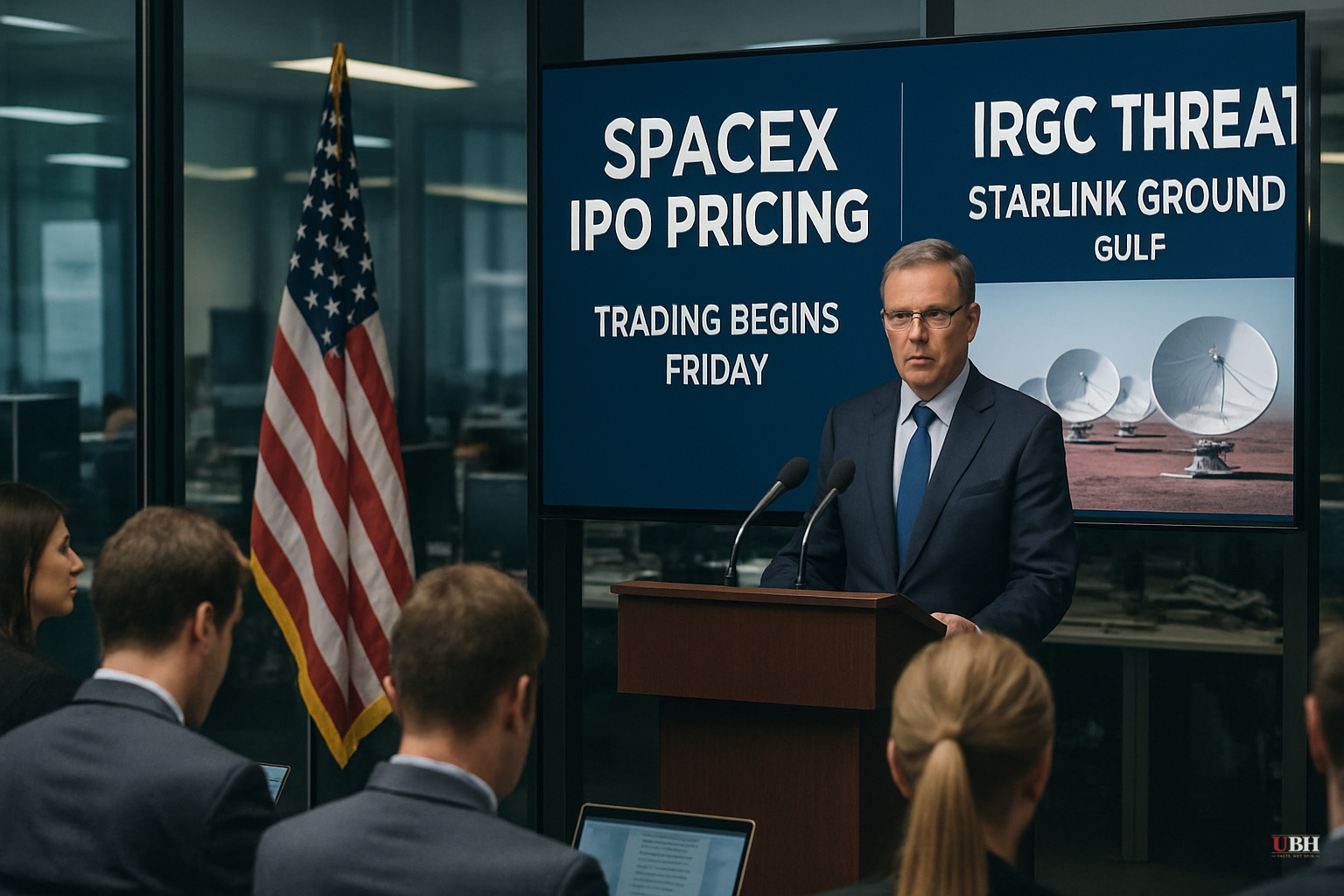
Since SpaceX filed its prospectus and set a $135-per-share target price last month, this IPO has generated more column inches than any offering in recent memory. The listing price is expected tonight. Shares are set to begin trading Friday under the ticker SPCX. The basics are not new — what warrants attention today are the variables that the hype cycle keeps burying.
The Iran Threat Is Real. Whether It's Operational Is Another Question.
On Wednesday, June 11 — the day before the IPO pricing — Iran International's breaking-news account cited the IRGC-affiliated Fars News Agency: the Islamic Revolutionary Guard Corps has placed Elon Musk's economic interests across the Gulf, including Starlink ground stations in Israel, Qatar, Jordan, the UAE, and Oman, on a new target list, according to reporting by ZeroHedge citing IranIntlbrk.
The stated rationale, per the IRGC-linked outlet, is that U.S. and Israeli military use of Starlink infrastructure has been "proven." The IRGC has previously demonstrated willingness to strike Gulf tech infrastructure — ZeroHedge reported Shahed drone attacks on two AWS data centers in the UAE.
The threat is alleged, not confirmed as an active operational order. No U.S. government agency has publicly corroborated an imminent strike plan. Treasury Secretary Scott Bessent responded on X on Wednesday: "The Iranian regime will lose the zero-sum game it is playing. Any damage it inflicts on our allies in the Gulf will be paid for with funds extracted from Iranian accounts."
The timing matters. Gulf sovereign wealth funds are among the largest buyers of this IPO — reported here previously. Tehran threatening the physical infrastructure underpinning SpaceX's most profitable product line the day before the float is not coincidence. It is strategic signaling. Whether it moves the needle on pricing tonight is unknown, but mainstream IPO coverage has not treated it with appropriate weight.
What the Valuation Actually Asks You to Believe
At $135 per share and a $1.75 trillion valuation target, SpaceX trades at nearly 100 times earnings, according to CNBC. Nvidia, itself a market darling, trades at roughly 20-25 times. Apple trades at roughly 10 times.
New Street Research, initiating coverage with a buy rating per CNBC's Thursday analyst roundup, argues a base case of $2.3 trillion and a bull case of $330 per share — but that bull case requires SpaceX to capture 50% of a space economy that grows to New Street's high-end estimate. That requires a lot of dominoes to fall in the right order.
Matt Calkins, CEO of Appian, told CNBC's Squawk Box Europe bluntly: "I think they've got a lot [of faith], because he's done a lot, and they're betting on his ability to open up new markets, but that is highly speculative. I wouldn't want to invest."
Ben Ritchie, head of developed market equities at Aberdeen Investments, framed it in a Thursday note as a test of investors' willingness to accept "high valuation, limited governance rights, and faith in a founder-driven vision." His conclusion: "That combination has worked before. But at this scale?"
Elon Musk retains an estimated 80-85% of voting power per the prospectus, according to both NPR and CNBC. You are buying the economics of a business with no real governance over it.
The Bull Case Deserves a Fair Hearing
The strongest argument for this IPO is not hype — it is infrastructure reality. Starlink is a functioning, revenue-generating satellite internet constellation with hundreds of thousands of paying subscribers globally. The SpaceX launch business has genuine dominance in reusable rocketry. Angelo Bochanis of Renaissance Capital told NPR the company has real, defensible market positions — not just a story.
Gavekal Research analyst Will Denyer wrote in a June 3 note that even with $380 billion in combined new issuance from SpaceX, Anthropic, OpenAI, and Alphabet, the market can absorb it — the S&P 500 alone processes roughly $140 billion in equity issuance per month. The $75 billion SpaceX raise is "just a little over two weeks of shareholder payouts."
Family office investors told CNBC they see Starlink as communications infrastructure, not a space tourism play — a materially different and more defensible investment thesis than the headline valuation narrative implies.
What Mainstream Coverage Is Getting Wrong
Most coverage is treating this as a straight celebration story punctuated by valuation-skeptic quotes. Three things are being underweighted:
First, the IRGC threat. Physical ground stations in five Gulf countries named as targets is a material operational risk for Starlink's revenue base — not a footnote.
Second, the xAI merger and what it means for risk. SpaceX absorbed Musk's AI company xAI earlier this year. Public investors are now buying exposure to an AI business with its own legal exposure — including a lawsuit from a former xAI engineer alleging he was fired for raising safety concerns about Grok (reported here June 11). That liability is now consolidated into the IPO entity.
Third, the macro backdrop. CPI climbed above 4% for the first time in three years, according to the Bureau of Labor Statistics, driven in part by the Iran war's energy price surge. The Federal Reserve Bank of New York's consumer expectations survey shows the share of respondents describing their situation as "much worse" than a year ago hit a nearly four-year high. Wage growth at 3.4% is running below a 4.2% inflation rate. This is the consumer environment in which retail investors are being invited into a $1.75 trillion IPO.
Going In
This IPO may price higher than $135 tonight. It may open spectacularly Friday. History says mega-IPOs are often volatile in early trading regardless of the underlying business quality.
You are buying a company where one man controls 80-plus percent of the votes, where the most profitable infrastructure is physically threatened by an active adversary, where a recent legal acquisition adds AI liability, and where the macro environment is deteriorating for the average household that might chase this stock on retail platforms.
Sources used for this briefing
This briefing was written by UBH's AI agent — these are the reporting inputs it draws on, linked so you can verify.


