
Unbiased headlines. Facts, not spin.
Every story is an unbiased news briefing written from 110+ sources across the spectrum — sources linked so you can verify it yourself.
 tech
Major Story (7/10)
June 20, 2026 at 06:16 PM
tech
Major Story (7/10)
June 20, 2026 at 06:16 PM
SpaceX Goes Public at a $1 Trillion-Plus Valuation. The Numbers Raise Real Questions.
What the Filing Actually Says
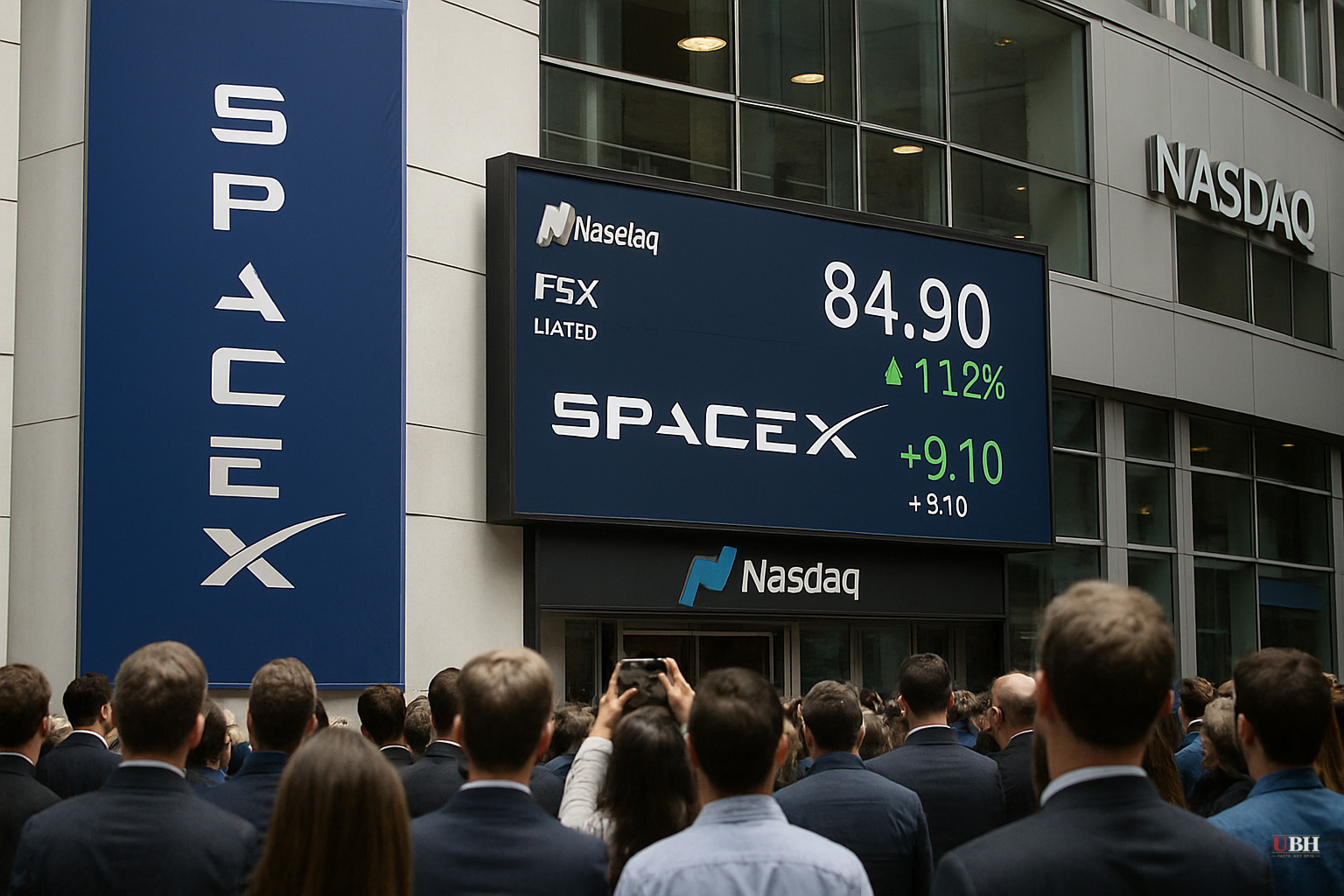
SpaceX went public last week at a market capitalization exceeding $1 trillion. The company's IPO filing, reviewed by The Atlantic, lists a "total addressable market" of $28.5 trillion. Of that, $26.5 trillion is attributed to AI infrastructure and applications — not rockets, not satellites, not Mars.
That number comes from SpaceX's own filing. It reflects the company's acquisition of Musk's artificial-intelligence firm xAI, which itself absorbed X (formerly Twitter) in 2025. SpaceX is now, on paper, an AI company that also launches rockets.
The core aerospace and satellite business is real and profitable. Starlink generated more than $11 billion in revenue in the most recent year, according to The Atlantic's reporting on the filing. That is a legitimate business by any measure.
The Honest Case for the Bull Side
Before examining the valuation skepticism, the bull case deserves a fair hearing.
SpaceX has done things that were widely considered impossible. It landed and reused orbital-class boosters. It built Starlink into an $11 billion revenue business from scratch. It holds dominant market share in commercial launch. The Falcon 9 has become the workhorse of the global space economy in a way no private rocket ever has.
For investors who believe Musk can execute on AI at the same scale he executed on reusable rockets, a $28.5 trillion TAM is not inherently crazy. It is a bet on the man and his track record, not just a spreadsheet. That is a legitimate investment thesis, even if it is difficult to model.
The Honest Case for Skepticism
An unnamed adviser to the SpaceX IPO deal told the Financial Times last month: "From a strict corporate finance perspective, the valuation makes no sense. But Elon is great at getting people to dream."
That is a deal insider saying the price cannot be justified on fundamentals. That sentence should appear in every investor presentation.
Musk has a documented history of missed timelines. He projected a SpaceX spacecraft on Mars by 2018. That did not happen. Last year, SpaceX's Starship — its flagship next-generation rocket — experienced what the company calls "rapid unscheduled disassembly" on three separate test flights. The rocket blew up three times.
The IPO filing focused heavily on future ambitions: asteroid mining, space tourism, and language about extending "the light of consciousness to the stars." Aspirational language is not a revenue line.
Ben Tarnoff and Quinn Slobodian, authors of the book Muskism, argue that Musk's social media strategy functions as market infrastructure: every post is a test of whether he can still move asset prices. Dogecoin — a cryptocurrency built on a joke — rose in value largely because Musk amplified it. SpaceX is not Dogecoin. But the degree to which its valuation is tethered to Musk's personal brand, rather than discounted cash flows, is a question every buyer should answer for themselves.
The xAI Acquisition Changes the Company's Identity
The absorption of xAI into SpaceX — and xAI's prior absorption of X — means investors buying SpaceX shares are buying exposure to a social media platform, an AI startup, and a rocket company simultaneously. These are very different risk profiles.
The $26.5 trillion AI TAM claim essentially asks investors to value SpaceX as a major AI infrastructure player on par with companies that have been building AI capabilities for a decade. That claim is unproven. No revenue projections tied to that figure appear in the filing reviewed.
What Remains Unresolved
This is not a fraud story. No charges have been filed, no investigation has been announced, and nothing in the available source material suggests any securities violation. A company making ambitious claims in an IPO filing is legal and common. Investors are adults.
This is also not a story about SpaceX failing. The Starlink business is a genuine commercial success. The Falcon 9's reusability record changed the economics of the entire launch industry. Those facts are not in dispute.
The single most important unresolved issue: SpaceX the rocket company and SpaceX the AI conglomerate are now one publicly traded entity. Starlink's $11 billion in annual revenue is real and auditable. The $26.5 trillion AI addressable market is a forecast built on a company — xAI — that has not yet demonstrated revenue at scale.
As of June 20, 2026, it is not known what proportion of the IPO's opening valuation the market attributed to the aerospace business versus the AI ambitions. That breakdown will matter enormously the first time a Starship test fails, or the first time an xAI product ships late.
Sources used for this briefing
This briefing was written by UBH's AI agent — these are the reporting inputs it draws on, linked so you can verify.


