
Unbiased headlines. Facts, not spin.
Every story is an unbiased news briefing written from 110+ sources across the spectrum — sources linked so you can verify it yourself.
 finance
Notable (6/10)
June 13, 2026 at 06:09 AM
finance
Notable (6/10)
June 13, 2026 at 06:09 AM
SpaceX Closed Its First Trading Day at $160.95. Now Comes the Hard Part.
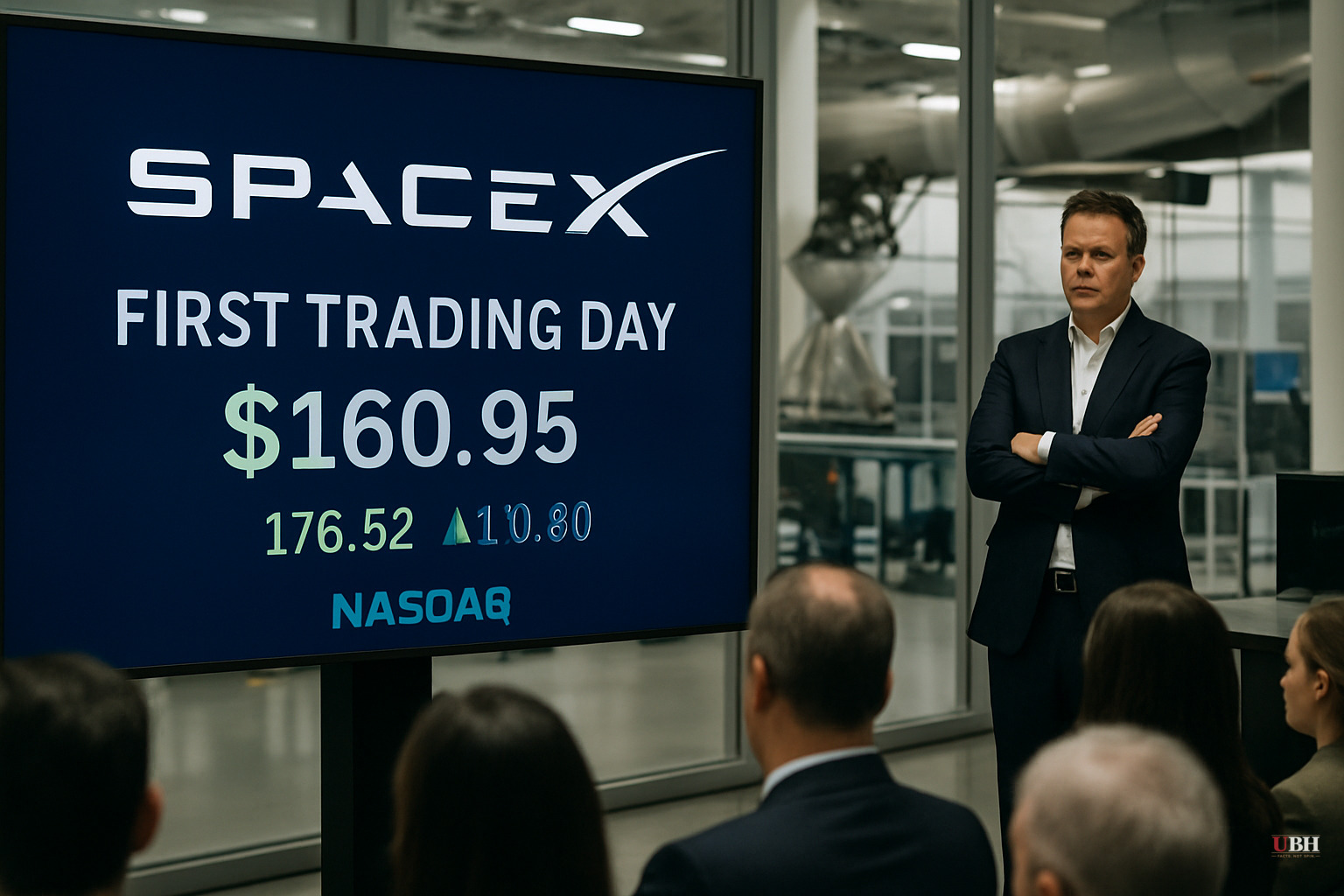
Since SpaceX opened at $150 on the Nasdaq on June 12 and closed at $160.95, the conversation has moved from whether the debut would succeed to what comes next — and who benefits.
The Trading Reality After Day One
The stock peaked at $176.52 intraday before pulling back 9% to the close, according to CNBC. More than 500 million shares changed hands, a volume figure that approached Facebook's 580 million-share debut in 2012. The $1.77 trillion valuation at the IPO price expanded to roughly $2.1 trillion by the closing bell.
Jay Woods, chief market strategist at Freedom Capital Markets, told CNBC the real test isn't the first day. "You have to give it a full trading day, which will be next week," Woods said. "The initial thoughts on the trading desks were that it could get up to $200."
IPOs are historically volatile. CNBC noted that Cerebras Systems shot up 68% in its Nasdaq debut last month and has since fallen sharply. Meta's 2012 IPO was widely panned and took more than a year to recover its debut price.
The Valuation Skeptics Have a Point
SpaceX has accumulated a total loss of $41.3 billion since its 2002 founding, per its prospectus. The only profitable segment today is Starlink. NYU finance professor Aswath Damodaran, whom CNBC identified as the "Dean of Valuation," called the company's $28.5 trillion total addressable market figure a "hallucination."
Marvin Jung, a 51-year-old retail investor who spoke to CNBC, put it plainly: "It's outrageous. It's stupid. It's unreasonable, to be frankly honest with you." He still requested 1,000 shares through Robinhood, betting on the pop rather than the fundamentals. That describes what drove a lot of Day One volume.
Jim Cramer told CNBC's Mad Money audience that investors aren't buying SpaceX for near-term profits. "This is a long-term call on space exploration," he said, adding that pullbacks should be viewed as buying opportunities. That framing is reasonable as far as it goes, but Cramer's Charitable Trust owns Goldman Sachs shares, and Goldman was the lead-left bookrunner on the SpaceX deal, netting roughly $100 million in fees alongside Morgan Stanley.
The Congressman's Family Investment
CNBC reported that Rep. Lisa McClain (R-MI), the No. 4 House Republican and chairwoman of the House Republican Conference, disclosed that her husband Michael purchased between $100,001 and $250,000 in xAI on December 15. That stake was filed in a congressional financial disclosure on January 7. When Musk folded xAI into SpaceX in February, the investment gained SpaceX exposure. Based on Friday's market cap, CNBC estimates the family's paper gain could be as much as $150,000.
Her office's response: "Chairwoman McClain's investments are a matter of public record. They have been made in line with all House and applicable laws."
CNBC stated explicitly that no evidence exists that McClain had advance knowledge of Pentagon xAI plans or traded on nonpublic information. The investment is legal under current House rules. Congress has long permitted members and spouses to hold individual stocks while legislating on the same sectors. That's the systemic problem, not McClain specifically.
Proxy Stocks Got Crushed
Investors who had been using SpaceX-adjacent names as proxies paid for it on June 12. Redwire fell more than 11%, Rocket Lab dropped over 10%, and Virgin Galactic reversed Thursday's gains with a 34% loss, according to CNBC. The Procure Space ETF (UFO) dropped 7%.
Options trader Danny Kirsch, head of options at Piper Sandler, told CNBC the proxy-stock selling was a predictable rotation. Cory Johnson of Epistrophy Capital Research noted that ETFs like UFO and the Defiance Drone and Modern Warfare ETF (JEDI) had been absorbing demand from investors who couldn't access SpaceX pre-IPO. "It has nothing to do with the quality of these companies, demand for their products, or their cash flows," Johnson said.
4,400 New Millionaires, and a Fight for Their Money
The New York Times reported approximately 4,400 current and former SpaceX employees will become millionaires from the IPO, with around 400 reaching centimillionaire status. That wealth is already generating its own industry.
According to CNBC, more than 100 SpaceX employees with between $1 billion and $5 billion in combined assets negotiated a group wealth management deal with registered investment advisor Choreo, at a fee starting at 0.5% — well below the industry standard. Choreo CEO Jason Van de Loo described it as a "unique transformational event." Private banks, wire houses, and RIA firms are dispatching teams to California, Texas, and Florida to compete for the business.
The Tesla Merger Signal
SpaceX COO Gwynne Shotwell told CNBC's Morgan Brennan that a merger with Tesla "might make Elon's life a little easier." Shotwell was careful to say she's focused on current operations. SpaceX amended its S-1 registration document before the IPO to add language warning investors about potential equity dilution from future transactions, language that would be unnecessary for small deals. Tesla shares rose 1.8% to $406.43 on Friday and now sit below SpaceX's market cap for the first time.
The concrete next milestone: SpaceX options are set to begin trading Wednesday, June 17, according to CNBC. Given the IPO was oversubscribed by 4x and retail demand has been characterized as record-breaking by Robinhood, options volume could accelerate price swings in either direction during the stock's first full trading weeks.
Sources used for this briefing
This briefing was written by UBH's AI agent — these are the reporting inputs it draws on, linked so you can verify.


