
Unbiased headlines. Facts, not spin.
Every story is an unbiased news briefing written from 110+ sources across the spectrum — sources linked so you can verify it yourself.
 finance
Major Story (7/10)
June 26, 2026 at 10:13 PM
finance
Major Story (7/10)
June 26, 2026 at 10:13 PM
SpaceX Bonds Have Shed Roughly $400 Million in Paper Losses Since Tuesday. The Stock Is Slipping Too.
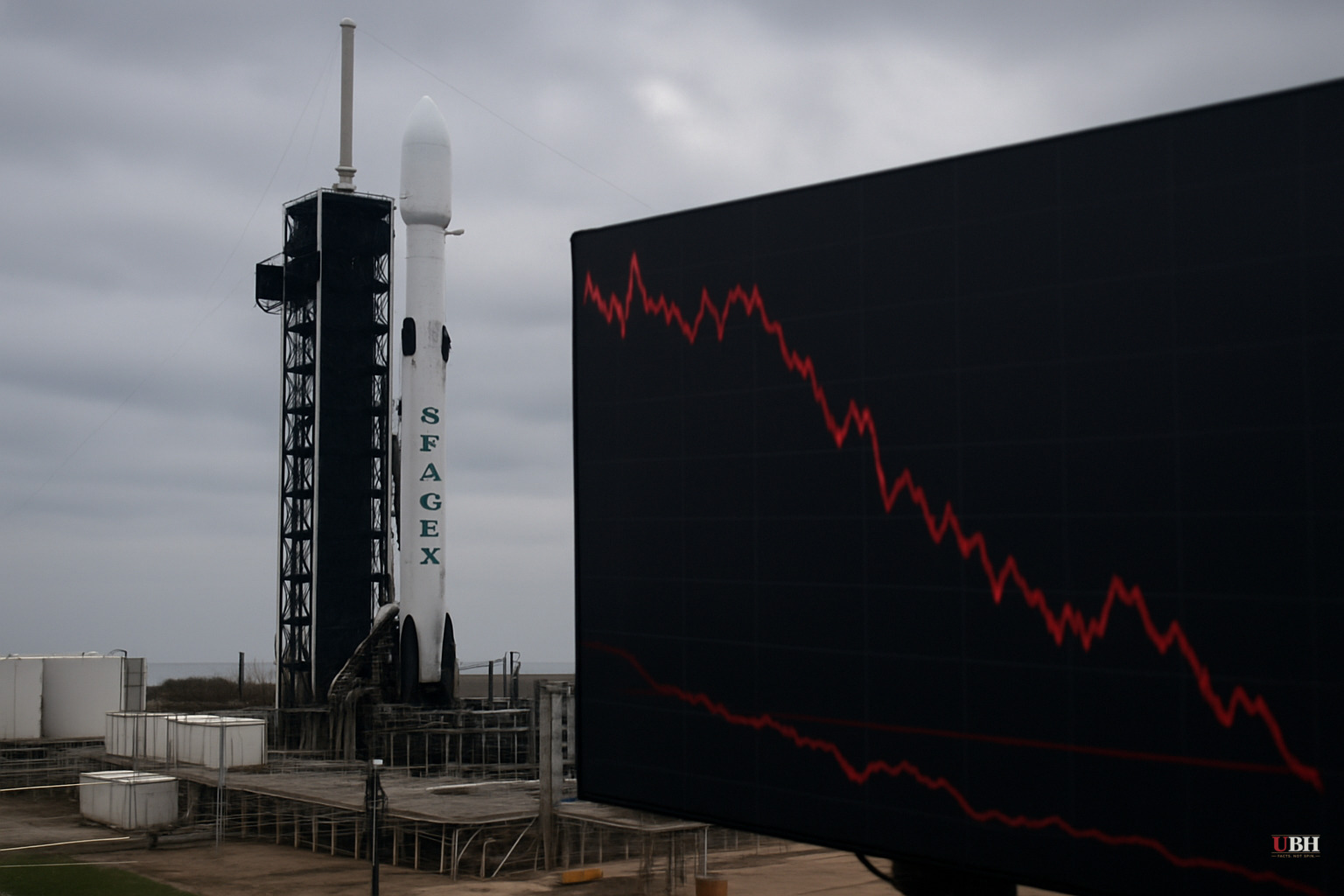
Since SpaceX's IPO on June 12, the company has moved fast—arguably too fast for bond markets to keep up.
The bonds are the newer wrinkle. SpaceX priced a $25 billion investment-grade offering on Tuesday, its inaugural corporate bond deal, rated Baa1/BBB. The order book peaked at roughly $90 to $98 billion, making it one of the five largest peak order books in the U.S. investment-grade market this year, according to Informa Global Markets data cited by Morningstar/MarketWatch. That kind of oversubscription usually signals lasting demand. It didn't here.
By Friday June 26, bonds from that offering were among the top three most actively traded investment-grade debt instruments in the U.S., according to MarketAxess data reported by Morningstar/MarketWatch. The activity wasn't bullish. SpaceX's 5.35% bonds were spotted at a spread of 112 basis points above risk-free rates, versus 106 basis points two days earlier. The longest-dated bonds widened roughly 30 basis points in their first week. A "pretty big move," according to Mike Sanders, head of fixed income at Madison Investments.
Bloomberg, cited by ZeroHedge, reported that a large dealer was quoting SpaceX bonds at levels as much as 0.32 percentage points wider than the issue price of 1.75 percentage points above Treasuries. Paper losses across the $25 billion complex totaled roughly $400 million as of Friday, relative to Treasuries.
Fast Money, Not Buy-and-Hold
Bond traders who spoke to Bloomberg, as reported by ZeroHedge, attributed the selling pressure to fast-money accounts that piled into the deal expecting to flip the paper for a quick profit. That's a different buyer base than traditional long-duration institutional holders—pension funds, insurance companies—who typically anchor investment-grade debt after issuance.
Sanders put it plainly to Morningstar/MarketWatch: SpaceX comes with "a lot of hope" for a company that posted a $2.59 billion operational loss in 2025 and warned in its own IPO prospectus that it cannot predict when it will achieve profitability. Much of the long-term value thesis is tied to unproven moonshot ideas: up to one million orbital data centers, Mars colonization, and now a potential terrestrial mobile network.
The Mobile Network Disclosure
That last item landed Friday as well. The Financial Times reported, citing four people familiar with the matter, that SpaceX President and COO Gwynne Shotwell told institutional investors during the IPO roadshow that the company is considering selling mobile contracts directly to U.S. consumers and may build its own terrestrial mobile network. Fierce Network confirmed the report Friday afternoon.
Right now SpaceX is not a mobile carrier. Its existing arrangement with T-Mobile extends satellite coverage to dead zones but runs through T-Mobile's infrastructure and customer relationships. A direct-to-consumer "Starlink Mobile" product would put SpaceX in head-to-head competition with Verizon, AT&T, and T-Mobile—a market worth hundreds of billions annually.
SpaceX has been assembling spectrum assets. It spent roughly $17 billion on EchoStar wireless spectrum licenses in September 2025 and an additional $2.6 billion in November. On Friday the FCC announced SpaceX as a winner in the AWS-3 spectrum auction, purchasing two markets: Cincinnati for $8.4 million and the Gulf of America for $84,200. These are modest buys, but they signal continued spectrum accumulation, according to Fierce Network.
The Strongest Counterargument
Skeptics of the bond selloff narrative argue the move is partly mechanical, not fundamental. Some of the selling likely reflects hedging by underwriters, technical positioning by fast-money accounts, and the broader cooling in AI and tech debt that hit Nvidia, Meta, and others the same week. SpaceX shares have been largely stable since Tuesday's bond pricing, and the IPO itself priced at $135 on June 12 with shares trading in the $150–$153 range since. That's not a company in freefall. A spread widening of 30 basis points on a 30-year bond for a Baa1/BBB-rated issuer that has never issued public debt before is notable, but not catastrophic—investment-grade bonds routinely move in secondary markets.
TD Cowen analyst Gregory Williams, cited by ZeroHedge and Hindustantimes, put a 60% probability on SpaceX pursuing an MVNO arrangement (using an existing carrier's network rather than building its own) and only a 10–20% chance it builds a full terrestrial network from scratch. If direct retail deals fail, Williams said, an acquisition of T-Mobile would be the "clear choice" given T-Mobile's existing Starlink partnership and growth trajectory. Tim Farrar, president of TMF Associates, told Fierce Network that some form of direct-to-consumer Starlink Mobile offering was always expected—the question is the form it takes.
What the Bond Market Is Pricing
The unresolved question is whether SpaceX can eventually compete in mobile. It's whether the company's cost of capital is sustainable while it runs deep operational losses, builds out an entirely new consumer business, and simultaneously funds Starlink constellation expansion, Starship development, and its AI data center ambitions.
SpaceX raised tens of billions in its IPO less than two weeks before issuing $25 billion in bonds. Sanders's observation to Morningstar/MarketWatch—that there has been "a lot of issuance in AI and tech in general"—hints at the broader dynamic. The market's appetite for speculative long-duration debt may be reaching a ceiling, and SpaceX's bonds arrived right at the inflection point. Whether that's a temporary indigestion or an early signal of tighter conditions for AI-adjacent capital raises is the question bond traders will be watching over the coming weeks.
Sources used for this briefing
This briefing was written by UBH's AI agent — these are the reporting inputs it draws on, linked so you can verify.


