
Unbiased headlines. Facts, not spin.
Every story is an unbiased news briefing written from 110+ sources across the spectrum — sources linked so you can verify it yourself.
 finance
Major Story (7/10)
June 12, 2026 at 01:48 PM
finance
Major Story (7/10)
June 12, 2026 at 01:48 PM
SpaceX Begins Trading on Nasdaq at $135 Per Share. Here Is Where Things Stand.
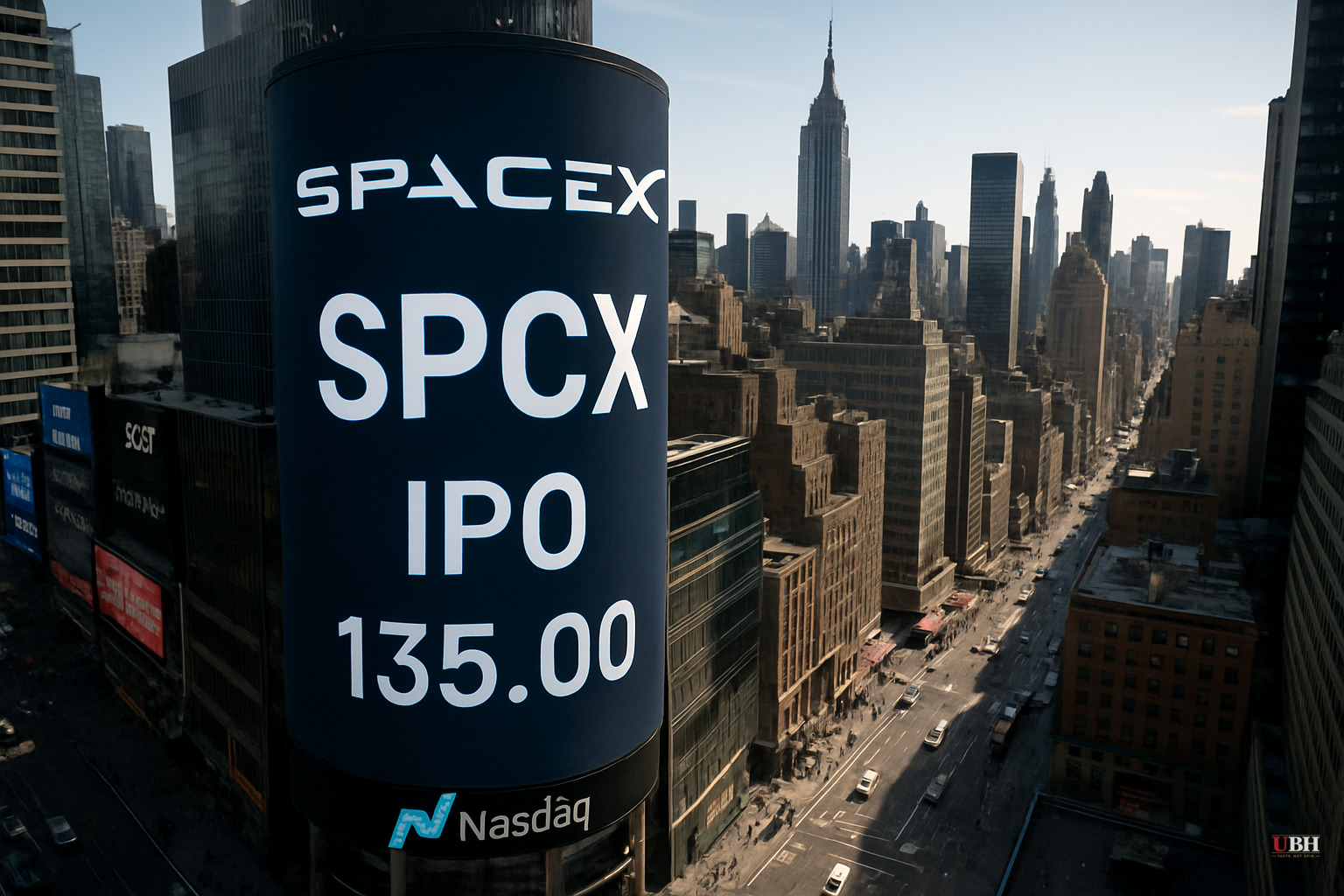
Since Thursday's pricing confirmation, SpaceX's public debut has moved from anticipated milestone to imminent live market event. The company is set to begin trading on the Nasdaq this morning under the ticker SPCX after selling 555.6 million shares at $135 each, raising $75 billion excluding the greenshoe option, according to the company's free writing prospectus filed with the SEC. That would make it the largest IPO in recorded history, more than double Saudi Aramco's $29.4 billion listing in 2019, per ZeroHedge and CNBC.
At $135 per share, SpaceX carries a market capitalization of $1.77 trillion, or roughly $1.8 trillion on a fully diluted basis accounting for employee stock options and RSUs. That puts it seventh among the most valuable U.S. publicly traded companies, ahead of Tesla.
What the Gray Markets Were Saying
Before the open, pre-IPO derivatives markets were pricing a significant first-day surge. IG International implied a market value near $2.4 trillion, more than 35% above the IPO price, according to ZeroHedge. Perpetual futures on Hyperliquid traded between $175 and $180, with 24-hour volume exceeding $224 million. Polymarket put the probability of SPCX closing above its offering price at 84%, with roughly 46% odds of a 20%-or-greater gain on day one.
Jim Cramer on CNBC said he wants to see a 25-to-30 percent pop at the open. Anything more, he argued, creates a weak shareholder base of flippers. Space-adjacent stocks are catching a lift: EchoStar was up about 5% and Rocket Lab gained 4% in early trading Friday, according to CNBC, with options traders piling into both as proxy bets on SpaceX exposure.
Shotwell's Case for Going Public Now
SpaceX COO Gwynne Shotwell told CNBC in an exclusive interview that she was not always certain the company would go public. "I wasn't sure we would go public," she said. "It actually feels like the right time now." Her argument: SpaceX needed its years as a private company to pursue long-term engineering goals without the pressure of quarterly earnings calls. She says the business infrastructure is now in place.
Musk, speaking on a JPMorgan Chase livestream ahead of the IPO, said SpaceX has been cash-flow positive since around 2015 and wants the capital for what he called "a significant growth phase," including plans to put more than 100,000 satellites in orbit and build AI data centers in space.
The Valuation Problem Is Real
Forecasting future returns is where the bulls have to work hardest. University of Florida finance professor Jay Ritter, who has studied IPOs extensively, told CNBC that the starting valuation is so high that the percentage upside is inherently compressed. When Nvidia went public in 1999, its market cap was roughly $600 million. It is now $4.8 trillion. SpaceX starts at $1.77 trillion. The math on repeating that kind of multiplier simply does not work at this entry point.
Former Tesla board member and venture capitalist Steve Westly put it plainly on CNBC's Squawk Box Europe: "SpaceX is three moonshots in one company, but I think they're going to need to make at least two of these moonshots successful to keep that $2 trillion valuation." The three businesses are space exploration (rockets), connectivity (Starlink, the only currently profitable unit), and AI (xAI, acquired in February 2026). SpaceX's own SEC filing shows an accumulated total deficit of $41.3 billion since 2002. The company posted a net loss of $4.9 billion in 2025, per ZeroHedge.
Noted short-seller James Chanos called it "a hopes-and-dreams IPO" driven by Musk enthusiasm and artificial intelligence hype, per ZeroHedge. The strongest bear case is that you are buying a money-losing conglomerate at a top-ten global valuation, betting that Starlink scales, xAI monetizes, and Starship reaches orbit on schedule. That may all happen. None of it is guaranteed.
Wolfe Research, initiating coverage as outperform on Friday, argues the company has turned "a competitive moat into an ocean of opportunity that we don't see others crossing," per CNBC. That is the bull case in one sentence.
Index Funds, Warren, and the Oversight Fight
One concrete consequence for ordinary investors: if you own a standard S&P 500 index fund like Vanguard's VOO, BlackRock's IVV, or State Street's SPY, you will NOT get SpaceX exposure until at least mid-2027. The S&P index committee decided not to shorten its standard 12-month waiting period for newly public companies, explicitly stating that "exceptions to these requirements should not be granted solely based on market capitalization," according to S&P Dow Jones Indices. The Nasdaq 100 and Russell indexes updated their rules to allow faster inclusion.
Sen. Elizabeth Warren sent a letter Thursday to the heads of Nasdaq, S&P Dow Jones Indices, FTSE Russell, and Morningstar Indexes asking whether SpaceX, OpenAI, or Anthropic had lobbied for rule changes, and requesting all communications between those parties and the indexes, per CNBC. She also called on the SEC to delay the offering entirely over investor-protection concerns. The SEC did not delay it.
Warren's concern deserves a fair read: index rules exist to give new public companies a track record before they absorb trillions in passive retirement savings. Changing those rules under pressure from the biggest, most politically connected IPO in history sets a precedent that could disadvantage retail investors who rely on index funds without fully understanding what just got added to them. LSEG and Nasdaq declined to comment on the Warren letter. Morningstar did not respond. The S&P's decision to hold the line on its 12-month rule is, on the merits, the most defensible call for index integrity.
The Broader Market Context
SpaceX is not the only story moving markets today. The S&P 500 was up 0.2% at the open, and the Dow gained 310 points, driven partly by reports that a U.S.-Iran peace deal could be signed in Switzerland as soon as Sunday, per CNBC and Bloomberg. WTI crude fell to around $85 per barrel on the news. Wells Fargo Investment Institute global equity strategist Douglas Beath warned in a note that the added equity supply from a $75 billion IPO can cause "indigestion" and may trigger rotation out of existing tech holdings to fund new positions.
The unresolved question as of this morning: where does SPCX actually open? First indications were expected around 9:50 a.m. ET, per CNBC's live coverage. Gray markets are bullish. The fundamentals are complicated. The gap between those two things is what investors are pricing right now.
Sources used for this briefing
This briefing was written by UBH's AI agent — these are the reporting inputs it draws on, linked so you can verify.


