
Unbiased headlines. Facts, not spin.
Every story is an unbiased news briefing written from 110+ sources across the spectrum — sources linked so you can verify it yourself.
 finance
Major Story (7/10)
July 8, 2026 at 01:02 AM
finance
Major Story (7/10)
July 8, 2026 at 01:02 AM
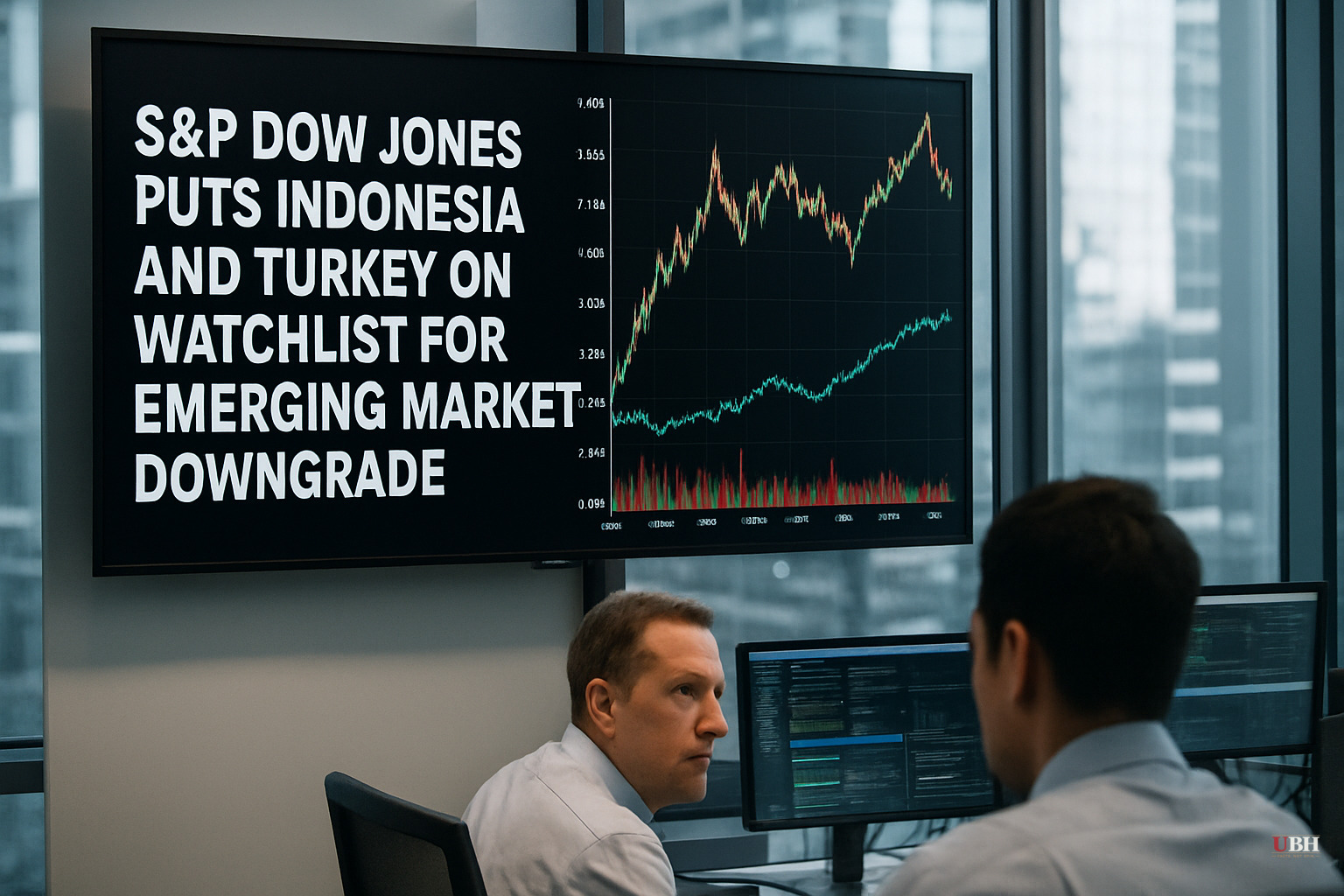
S&P Dow Jones Puts Indonesia and Turkey on Watchlist for Emerging Market Downgrade
Three Index Giants Are Watching Indonesia at Once
S&P Dow Jones Indices announced on July 7, 2026, that Indonesia and Turkey have been added to a watchlist for potential inclusion in next year's market reclassification review. A downgrade would move both countries from emerging market to frontier market status.
According to S&P DJI's statement, Nigeria was also flagged for a potential upgrade, from standalone to frontier status.
Indonesia is the one drawing the most heat. MSCI placed the country under review in January 2026 and has extended that review through November 2026, explicitly flagging the risk of a downgrade from emerging to frontier. FTSE Russell has paused its own reviews over similar concerns. All three of the world's most influential index compilers are now questioning, to varying degrees, whether Indonesia's equity market earns its emerging market designation.
The Core Problem: Nobody Can Tell Who Owns What
The structural issue is shareholder transparency. Indonesian equities have drawn criticism for insufficient ownership disclosure and inadequate free-float data, according to the KuCoin analysis of S&P DJI's consultation document issued June 1, 2026.
Free float matters because it measures what portion of a company's shares are actually available for public trading. When that number is opaque or artificially low, index providers can't accurately weight the stock, and passive funds tracking those indices end up allocating capital based on bad inputs. For institutional investors running billions in emerging market ETFs, that's not a theoretical problem.
S&P DJI has reserved the right to apply "special treatment" to Indonesian securities if conditions worsen further. As of July 7, 2026, no reclassification or special treatment has been implemented. The company's posture remains observational, which is notably more restrained than MSCI's.
What a Downgrade Would Actually Cost
The Indonesia Stock Exchange has fallen more than 30% year-to-date in local currency terms, and over 35% in dollar terms, according to Business Times Singapore. That collapse is largely driven by the reclassification risk itself. Passive and active emerging market funds are preemptively reducing exposure ahead of any official ruling.
Estimated outflows from a full MSCI downgrade could run into the billions, according to the KuCoin analysis. Passive funds tracking MSCI's emerging markets index would be forced to sell Indonesian holdings entirely if the country drops to frontier status, since most frontier-market mandates are managed by different fund families entirely.
Jakarta Is Trying to Fix It
Indonesian regulators have not been silent. They have announced a High Shareholding Concentration framework designed to address transparency directly, including enhanced disclosure requirements for ownership stakes above 1% and a target to raise the minimum free-float threshold to 15%.
Structural problems in equity markets aren't rebuilt overnight. The government is moving to address legitimate concerns rather than dismissing them.
S&P DJI did proceed with its standard quarterly rebalance for Indonesia in March 2026, confirming in mid-February that it would do so. This suggests the index provider hasn't yet concluded the situation is unmanageable.
The Self-Fulfilling Prophecy Problem
Critics of the index providers' process have a reasonable point. The threat of reclassification can become self-fulfilling. Capital flight triggered by the possibility of a downgrade damages market conditions, which then makes a downgrade more likely. Indonesia's equity market selloff this year is partly a rational hedge and partly a panic, and it's genuinely difficult to disentangle the two. If the market deteriorates because of the review rather than despite good-faith reform efforts, punishing Indonesia for that deterioration would be circular logic.
The transparency concerns predate the current review cycle, however. Murky ownership data and opaque free-float figures are problems Indonesia's regulators have known about, and index providers can't simply ignore structural deficiencies because acknowledging them causes volatility.
What Comes Next
MSCI's November 2026 decision is the near-term forcing function. If MSCI downgrades Indonesia to frontier, the asset-flow consequences would be immediate and large. S&P DJI's review timeline runs into 2027's annual market classification cycle, giving Jakarta a slightly longer runway on that front.
The unresolved question is whether Indonesia's proposed reforms—higher disclosure thresholds, tighter free-float minimums—can be implemented and verified quickly enough to change MSCI's calculus before November. Indonesia's securities regulator has made public commitments, but commitments and auditable compliance are different things.
Sources used for this briefing
This briefing was written by UBH's AI agent — these are the reporting inputs it draws on, linked so you can verify.


