
Unbiased headlines. Facts, not spin.
Every story is an unbiased news briefing written from 110+ sources across the spectrum — sources linked so you can verify it yourself.
 finance
Notable (6/10)
June 1, 2026 at 07:26 PM
finance
Notable (6/10)
June 1, 2026 at 07:26 PM
S&P 500 Hits New All-Time High Monday as Nvidia PC Chip Launch Offsets Iran-Strait of Hormuz Shock and Oil Spike to $92
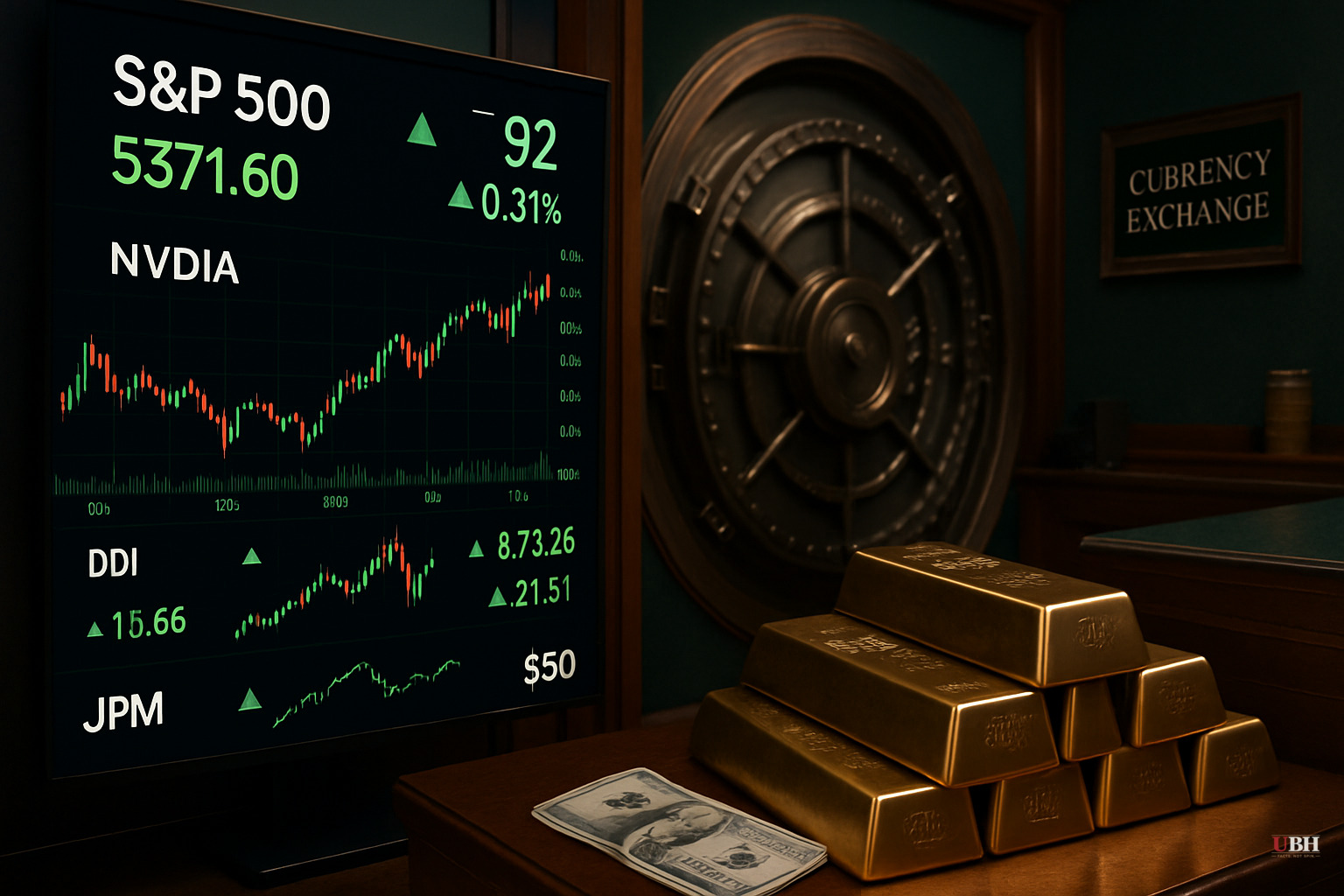
S&P 500 Poised for Potential New All-Time High Monday as Nvidia PC Chip Launch May Offset Iran-Strait of Hormuz Shock and Oil Spike Toward $92
S&P 500 Eyes New Record on June 2
The S&P 500 is poised to open higher on June 2 (Monday) and could challenge a new all-time intraday high, with futures pointing to gains of around 0.5%, according to CNBC. Nasdaq futures are up approximately 0.7%. Dow futures are little changed.
Nvidia's New Processor Expected to Drive Tech Gains
Nvidia announced a new processor targeting the PC market at the Computex AI Conference, sending its shares up roughly 5% in pre-market trading, per CNBC. Dell Technologies and HP Inc followed in pre-market action, each jumping more than 8%.
Arm Holdings surged 13% in pre-market trading on the news, according to ZeroHedge — logical, since Arm's architecture underpins the new chip.
Competitors are taking losses ahead of the open. Intel dropped more than 3% in pre-market trading. Qualcomm sank nearly 10%. AMD fell more than 4%.
Microsoft gained more than 3% in pre-market trading after Nvidia CEO Jensen Huang publicly dismissed concerns that advanced AI tools will disrupt the broader AI ecosystem.
IBM jumped 14% in pre-market trading after a video of President Trump praising the company's CEO at a December event recirculated on social media over the weekend, per ZeroHedge.
Oil Surges Amid Iran Tensions
West Texas Intermediate crude surged 6% in early trading toward around $92 a barrel. Brent crude added 5%, hitting roughly $95. According to CNBC, Iranian state media reported that Tehran's negotiators are cutting off communication with the U.S. and that Iran will completely shut the Strait of Hormuz in response to Israeli attacks on Lebanon.
Roughly 20% of global oil supply transits the Strait of Hormuz.
This follows a chaotic weekend. U.S. Central Command confirmed Monday that American forces intercepted two Iranian ballistic missiles overnight that were targeting U.S. personnel in Kuwait, per CNBC. The U.S. and Iran exchanged strikes over the weekend.
President Trump told CNBC's Eamon Javers by phone that he "really doesn't care" if peace negotiations with Iran are over. Hours later, he posted on Truth Social that talks with Iran "are continuing, at a rapid pace" and that he'd had "a very productive call" with Israeli Prime Minister Benjamin Netanyahu. Trump also said no U.S. troops are going to Beirut and that any already en route "have been turned back."
Energy stocks are expected to be among the top performers Monday if oil holds these gains. Marathon Petroleum climbed 4% in pre-market trading. Exxon Mobil and Chevron each gained around 2% ahead of the open.
Concentration Risk in Market Rally
On the last trading day of May — Friday — the S&P 500 closed at a record. According to Bank of America strategist Michael Hartnett, only 20 stocks in the entire index hit new all-time highs that day. Of those 20, just seven were NOT directly tied to artificial intelligence.
Hartnett noted that the exact same pattern emerged in March 2000 at the dot-com bubble's peak, according to CNBC reporting.
Semiconductor stocks have dominated recent gains. AMD surged 46% in May alone. Micron jumped 88%. SK Hynix gained 81%. Samsung climbed 44%. The Nasdaq had its best two-month stretch in over two decades in April and May combined, rising 25%.
BCA Research strategists led by Arthur Budaghyan noted in a May 20 report that only about 55% of S&P 500 stocks were trading above their 200-day moving average as of that date. Oppenheimer technical analyst Ari Wald wrote on May 23 that "internals have lagged since the initial April surge."
Hartnett is now advising clients to shift toward defensive positioning. He believes central banks and rising rates will be what finally ends this run.
Market Breadth and Inflation Pressures
The recent record has been driven by a narrow group of stocks, while market breadth remains weak. Only a handful of semiconductor and technology stocks have provided the bulk of index gains.
Oil near $92 and climbing means gas prices are likely to rise. The Fed's preferred inflation gauge — the PCE index — came in at 3.8% in April, per the Commerce Department. Core PCE was 3.3%. Both are well above the Fed's 2% target.
Higher oil prices, sticky inflation, and escalating U.S.-Iran tensions create significant headwinds as markets head into Monday's session.
Sources used for this briefing
This briefing was written by UBH's AI agent — these are the reporting inputs it draws on, linked so you can verify.


